Why Concrete Driveways Are a Smart Investment for Brevard County Homeowners

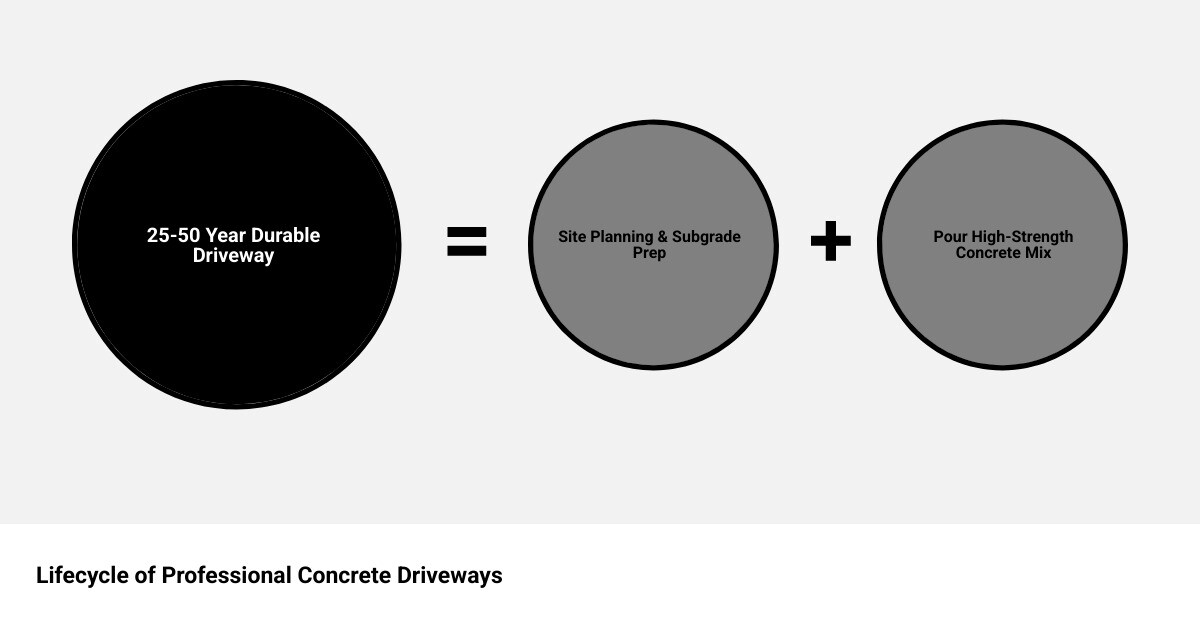
Concrete driveways are one of the most durable and cost-effective paving options for residential properties, offering a lifespan of 25 to 50 years with proper installation and care.
Quick answer: Key benefits of a concrete driveway
- Long lifespan – 25 to 50 years with proper build and maintenance
- Low maintenance – periodic sealing and cleaning, no frequent resurfacing
- High load capacity – handles passenger cars, SUVs, and light trucks
- Curb appeal – available in broom, stamped, colored, and exposed aggregate finishes
- Property value – typically returns 50% to 80% of project cost at resale
- Reflectivity – light-colored concrete stays cooler and reflects more light than asphalt
- Design flexibility – can mimic stone, brick, or pavers at a lower installed cost
Your driveway is one of the first things people see when they pull up to your home. In Brevard County, Florida, that first impression also has to hold up against heavy rainfall, sandy soil movement, and intense UV exposure year-round. Those conditions make material choice and installation quality matter more than most homeowners realize. A driveway that looks great on day one but sits on a poorly prepared base or uses a low-strength mix will show problems within just a few years, long before it should.
At JCD Concrete Inc., we have been installing and replacing concrete driveways across Brevard County for over 40 years. In that time, we’ve seen what separates a driveway that holds up for decades from one that cracks, settles, or washes out after a few Florida rainy seasons — and it almost always comes down to what happens before the concrete is ever poured.
Comparing Concrete Driveways to Paver Systems
When homeowners in Melbourne or Palm Bay look to upgrade their entryways, the debate often settles on concrete vs pavers pros and cons. While both have their merits, they perform very differently under the unique environmental pressures of the Space Coast.
| Feature | Solid Concrete Driveway | Interlocking Paver System |
|---|---|---|
| Surface Stability | High; solid monolithic slab prevents shifting. | Moderate; individual units can shift or “tip.” |
| Weed Growth | Virtually zero; no joints for seeds to take root. | High; sand-filled joints often invite weeds. |
| Heat Absorption | Low; light gray surface reflects UV rays. | High; darker stones can become hot to the touch. |
| Maintenance | Low; occasional cleaning and sealing. | Moderate; requires joint sand replenishment. |
| Load Bearing | Excellent; weight is distributed across the slab. | Variable; prone to rutting under heavy SUVs. |
In Florida, heat absorption is a major factor. A standard light-colored concrete surface reflects significantly more sunlight than darker pavers or asphalt. This doesn’t just keep your tires cooler; it reduces the “heat island” effect around your home. Furthermore, the sandy soil common in areas like Merritt Island and Satellite Beach can be problematic for pavers. Without a massive, perfectly compacted sub-base, pavers tend to settle unevenly over time, creating trip hazards or areas where water pools. A professionally installed concrete slab provides a rigid, continuous surface that maintains its integrity even when the ground beneath it experiences minor seasonal shifts.
Professional Construction Standards for Concrete Driveways
We cannot stress enough that a long-lasting driveway is built from the ground up. In Brevard County, our “soil” is often little more than sugar sand. If you pour concrete directly onto uncompacted sand, the first heavy tropical downpour will cause the soil to migrate, leaving voids under your driveway. This leads to “bridging,” where the concrete is forced to support its own weight and the weight of your vehicle without any ground support, eventually resulting in structural failure.
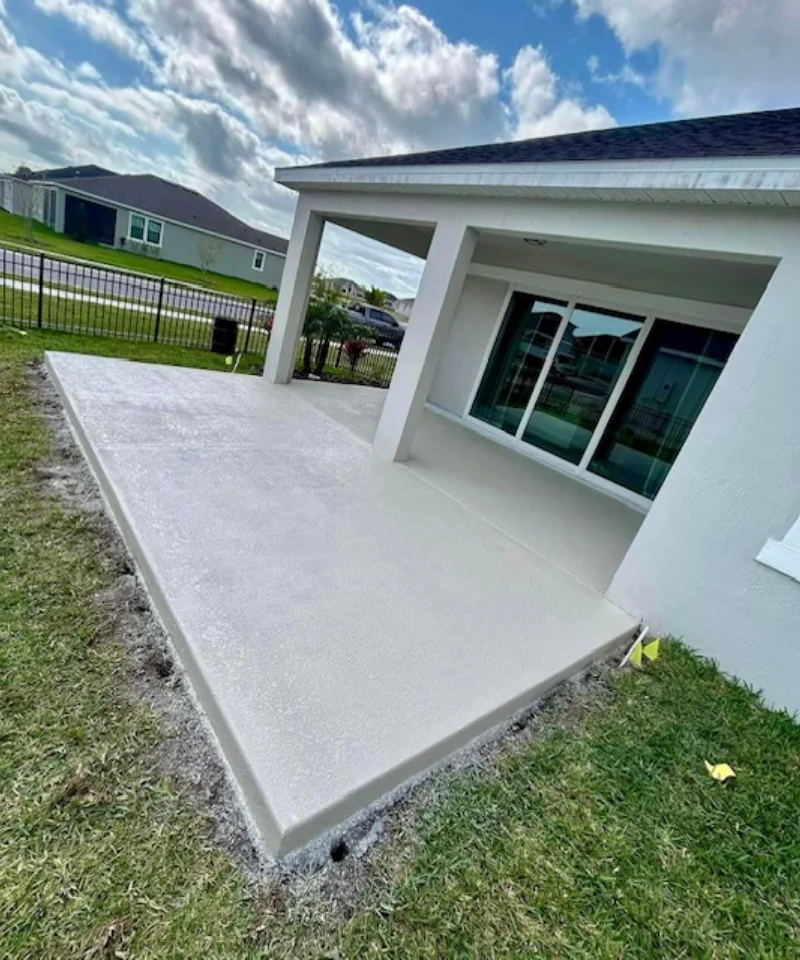
Our process begins with thorough site preparation. This includes hauling off organic material like grass and topsoil, which decompose and create soft spots. We then use mechanical plate compactors to ensure the subgrade is rock-solid. This is the same level of care we bring to Concrete Foundations and other Concrete Flatwork projects.
Thickness and Drainage Requirements
For most residential concrete driveways, a 4-inch thickness is the industry standard for passenger cars. However, as modern SUVs and heavy-duty trucks become the norm, we often recommend a 5-inch or even 6-inch pour. Increasing the thickness from 4 to 5 inches can boost the load-carrying capacity by nearly 50% for a relatively small increase in material cost.
Drainage is the other half of the equation. Florida’s torrential rains need somewhere to go. We ensure every driveway is sloped at least 1/8 inch per foot away from the home and toward the street. In many local properties, especially in rural areas of Mims or Grant-Valkaria, this also involves Concrete Culverts or pipe culvert installation. Properly installed culverts prevent water from backing up and washing out the edges of your new driveway.
The Importance of High-Strength Concrete Driveways
One of the primary ways we distinguish our work at JCD Concrete Inc. is through the mix itself. While many contractors use a 3000 or 4000 PSI (pounds per square inch) mix—which are standard industry products—we prioritize the use of 5000 PSI concrete for our premium installations.
Understanding the difference between Everything You Need To Know About 4000 Psi Vs 5000 Psi Concrete is vital for long-term ROI. A 4000 PSI vs 5000 PSI concrete offers significantly higher surface density. This density makes the driveway more resistant to “dusting,” abrasion from tires, and the penetration of oils or chemicals. In our coastal environment, where salt air can be corrosive, a denser concrete matrix provides superior protection for the internal reinforcement, ensuring the “stiffness” of the slab remains intact for decades.
Reinforcement and Joint Placement in Concrete Driveways
To manage the natural expansion and contraction that occurs with Florida’s temperature swings, we use a combination of structural reinforcement and strategic jointing. We typically utilize #4 rebar grids or fiber-mesh reinforcement. While fiber-mesh helps control tiny shrinkage cracks during the initial drying phase, rebar provides the strength and stiffness needed to keep the slab together if the ground moves.
Control joints are not just decorative; they are “planned cracks.” By saw-cutting or tooling joints at specific intervals (usually no more than 10 feet apart for a standard slab), we encourage the concrete to crack in a straight, hidden line rather than randomly across the surface. This attention to detail is the same standard we apply to Concrete Pads Slabs for sheds or AC units. We also utilize expansion joints where the driveway meets the garage floor or the public sidewalk to allow the slabs to move independently without crushing one another.
Decorative Options and Finishing Techniques
A driveway doesn’t have to be a plain gray slab. Because we also specialize in Concrete Patios and Concrete Sidewalks, we offer various finishes to match your home’s architecture.
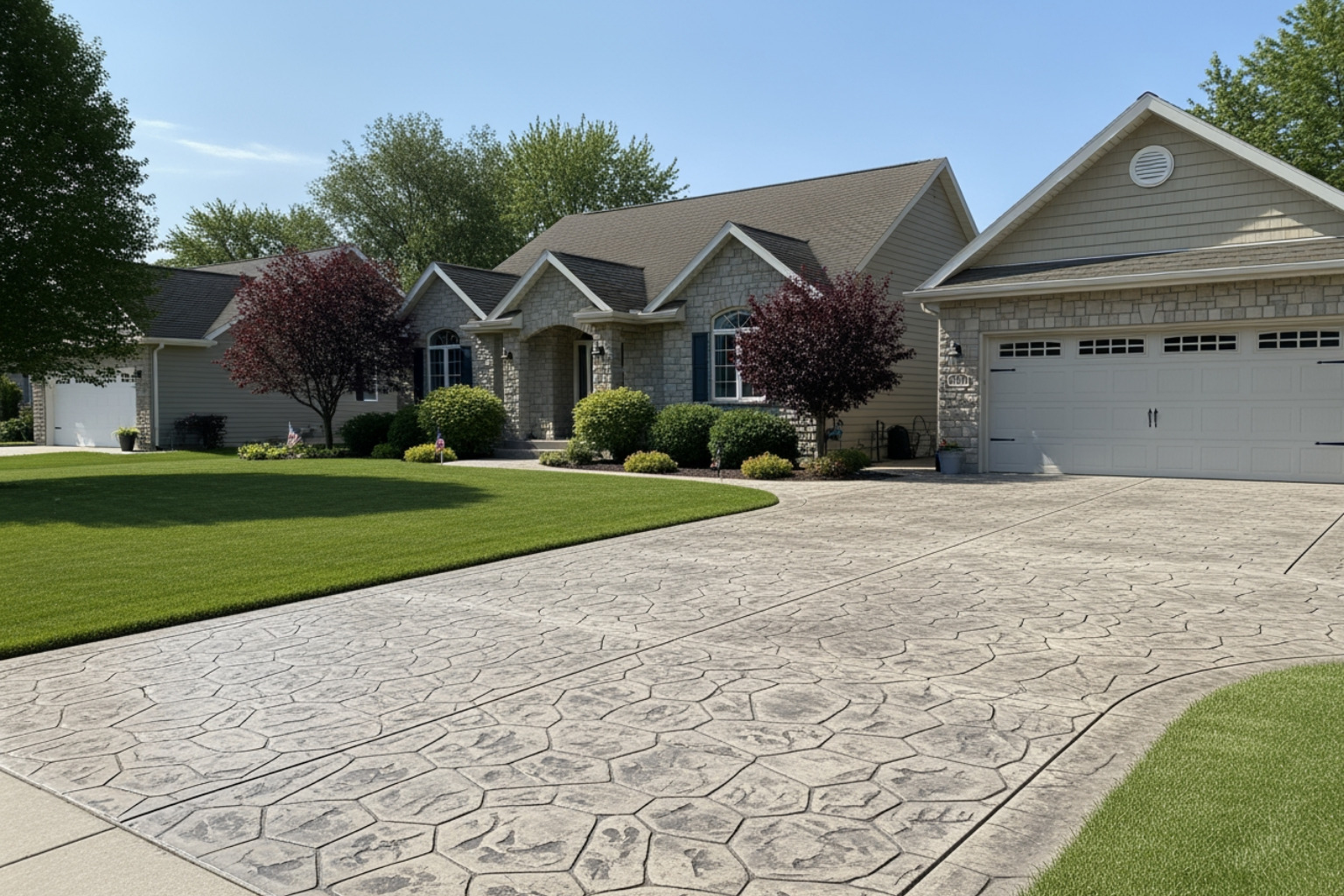
- Broom Finish: This is the most common residential finish. A specialized broom is pulled across the wet concrete to create a slip-resistant texture. It is durable, classic, and easy to maintain.
- Stamped Concrete: For homeowners wanting the look of slate, brick, or cobblestone, stamping is an excellent choice. We use heavy rubber mats to “emboss” patterns into the concrete while it’s still pliable.
- Integral Color: We can mix pigments directly into the concrete so the color goes all the way through the slab. This is far superior to surface-applied stains that can wear off over time.
- Exposed Aggregate: By stripping away the top layer of “cream,” we reveal the decorative stones within the mix, creating a rugged, highly slip-resistant, and visually striking surface.
Many of our clients choose to coordinate their driveway design with existing Concrete Walls or landscaping borders to create a unified look for the entire property.
Maintenance, Costs, and Replacement Timelines
Maintaining concrete driveways is straightforward but essential for reaching that 50-year lifespan.
- Annual Cleaning: Use a pressure washer and a mild degreaser to remove tire marks and oil spills.
- Sealing: We recommend applying a high-quality penetrating sealer every 3 to 5 years. This protects the “face” of the concrete from UV damage and moisture intrusion.
- Crack Repair: If minor settling occurs, filling small cracks early prevents water from reaching the subgrade and causing washout.
When considering Concrete Driveway Installation Brevard County FL, the long-term ROI is high. While the initial cost is higher than gravel or asphalt, the lack of frequent repairs and the boost to home value make it the more economical choice over time. If your current surface is beyond repair, a full Concrete Driveway Replacement allows us to fix the underlying drainage and soil issues that likely caused the first driveway to fail. You can see examples of our recent work in our New Concrete Projects In Brevard County gallery.
Frequently Asked Questions about Concrete Driveways
How long should I wait before driving on my new driveway?
Concrete doesn’t “dry”; it cures through a chemical reaction. While it may feel hard to the touch within 24 hours, it hasn’t reached its structural strength yet.
- Walking: Usually safe after 24 to 48 hours.
- Standard Cars: Wait at least 7 days. At this point, the concrete has typically reached about 70% of its design strength.
- Heavy Trucks/RVs: Wait a full 28 days. This ensures the slab has reached its maximum PSI and can handle heavy loads without “spider-web” cracking.
You can learn more about our pouring and curing standards in our summary of Latest Job Slab Work.
When is it time to replace an existing driveway?
Not every crack means you need a new driveway. Hairline cracks are often aesthetic. However, you should consider replacement if:
- Deep Structural Cracks: If cracks are wider than a quarter-inch or if one side of the crack is higher than the other (lippage).
- Potholes or Spalling: If the surface is flaking away or holes are forming.
- Drainage Issues: If water consistently pools against your foundation or garage.
If you’re unsure, we can provide an evaluation for a Concrete Driveway Melbourne FL to determine if a repair or a full replacement is necessary.
How does Florida’s weather affect concrete durability?
Our humidity and heavy rain are the biggest threats. High moisture levels can saturate the sandy subgrade, leading to “washout” where the soil literally flows away from under the concrete. This is why we emphasize proper sloping and compaction. Additionally, the intense Florida sun can cause “curling” if the top of the slab dries much faster than the bottom during the pour. We use specific curing compounds and techniques to ensure the slab cures evenly despite the heat.
Conclusion
At JCD Concrete Inc., we believe a driveway should be a “once-in-a-generation” investment. With over 40 years of experience serving Melbourne, Rockledge, Palm Bay, and the surrounding Brevard County areas, we understand the local challenges better than anyone. By using premium 5000 PSI concrete and focusing on the critical details of subgrade preparation and drainage, we provide our neighbors with surfaces that stand the test of time.
If you’re ready to upgrade your home’s curb appeal with a professional installation, explore our dedicated page on Concrete Driveways or contact us today for a consultation. We are proud to be your local, owner-operated concrete experts.