Concrete Driveway Installation & Replacement & Sidewalk Services

If you are looking for professional concrete sidewalk contractors in Melbourne, FL, here is a quick summary of what to look for before you hire:
- Licensed and insured – Always verify before signing anything
- Local experience – Florida soil, drainage, and weather require contractors who know the area
- Written estimates – Get everything in writing, including materials and timeline
- Verified reviews – Check Google and BBB ratings from real customers
- High-strength concrete – Ask what PSI mix they use; it directly affects how long your sidewalk lasts
- ADA compliance knowledge – Certain commercial properties and publicly accessible walkways must comply with ADA accessibility requirements
A cracked, uneven, or poorly drained sidewalk is more than an eyesore. In Florida’s climate, it becomes a safety hazard fast. Heavy rainfall, sandy soil, and intense UV exposure all work against concrete that wasn’t installed correctly from the start. The difference between a sidewalk that holds up for years and one that starts crumbling within a few seasons usually comes down to one thing: who poured it and how.
I’m John DomBek, owner of JCD Concrete Inc., and with over 40 years of hands-on concrete work across Brevard County, FL, I’ve seen firsthand what separates a sidewalk that lasts for decades from one that begins failing after only a few seasons. In the sections below, I’ll walk you through exactly what to look for, what questions to ask, and what a quality installation actually involves.
What to Look For in Local Concrete Sidewalk Contractors
When searching for the right professional in Brevard County, FL, you cannot afford to treat concrete as a basic commodity. Pouring concrete in our coastal environment requires specialized local knowledge. The contractor you choose must understand how our unique conditions—like shifting sandy soil, high humidity, intense UV exposure, and Florida’s heavy seasonal rainfall—affect the pouring and curing process.
First and foremost, verify that any contractor you consider carries active liability insurance and proper licensing. Improperly installed concrete can create code issues, drainage problems, and costly repairs. A qualified local professional will be deeply familiar with Brevard County, FL regulations, setbacks, and drainage requirements. When you hire someone who understands local conditions, they will take steps to ensure your path does not wash out during the next heavy summer storm.
Essential Services Offered by Local Concrete Sidewalk Contractors
A professional contractor does not just show up and pour wet mix on the ground. A full-service concrete company should offer a comprehensive range of solutions for residential properties. When evaluating local experts, look for those who specialize in:
- New Sidewalk Construction: Laying down brand-new pathways to connect your Concrete Driveways, patio, or home entryway.
- Concrete Sidewalks Replacement: Demolishing and hauling away old, crumbling paths and replacing them with durable new surfaces.
- Panel-by-Panel Repair: Replacing only the damaged sections (or panels) of a sidewalk to save you money when the rest of the path is still in good shape.
- Trip Hazard Mitigation: Grinding down raised edges or replacing uneven slabs caused by tree roots or soil settling.
- Concrete Flatwork: Broad flatwork capabilities, including walkways, entryways, and patio slabs.
Providing these services requires specialized equipment, proper grading tools, and a crew that knows how to handle concrete in hot weather before it sets too quickly.
How to Hire Reputable Concrete Sidewalk Contractors
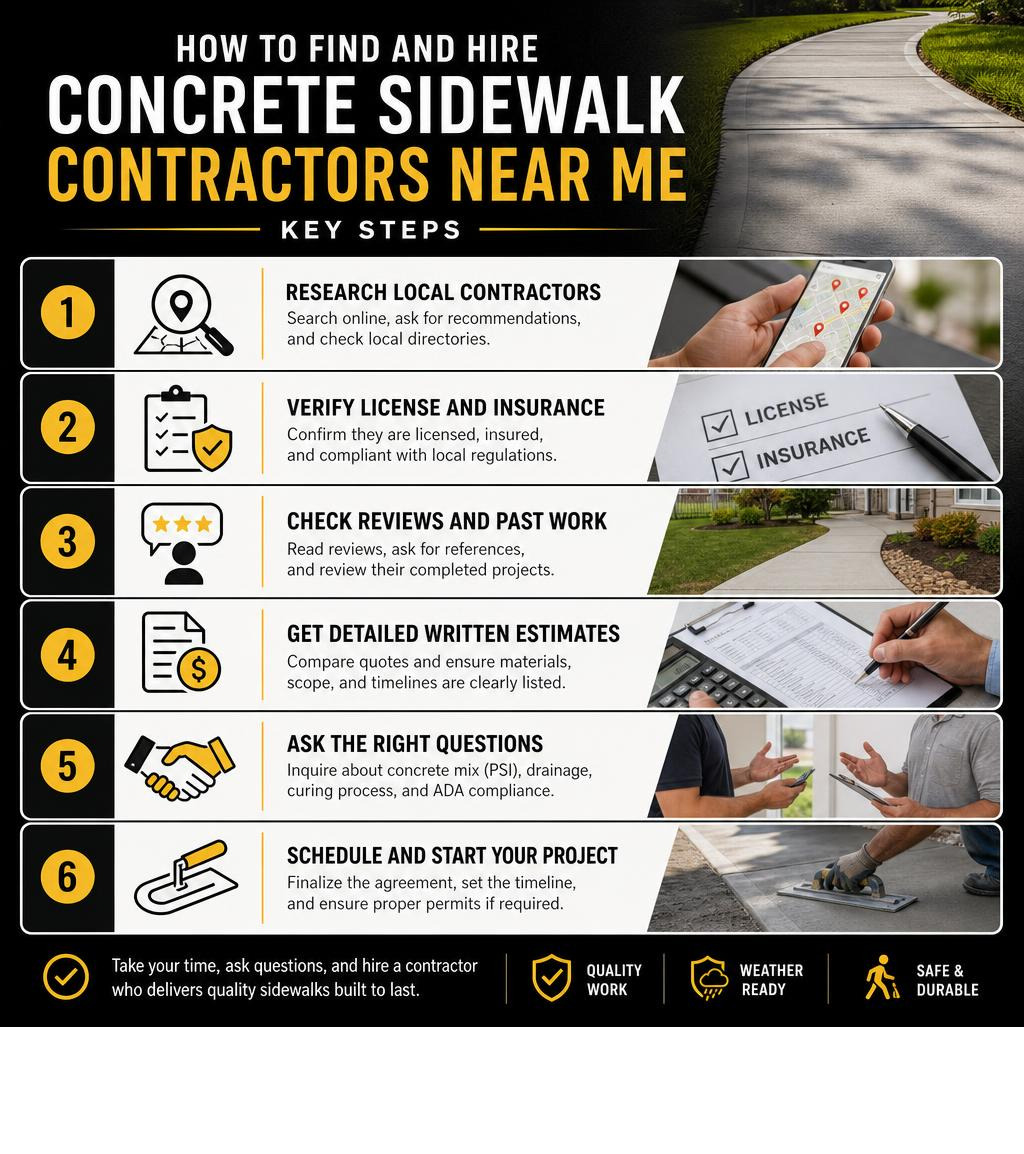
Finding a contractor is easy, but hiring a reputable one takes a little bit of homework. We recommend following a simple step-by-step process to protect your investment:
- Ask for Written Estimates: Never accept a verbal quote over the phone. A reputable contractor will visit your property in Melbourne, FL, Palm Bay, FL, or Titusville, FL to assess the site, check the grading, and provide a detailed, written estimate outlining the scope of work, material strength, and project timeline.
- Verify Their Local History: Look for contractors who have spent decades serving the local community. For example, learning more About Us will show you how forty years of local, owner-operated experience translates to better results on Florida soil.
- Check Their Portfolio: Ask to see recent local projects, especially completed concrete sidewalk work that matches the type of path, walkway, or replacement project you have in mind.
- Read Real Customer Reviews: Look for consistent praise regarding communication, cleanliness, and the structural quality of the finished product.
Questions To Ask Before Hiring
A dedicated checklist makes it easier to compare concrete sidewalk contractors and avoid vague estimates. Before choosing a contractor, ask:
- Are you licensed and insured for concrete work in Brevard County?
- Will you inspect the site in person before giving a final estimate?
- What concrete strength do you recommend for this sidewalk, and why?
- How thick will the sidewalk be poured?
- How will you prepare and compact the base before pouring?
- How will you handle drainage so water does not undermine the slab?
- Will tree roots, existing cracks, or uneven panels need to be removed before replacement?
- Where will expansion joints or control joints be placed?
- What finish do you recommend for outdoor traction?
- Does the estimate include demolition, haul-away, cleanup, and any needed permit guidance?
The best contractor should be able to answer these questions clearly. If the answers are vague, or if the estimate skips site preparation and drainage details, that is a sign to slow down before signing.
Common Mistakes We See When Replacing Sidewalks
After more than 40 years installing concrete throughout Brevard County, one of the most common problems we encounter is sidewalks poured over poorly prepared subgrade. The concrete itself may look good on day one, but if the soil beneath it was not properly compacted or drainage was not considered, cracking and settlement often follow.
Another common issue is replacing only the visible broken panel without addressing the reason it failed. Tree roots, soft soil, poor runoff, and thin concrete can all cause the same problem to return if they are ignored during replacement. A good sidewalk contractor should look beyond the cracked surface and identify what caused the damage before recommending a repair.
We also see projects where control joints, expansion joints, or finished slopes were treated as afterthoughts. Those details may not stand out immediately, but they play a major role in how the sidewalk handles movement, sheds water, and stays safe under daily use.
Customization and Decorative Concrete Finishes
Your sidewalk doesn’t have to be a plain gray walkway. Modern concrete techniques allow you to customize your walkways to match the aesthetic of your home and landscaping.
- Broom Finish: The traditional choice for outdoor pathways. A specialized broom is pulled across the freshly poured concrete to create a textured, slip-resistant surface that remains safe even during heavy Florida rainstorms.
- Stamped Concrete: This technique molds patterns into wet concrete to mimic natural stone, slate, brick, or even wood planks. It provides the high-end look of individual pavers without the maintenance headaches.
- Colored Concrete: Pigments are mixed directly into the concrete before it is poured, ensuring a rich, long-lasting color that will not peel or wear away under intense UV exposure.
If you are planning to upgrade other areas of your yard, coordinating your sidewalk with your Concrete Patios or pool deck creates a unified, beautiful outdoor living space. While some homeowners consider pavers for these areas, we always advise looking at the long-term maintenance. Over time, individual pavers tend to shift, grow weeds in the joints, and require regular re-sanding and sealing to prevent washouts. A solid, professionally poured concrete walkway avoids these issues entirely.
Key Factors Influencing Sidewalk Durability and Cost in Florida
_compressed.webp?alt=media&token=545e48f8-fb77-4c6d-b0a9-c9c4aefc074d "newly poured concrete sidewalk at Turkey Creek Sanctuary Park in Palm Bay, FL")
When planning your project, it is helpful to understand what goes into the overall cost and longevity of your sidewalk. While many homeowners naturally focus on the initial price, the long-term value of your concrete depends heavily on the materials used and the preparation of the ground beneath it.
While many contractors continue using 4000 PSI concrete for residential sidewalks, JCD Concrete exclusively installs 5000 PSI concrete because we believe homeowners benefit from the added durability and long-term performance.
| Feature | Standard 4000 PSI Concrete | Premium 5000 PSI Concrete (Our Standard) |
|---|---|---|
| Primary Use | Standard residential paths, light foot traffic | Heavy-duty driveways, residential paths, premium long-lasting sidewalks |
| Resistance to Wear | Moderate; susceptible to surface scaling over time | High; exceptional resistance to surface wear and heavy loads |
| Performance on Shifting Soil | Standard performance on prepared subgrades | Excellent; superior inherent strength and stiffness to bridge minor soil movements |
| Long-Term Value | May require repairs or replacement sooner | Built for maximum longevity with minimal maintenance |
Many of the same factors that influence driveway pricing also affect sidewalk projects, including excavation, grading, concrete thickness, reinforcement, and site preparation.
Why Sidewalks Fail Prematurely
Most sidewalk failures do not happen because concrete is a bad material. They happen because the installation was rushed, the base was not prepared correctly, or the concrete was not matched to the conditions on the property. In Brevard County, those details matter because sandy soil, heavy rainfall, tree roots, and fast-changing weather can expose weak installation practices quickly.
Common causes of premature sidewalk failure include:
- Poor compaction: If the soil or subbase is not compacted properly before the pour, the slab can settle unevenly and crack.
- Poor drainage: Standing water and uncontrolled runoff can wash out the soil beneath the sidewalk, leaving the concrete unsupported.
- Tree roots: Roots can lift individual panels, create trip hazards, and continue damaging the walkway if they are not addressed before replacement.
- Thin concrete: A slab that is poured too thin may not have enough strength for long-term residential use, lawn equipment, or edge loading.
- Weak concrete mix: Lower-strength concrete or poorly mixed concrete can wear faster, crack sooner, and perform poorly in Florida’s heat and rain.
An experienced sidewalk contractor looks for these problems before the forms are set, not after the concrete is already failing.
What A Quality Sidewalk Installation Includes
A durable sidewalk starts long before the concrete truck arrives. A quality installation should include a complete process that accounts for the property layout, the ground beneath the slab, water movement, and the finished appearance of the walkway.
A professional concrete sidewalk installation typically includes:
- Site layout: Planning the path, width, elevations, tie-ins, and drainage direction before excavation begins.
- Compaction: Preparing and compacting the subgrade so the sidewalk has a stable base.
- Forms: Setting straight, secure forms that hold the correct shape, thickness, slope, and finished elevation.
- Expansion joints and control joints: Placing joints where needed to manage movement and help guide natural cracking.
- Finish: Applying an appropriate outdoor finish, such as a broom finish, for traction and curb appeal.
- Cleanup: Removing debris, excess material, and old concrete so the finished project looks professional when the crew leaves.
These steps may sound basic, but they are exactly where low-quality work usually cuts corners. JCD Concrete focuses on proper preparation, high-strength materials, and clean jobsite execution so the finished sidewalk is built for the way the property actually drains and moves.
Managing Florida Soil and Drainage Challenges
In coastal Florida, the ground beneath your feet is constantly moving. Our sandy soil shifts easily, especially when heavy seasonal rains saturate the ground. If a contractor simply pours concrete directly onto loose sand without proper subgrade preparation, the sidewalk will quickly settle unevenly, crack, and become a major trip hazard.
Proper installation requires excavating the organic topsoil, laying down a solid, compacted subbase, and planning for water runoff. Without correct grading, heavy rains will pool next to your sidewalk, leading to washout—where the soil under the edge of the concrete washes away, leaving the slab unsupported. In areas with high water volume, we often integrate culverts and specialized drainage systems to direct water safely away from your pathways and Concrete Driveways.
Why Proper Drainage Matters
Drainage is one of the biggest differences between a sidewalk that lasts and one that starts failing early. Concrete is strong, but it still needs support underneath it. When water collects along the edge of a sidewalk or runs underneath the slab, it can erode the soil, soften the base, and create empty spaces that eventually lead to cracking or sinking.
This is especially important in Brevard County, where heavy rain can move across a property quickly. A contractor should evaluate where roof runoff, driveway runoff, yard slope, and nearby drainage paths will send water after the sidewalk is installed. In some cases, the right solution may involve grading adjustments, culverts, swales, or other drainage improvements that protect both the sidewalk and nearby concrete surfaces.
Because JCD Concrete also handles drainage-related concrete work, including driveway drainage solutions and concrete culverts, we look at sidewalks as part of the larger site—not just as isolated strips of concrete. That broader view helps prevent water from undermining the new walkway after the project is complete.
Navigating Local Codes, Permits, and ADA Compliance
Sidewalks may be subject to local building codes and accessibility requirements depending on where they are located and how they are used. Certain commercial properties and publicly accessible walkways must comply with ADA accessibility requirements.
ADA standards include specific measurements, such as:
- A minimum accessible route width of 36 inches.
- A maximum cross-slope of 2% to help prevent wheelchairs from slipping sideways.
- Properly constructed curb ramps with tactile, detectable warning surfaces where required.
Navigating these rules requires an experienced local eye. Make sure the contractor you choose has a proven track record of pulling the correct local permits and passing city inspections in Melbourne, FL, Cocoa, FL, Palm Bay, FL, and nearby Brevard County communities. Getting this wrong can result in costly corrections after the work is complete.
Common Sidewalk Issues and Professional Solutions
_compressed.webp?alt=media&token=c4843ae9-ad01-410d-bfc7-2fc39141e7a1 "before and after concrete sidewalk installation in Florida")
Over time, even professionally poured concrete can face environmental challenges. Understanding these common issues can help you decide when it is time to call in a professional for repairs:
- Cracking: Hairline cracks are common as concrete shrinks during the curing process, but deep, structural cracks are usually caused by poor subgrade preparation or heavy vehicle overruns. Professionals solve this by cutting out the damaged section, re-compacting the soil, and pouring a new, high-strength panel.
- Uneven Slabs and Trip Hazards: Shifting sandy soils or invasive tree roots can push individual concrete panels upward or cause them to sink. During repairs, we emphasize thorough root removal and soil compaction before pouring new concrete to help protect your new path from future root damage.
- Surface Scaling and Spalling: This occurs when the top layer of the concrete flakes away, often due to poor mixing, excess water during finishing, or intense weather wear. In some situations, applying a quality concrete sealer can help reduce moisture intrusion and surface wear.
If you notice any of these issues developing on your property, exploring professional Services early can help prevent small cracks from turning into expensive, full-scale replacements.
Frequently Asked Questions about Sidewalk Installation
How long does it take to install a concrete sidewalk?
For a standard residential sidewalk, the physical installation process typically takes between 2 to 4 days. This includes site preparation, setting up the wooden forms, compacting the subgrade, pouring the concrete, and applying the final finish. Once poured, you can typically walk on the surface after 24 to 48 hours, though we recommend keeping heavy vehicles off the concrete for at least a week to allow it to gain its proper strength.
What is an effective way to maintain a concrete sidewalk in Florida?
Periodic cleaning and occasional sealing, when appropriate, can help keep a concrete sidewalk looking its best. In Florida’s humid, rainy climate, removing built-up mold, mildew, and dirt also helps maintain curb appeal and reduce slick spots over time.
Why is 5000 PSI concrete preferred over standard mixes?
Standard 4000 PSI mixes are suitable for standard foot traffic. However, by upgrading to 5000 PSI concrete, you get a denser material with enhanced strength and stiffness. This mix provides additional durability against heavy lawnmowers, delivery trucks backing onto the edge of your path, and the natural shifting of sandy coastal soils.
Conclusion
Investing in a new concrete sidewalk is about more than just creating a walking path; it is about protecting your property’s safety, improving its drainage, and boosting its long-term curb appeal. By choosing a licensed, experienced local contractor who understands Brevard County’s unique environmental challenges, you can help your outdoor surfaces remain beautiful and structurally sound for years to come.
At JCD Concrete Inc., we have spent over 40 years providing top-quality materials and exceptional, owner-operated service to homeowners throughout Melbourne, FL, Palm Bay, FL, Cocoa, FL, and the surrounding beach communities. We focus on high-strength materials—we build paths designed to last.
If you are ready to upgrade your property with premium concrete flatwork services, we are here to help. Contact Us today to discuss your project and schedule a free, honest estimate with our local team.