Concrete Slab vs. Pavers: Quick Comparison for Florida Patios
If you’re deciding between a concrete slab and pavers for a new patio, the best choice depends on your budget, maintenance expectations, drainage conditions, and the look you want to achieve. Both can perform well in Florida when installed correctly, but each has distinct advantages.
Here is the quick comparison:
| Factor | Concrete Slab | Pavers |
|---|---|---|
| Upfront cost | Usually lower | Usually higher |
| Installation speed | Faster to install | More labor-intensive |
| Drainage | Depends on proper slope | Joints allow some water movement, but base prep still matters |
| Durability | Excellent long-term durability when properly installed | Flexible system that handles minor movement well |
| Repairs | Cracks and patches are harder to hide | Individual pavers can be lifted and replaced |
| Maintenance | Sealing, washing, and crack monitoring | Weed control, joint sand refresh, occasional leveling |
| Appearance | Clean slab, broom finish, stamped, stained, or colored | Many shapes, colors, borders, and patterns |
| Best fit | Lower-maintenance patios, clean modern surfaces, larger budget-conscious areas | Decorative patios, areas with roots or movement, premium landscape designs |
For most homeowners, concrete slabs offer the best combination of affordability, durability, and low maintenance, while pavers provide greater design flexibility and simpler spot repairs. The right choice depends on your priorities and the conditions of your property.
I’m John DomBek, owner of JCD Concrete Inc., and with more than 40 years of experience installing residential concrete throughout Brevard County, I’ve seen how the concrete slab vs pavers debate plays out differently here in Florida compared to what most online guides describe. Below, I’ll compare the two options by cost, drainage, durability, maintenance, appearance, and the situations where each one makes the most sense.
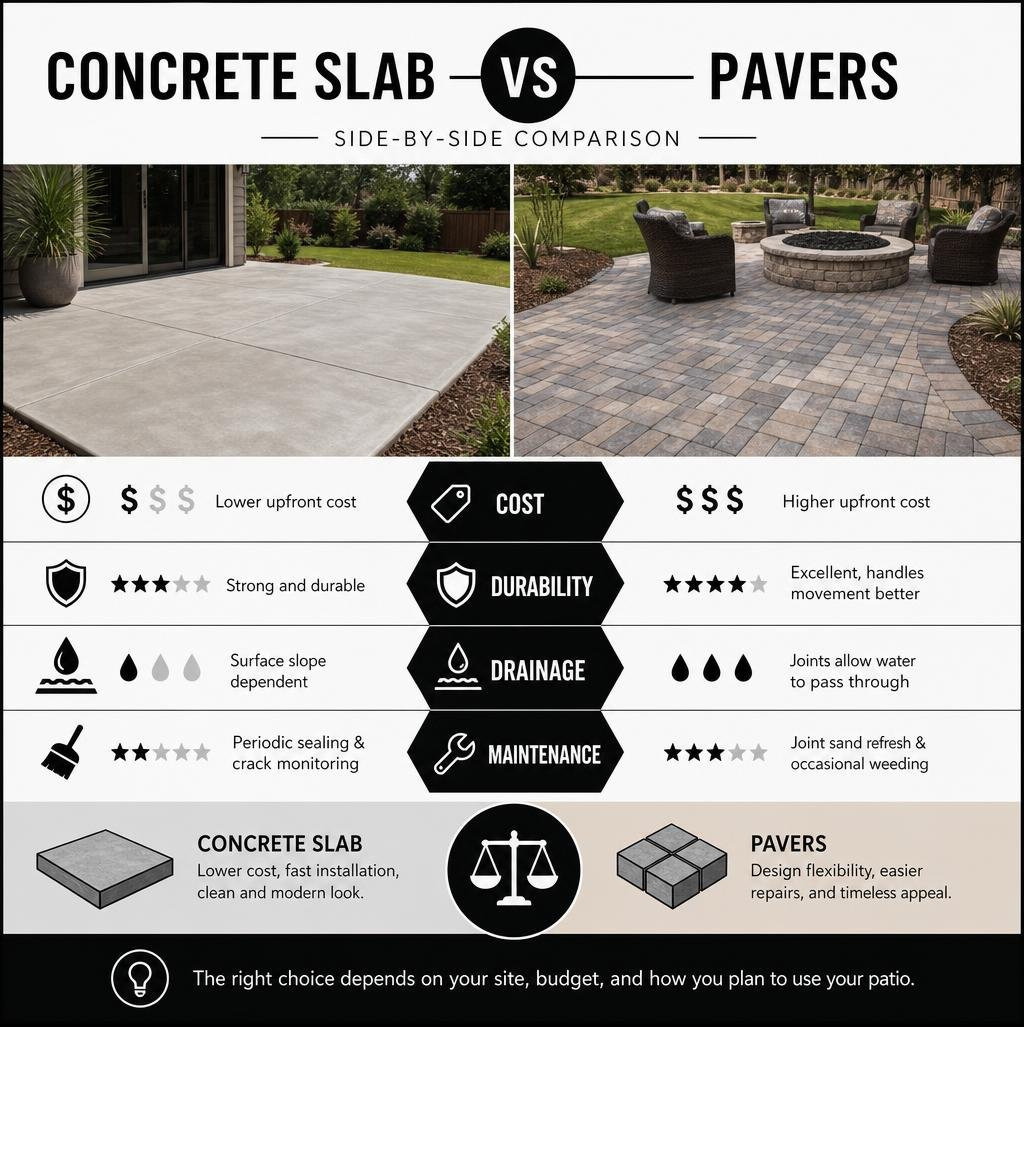
Cost: Which Patio Option Is More Affordable?
For most homeowners, budget is one of the biggest deciding factors. A basic poured concrete slab is usually the more affordable way to create a clean, usable patio surface.
- Poured concrete slabs: Often cost less because the installation is more direct. Pricing depends on access, excavation, thickness, reinforcement, finish, drainage needs, and whether you choose a decorative option like stamped or stained concrete.
- Paver patios: Usually cost more because they require more hand labor. The crew has to excavate, install and compact the base, place bedding sand, set each paver, install edge restraints, and sweep sand into the joints. The exact difference depends on the paver selected, site access, excavation requirements, and how much base preparation the property needs.
Concrete also tends to be faster to install, which can reduce labor time on a straightforward patio. Because installation is typically completed more quickly, labor costs are often lower than with an individual paver installation. Pavers can be worth the higher upfront investment when the homeowner wants a premium decorative look or expects future repairs to individual areas.
The important thing is not to compare only the price per square foot. In Brevard County, drainage corrections, access limitations, demolition, subgrade preparation, and reinforcement can affect the final cost of either option. A low bid that skips those details can become expensive later if the patio settles, cracks, or drains toward the house.
For homeowners leaning toward a poured slab, you can learn more about how we build patios on our concrete patios page.
Drainage and Site Prep: Why the Base Matters for Both Options
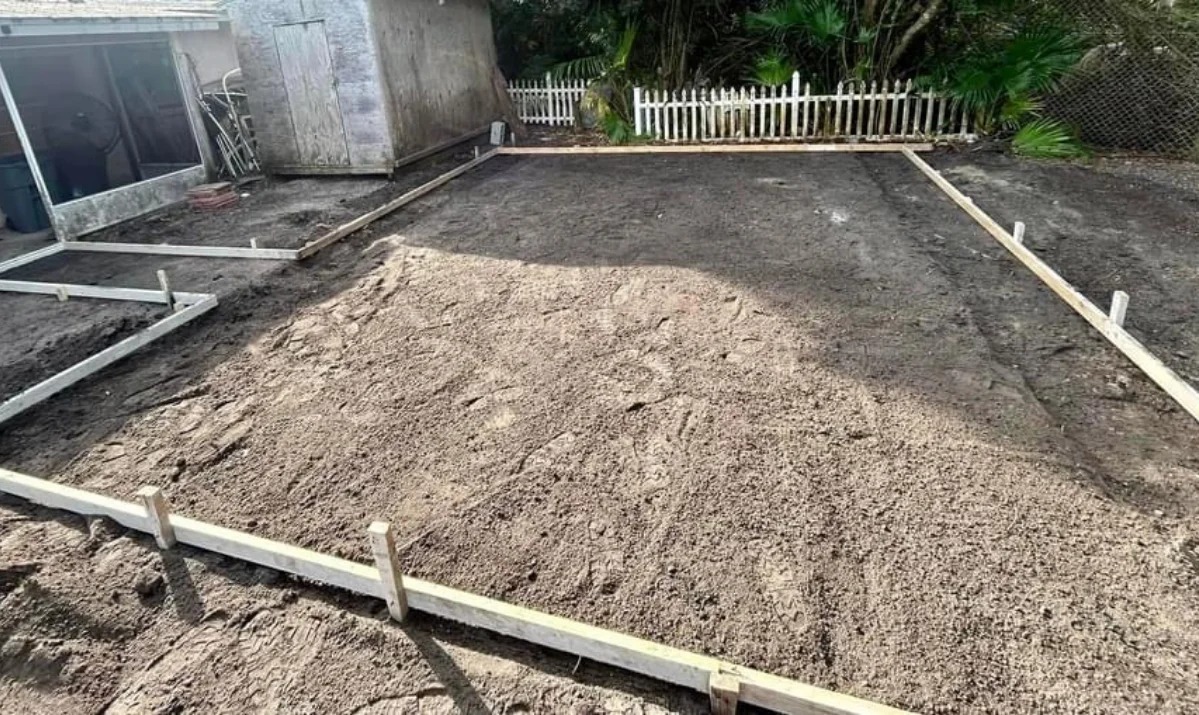
With more than 40 years of experience working in coastal Florida, from Titusville down to Palm Bay and out to the barrier islands like Cocoa Beach, one lesson we’ve learned is that your patio is only as good as the dirt underneath it.
Brevard County presents challenging site prep conditions. We deal with sandy soils, high water tables, salt air near the coast, and heavy Florida rainstorms that can quickly expose poor grading. Whether you choose a solid concrete slab or individual pavers, the key to long-term performance is proper compaction and positive drainage.
A poured concrete slab sheds water across the surface when it is pitched correctly. For many Florida homes, that is an advantage because stormwater can be directed away from the foundation and into the yard or drainage swale.
Pavers allow some water to move through the joints, but they are not a complete drainage solution by themselves. If the base is poorly compacted or the yard is graded incorrectly, water can still collect underneath the pavers. Over time, that can cause sinking, wobbling, or uneven areas.
One misconception we frequently encounter is homeowners assuming pavers automatically solve drainage problems. In reality, poor grading underneath either material will eventually create problems.
Before a slab is poured or the first paver is laid, the native sandy soil must be prepared correctly. We remove organic debris, establish the correct grade, and compact the subgrade to create a stable foundation. For more technical insights into how we handle these site conditions, you can read about our concrete flatwork services.
Durability: Concrete Slab vs Pavers in Florida Conditions
A concrete slab is a monolithic, rigid structure. Pavers are a flexible, interlocking system made of many individual units set over a compacted base and bedding layer.
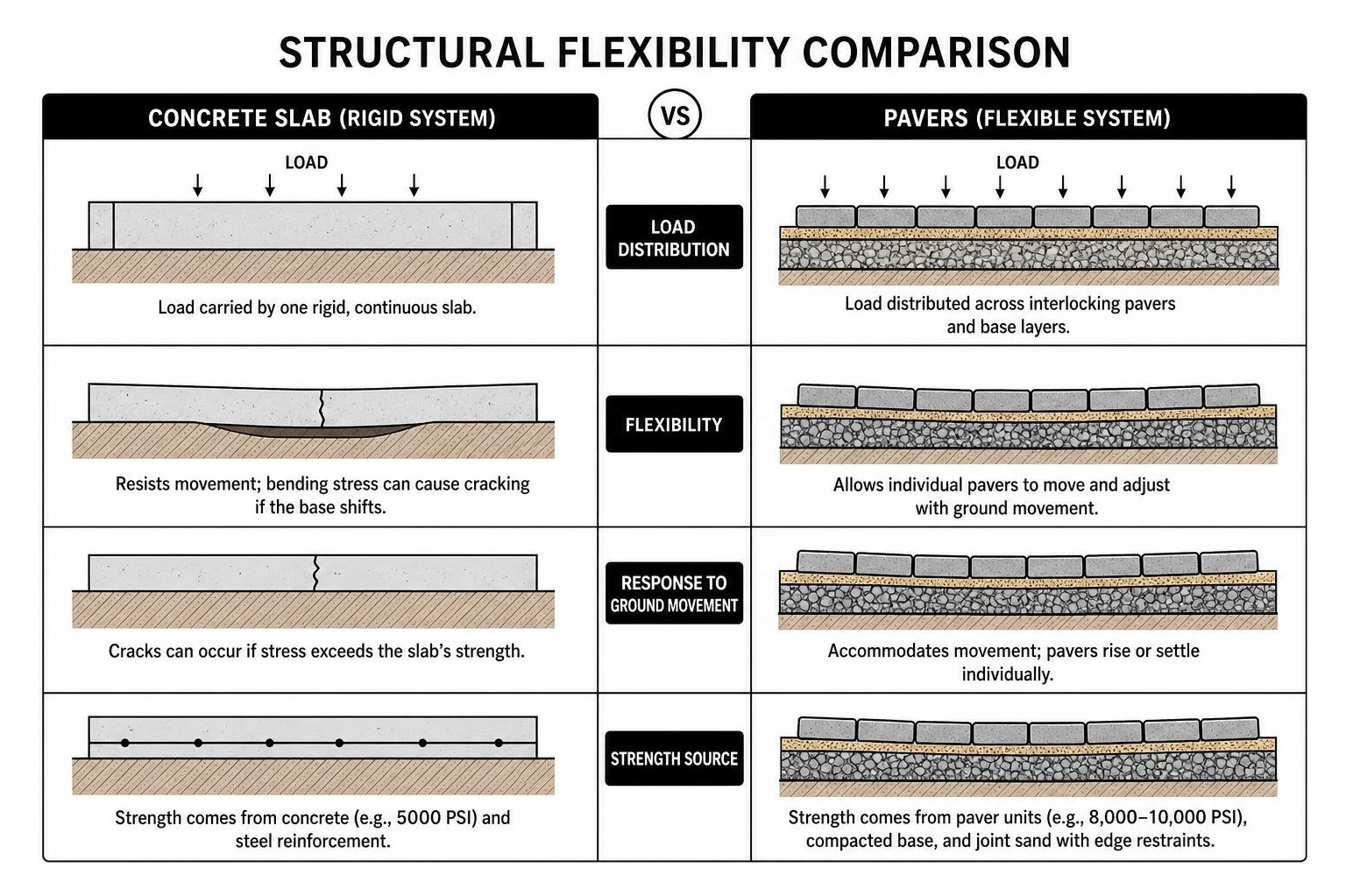
Because a concrete slab is one continuous surface, the quality of the base underneath becomes especially important. If the ground washes out or settles under one section, the slab has to resist that movement. At JCD Concrete, we install 5000 PSI concrete on every residential project because we believe homeowners benefit from the added strength, durability, and resistance to moisture intrusion. While many contractors continue using lower-strength mixes to reduce costs, we’ve found 5000 PSI performs better in Brevard County’s coastal environment. We also reinforce slabs with steel rebar where applicable.
Pavers distribute movement differently. Because they are individual units, they can shift slightly with the ground instead of cracking as one large surface. That flexibility can be helpful near tree roots or in areas where minor movement is expected. However, the system depends heavily on proper base compaction, joint sand, and edge restraints. If those fail, the pavers can spread, sink, or become uneven.
Concrete naturally shrinks as it cures, so hairline shrinkage cracks can occur. Properly placed control joints help manage normal shrinkage by encouraging small cracks to form where they’re less noticeable. Individual pavers are far less likely to crack across the entire patio because each unit moves independently, but they can still settle or become uneven if the base moves.
In coastal areas such as Satellite Beach, Cocoa Beach, and Melbourne Beach, salt air and moisture make material quality and installation details even more important. For poured concrete, proper concrete cover over reinforcement, good drainage, and regular sealing help reduce moisture and salt intrusion when properly maintained. You can learn more about our slab work on our concrete pads and slabs page.
Maintenance and Repairs: Which Is Easier to Live With?
Maintenance is where the concrete slab vs pavers decision becomes very practical.
A poured concrete slab is usually simpler to maintain. Most homeowners need to sweep it, rinse it occasionally, monitor any cracks, and reseal the surface every few years if it has a decorative finish or needs added protection from moisture, stains, and salt exposure.
Pavers require a different maintenance routine. Because they have joints, windblown seeds can settle between the units. Even with polymeric sand, homeowners may need to manage weeds, refresh joint sand, pressure wash carefully, and re-level areas that settle over time.
Repairs are the tradeoff. If a paver patio has a low spot or a damaged paver, a contractor can often lift the affected units, adjust the base, and reinstall the same pavers. The repair can blend in well.
Concrete repairs can be more difficult to blend seamlessly with the surrounding slab. If a slab cracks or settles because of a washout, the repair may leave a visible patch or color difference. In more serious cases, the damaged area may need to be removed and repoured. That is why good base preparation, reinforcement, control joints, and drainage matter so much before the concrete is ever placed.
For homeowners who want the lowest-maintenance surface day to day, concrete often has the advantage. For homeowners who prioritize easy spot repairs, pavers can be appealing.
Appearance: Clean Slab, Decorative Concrete, or Paver Patterns?
Appearance is one area where both options can work well, but they create different looks.
Concrete gives you a clean, continuous patio surface. A broom finish is simple and practical, while stamped concrete, stained concrete, colored concrete, and decorative borders can create a more finished outdoor living space. Today’s decorative concrete offers far more design flexibility than many homeowners expect.
Pavers offer more built-in pattern variety. Homeowners can choose different shapes, colors, borders, and laying patterns to create a custom look. Pavers are often chosen when the patio is meant to feel like it has a custom appearance.
The best choice depends on the style of the home. A modern coastal home may look best with a clean concrete slab or subtle gray stamped finish. A Mediterranean-style home may pair well with pavers or stamped concrete that mimics stone. A more traditional Florida home may work with either option depending on the budget and surrounding landscaping.
If you like the look of pavers but prefer a solid slab, stamped concrete can be a strong middle ground. Many homeowners are surprised to learn that stamped concrete can closely resemble natural stone or pavers while providing the continuous surface of a concrete slab. It gives homeowners the appearance of stone, slate, cobblestone, or wood plank patterns while keeping the surface monolithic and easier to maintain than a jointed paver system.
When Concrete Is the Better Choice
A concrete slab is often the better choice when the homeowner wants a durable, lower-maintenance patio at a more budget-friendly upfront cost. If long-term maintenance is one of your biggest concerns, concrete is often the simpler option.
Concrete may be the better fit if:
- You want to control the upfront budget.
- You prefer less weeding and joint maintenance.
- You are building a large patio area where paver labor costs can add up quickly.
- You want a stable surface for patio furniture, grills, or everyday outdoor use.
- You need a larger slab area that may also support heavier uses, such as an RV pad or utility area.
- You like clean, modern patio designs with fewer joints and visual breaks.
- Your contractor can properly grade the slab to move water away from the home.
For many Brevard County homeowners, a properly installed concrete slab offers the best balance of cost, durability, and maintenance. The key is making sure the slab is built correctly from the start: compacted subgrade, proper thickness, steel reinforcement where applicable, control joints, and drainage designed for Florida conditions.
Concrete is also a strong fit for homeowners who want a simple outdoor living surface without ongoing joint sand, weed control, or frequent re-leveling. If the goal is a clean patio that performs well through heavy Florida rainstorms and daily use, poured concrete is usually the more practical choice.
When Pavers Are the Better Choice
Pavers may be the better choice when appearance, design flexibility, or repairability is the top priority.
Pavers may be the better fit if:
- You want a custom decorative patio appearance with multiple colors, borders, or patterns.
- You prefer the look of individual stone or brick units.
- You have frequent tree-root concerns or minor ground movement in the area.
- You want the ability to lift and replace small areas later.
- Your patio design includes curves, complex layouts, borders, or detailed landscape transitions.
- You are matching a historic home, traditional property, or existing hardscape.
- You do not mind occasional weed control, joint sand maintenance, and possible re-leveling.
Pavers are not automatically better than concrete, and concrete is not automatically better than pavers. The better choice is the one that fits the site conditions, budget, maintenance expectations, and design goals.
For a detailed breakdown of how these materials perform under local weather conditions, read our concrete vs pavers pros and cons comparison.
Which Material Do We Recommend?
When a homeowner tells us they want to manage the budget, build a larger patio, keep maintenance simple, and avoid weeds between joints, we usually recommend a properly installed concrete slab. It gives them a clean, durable surface that can be graded for drainage and finished in a way that fits the home.
When a homeowner is focused on a custom decorative landscape appearance, future spot repairs, complex layouts, or matching an existing paver or historic hardscape, pavers may be worth the higher investment. They require more maintenance, but the design flexibility and easier individual-unit repairs can make sense for the right property.
Rather than recommending the same material for every project, we evaluate each property individually before making a recommendation. Soil conditions, drainage, access, nearby trees, patio size, and the homeowner’s long-term maintenance expectations all matter. That is why we look at the whole project before recommending one material over the other.
How to Choose the Right Contractor for Your Patio Project
A patio is a major investment, and choosing the right contractor can make the difference between a well-built outdoor living space and a costly headache. Whether you choose concrete or pavers, the installation quality matters more than the material alone.
Here is what to look for when gathering estimates:
- Licensing and insurance: Never work with an unlicensed or uninsured contractor. In Florida, proper licensing helps ensure the contractor understands local requirements, and insurance protects your property if something goes wrong.
- Site prep details: The proposal should explain excavation, grading, compaction, base preparation, thickness, reinforcement, and cleanup.
- Drainage plan: The contractor should be able to explain how water will move away from the house, patio, and foundation.
- Ask About Materials and Installation Standards: For concrete, ask about mix strength, reinforcement, control joints, and curing guidance. For pavers, ask about base depth, compaction, edge restraints, bedding sand, and joint sand.
- Repair expectations: A good contractor should explain what normal wear looks like, what can be repaired, and what maintenance the patio will need over time.
At JCD Concrete Inc., we bring more than 40 years of owner-operated concrete experience to patios throughout Brevard County, from Cape Canaveral down to Palm Bay. We use proper compaction techniques, install steel reinforcement where appropriate, design site-specific drainage solutions, and pour high-strength 5000 PSI concrete on residential projects.
Choosing between a concrete slab and pavers ultimately comes down to your budget, site conditions, appearance goals, and maintenance preferences. If you want a clean, durable, lower-maintenance patio, a professionally poured concrete slab is hard to beat. If you want a custom decorative surface with easier spot repairs and do not mind more joint maintenance, pavers can be a strong choice.
Contact JCD Concrete Inc. today to schedule your free estimate, and we’ll help you decide whether a concrete slab or paver patio is the right fit for your property.