What Is Commercial Concrete Leveling?
Commercial concrete leveling addresses uneven, settled, or poorly supported concrete surfaces on business and commercial properties. The right corrective approach depends on why the concrete moved, the condition of the existing slab, how the area is used, and whether the underlying drainage or soil problem can be corrected.
Some slabs may be candidates for professional leveling or targeted repair, while concrete that is badly fractured, deteriorated, poorly supported, or affected by recurring drainage problems may be better suited for removal and replacement.
For commercial property owners, the first step should be identifying the cause of the movement rather than choosing a repair method based only on speed or price.
| What to Evaluate | Why It Matters |
|---|---|
| Amount of settlement | Helps determine whether the slab is still practical to correct |
| Slab condition | Heavily fractured or deteriorated concrete may not be a good candidate for leveling |
| Underlying support | Washout, poor compaction, or voids can allow movement to continue |
| Drainage | Recurring water movement can recreate the problem after repair |
| Commercial use | Pedestrian traffic, vehicles, and equipment affect repair planning |
| Operational access | Repair sequencing may need to account for entrances, parking, or business operations |
I’m John DomBek, owner of JCD Concrete Inc., and after more than 40 years installing and repairing concrete across Brevard County, commercial concrete leveling is one option worth evaluating when an existing slab remains in usable condition but has become uneven. In the sections below, we’ll walk you through why commercial concrete becomes uneven, when an existing slab may be repairable or levelable, when replacement may be the better option, and what a contractor should evaluate before recommending a solution.
Why Uneven Commercial Concrete Needs Attention
Uneven concrete can affect pedestrian access, drainage, vehicle movement, and day-to-day use of a commercial property. The urgency depends on the location, amount of displacement, and how the surface is used.
In Brevard County, sandy soil, seasonal rainfall, drainage conditions, and areas with high water tables can contribute to erosion or loss of support beneath concrete when water is not properly managed.
For a business owner, uneven or deteriorated concrete can raise practical safety and access concerns, including:
- Accessible routes: Changes in level can affect accessibility requirements. Under ADA requirements for changes in level, vertical changes up to 1/4 inch are permitted without treatment, while larger changes may require beveling or another compliant transition depending on their height and location.
- Walking-working surface safety: Uneven or deteriorated concrete can create trip, access, or equipment-movement concerns. OSHA walking-working surface requirements require walking-working surfaces to be inspected and maintained in a safe condition, with hazardous conditions corrected or guarded.
Evaluating settlement early can help property owners understand whether the slab is still practical to level or repair before the condition becomes more extensive. If your concrete is structurally sound but simply uneven, a leveling evaluation may be worth considering. For related installation work, explore our concrete flatwork services and concrete sidewalk services.

Common Causes of Commercial Concrete Settlement
After more than 40 years installing and repairing concrete throughout Brevard County, we have identified a few recurring issues that can contribute to commercial concrete settlement:
- Inadequate subgrade preparation: Poorly supported or insufficiently compacted soil can settle after the slab is installed.
- Stormwater and washout: Water moving along slab edges or beneath concrete can carry sandy soil away and reduce support.
- Drainage problems: Downspouts, low areas, leaking drainage infrastructure, or poorly directed runoff can repeatedly saturate or erode supporting soil.
- Changes around the property: Excavation, landscaping, roots, utility work, or other site changes can affect support beneath existing concrete.
- Heavy or changing use: Loads or traffic patterns that differ from what the original slab and support conditions were designed for may contribute to performance problems.
Where Commercial Concrete Settlement Creates Problems
Sinking concrete can disrupt practical use across many different areas of a commercial property. Some of the most common areas where leveling, repair, or replacement may need to be evaluated include:
- Sidewalks and pedestrian routes: Uneven sections can affect accessibility and create trip concerns.
- Entrances and storefront approaches: Settlement can interfere with smooth pedestrian access and drainage.
- Concrete parking areas: Low or displaced sections can hold water or create rough transitions for vehicles.
- Commercial pads and flatwork: Settlement can affect how the surface drains and supports its intended use.
- Driveway and access areas: Movement near drainage features or culverts may point to washout or support problems beneath the concrete. For larger vehicle access areas, you can also view our concrete driveway services.
Commercial Concrete Leveling vs. Repair vs. Replacement
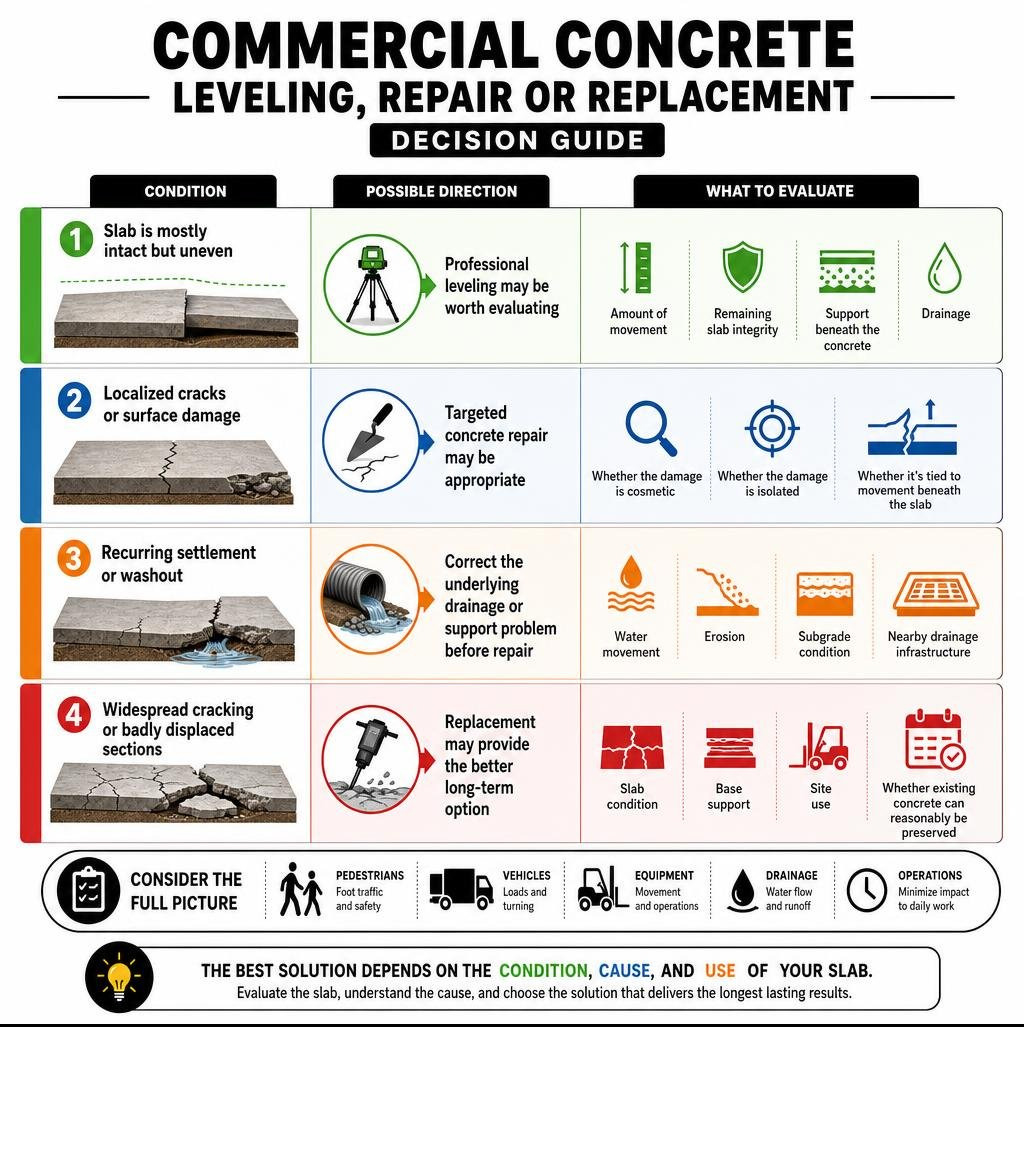
Uneven concrete does not automatically mean the entire slab needs to be replaced. The best solution depends on the slab’s condition and the reason it moved.
| Condition | Possible Direction | What the Contractor Should Evaluate |
|---|---|---|
| Slab is mostly intact but uneven | Professional leveling may be worth evaluating | Amount of movement, remaining slab integrity, support beneath the concrete, and drainage |
| Localized cracks or surface damage | Targeted concrete repair may be appropriate | Whether the damage is cosmetic, isolated, or tied to movement beneath the slab |
| Recurring settlement or washout | Correct the underlying drainage or support problem before repair | Water movement, erosion, subgrade condition, and nearby drainage infrastructure |
| Widespread cracking or badly displaced sections | Replacement may provide the better long-term option | Slab condition, base support, site use, and whether existing concrete can reasonably be preserved |
When Leveling May Be Worth Evaluating
A slab that is mostly intact but uneven may be a candidate for professional leveling or targeted correction. In those cases, the contractor should look at how far the slab moved, whether the concrete still has enough integrity to preserve, and whether the base beneath it can be stabilized so the movement does not continue.
For commercial properties, use matters. A sidewalk outside an office, a storefront approach, a concrete parking area, and a commercial access drive can all place different demands on the slab. The recommendation should account for pedestrian or vehicle traffic, drainage patterns, access needs, and how the work can be sequenced around normal property operations.
When Concrete Repair May Be Enough
Not every issue requires full replacement. Localized cracks, edge damage, surface wear, or small areas of settlement may be handled through targeted concrete repair if the surrounding slab remains sound. The key is determining whether the visible damage is isolated or whether it points to a larger support problem under the concrete.
A repair that only addresses the surface may not last if stormwater runoff, poor compaction, or washout is still undermining the slab. That is why an experienced contractor should evaluate the source of movement before recommending a repair plan.
When Replacement Is the Better Option
Replacement may be the better long-term option when the slab is badly fractured, severely displaced, deteriorated, or sitting on a base that cannot be corrected without removing the concrete. It may also make more sense when drainage issues need to be reworked, elevations need to be changed, or the existing slab was not built for its current commercial use.
When replacement is appropriate, proper site preparation, drainage, reinforcement where applicable, concrete specifications appropriate to the project’s use and requirements, placement, and curing all contribute to long-term performance. For related slab installation capabilities, explore our concrete pads and slabs.
What Happens During a Commercial Concrete Leveling Evaluation?
Because different causes of settlement require different solutions, the evaluation matters as much as the repair itself.
1. Identify the Movement
The contractor should document which sections are low, displaced, cracked, or holding water and how the affected area connects to adjoining concrete.
2. Look for the Cause
Drainage, erosion, poor compaction, voids, nearby utilities, roots, and site changes should be considered before deciding how to correct the surface.
3. Evaluate the Existing Concrete
A mostly intact slab may present different options than concrete that is heavily fractured, deteriorated, or repeatedly moving.
4. Consider How the Area Is Used
Pedestrian access, vehicle traffic, business hours, and operational needs can affect repair sequencing and the most practical corrective approach.
5. Compare Leveling, Repair, and Replacement
The contractor should explain why the recommended option fits the slab condition and what underlying soil or drainage corrections are needed to reduce the risk of recurring settlement.
What Affects the Cost of Commercial Concrete Leveling?
The cost depends on the size and location of the affected area, amount of settlement, condition of the existing concrete, site access, underlying soil or drainage problems, and the corrective approach recommended after inspection.
A contractor should first determine whether the existing slab is a practical candidate for leveling or repair. If the concrete is extensively fractured or the underlying support problem cannot be corrected without removal, replacement may be the more appropriate investment.
When comparing proposals, make sure each contractor is addressing the same affected area and the same underlying conditions. One estimate may include drainage or base corrections that another estimate does not, which can make the total prices difficult to compare without reviewing the scope.
What to Ask a Commercial Concrete Leveling Contractor
Commercial property owners should ask contractors to explain both the visible problem and the conditions beneath the slab before recommending a repair.
- What do you believe caused the settlement? The recommendation should address drainage, erosion, or support problems when they are contributing factors.
- Is the existing slab still a practical candidate for leveling or repair? Ask what condition would make replacement more appropriate.
- What corrective method are you recommending and why? The contractor should explain how the proposed approach fits the slab and property conditions.
- How will drainage or soil problems be addressed? Lifting or repairing concrete without correcting ongoing washout can allow settlement to recur.
- How will the work affect access and business operations? Ask about sequencing, restricted areas, and expected return-to-use guidance.
- What is included in the written proposal? Make sure the scope identifies affected areas, preparation, repair work, cleanup, and any exclusions.
Frequently Asked Questions About Commercial Concrete Leveling
Can all uneven commercial concrete be leveled?
No. Whether an existing slab is a practical candidate for leveling depends on its condition, the amount and pattern of settlement, support beneath the concrete, drainage, and how the area is used. Concrete that is badly fractured, extensively deteriorated, or affected by underlying conditions that cannot be corrected while the slab remains in place may be better suited for targeted replacement.
Does concrete leveling fix the drainage problem that caused settlement?
Not necessarily. Correcting the elevation of a slab does not automatically resolve the water movement, erosion, poor compaction, or drainage issue that caused it to settle. When those conditions are contributing to the problem, they should be evaluated as part of the repair plan to reduce the risk of recurring movement.
How long does the leveling or repair process take?
The timeline depends on the size of the area, the slab condition, the cause of the movement, site access, and whether drainage or base issues need to be corrected first. Some targeted repairs can be planned around normal business operations, while more extensive replacement work may require demolition, forming, concrete placement, curing time, and traffic control.
If replacement involves new concrete, light foot traffic is often possible after roughly 24–48 hours, but property owners should follow the project-specific access instructions provided for the installation. Concrete continues gaining strength through the first week and generally reaches its specified design strength around day 28 under standard curing assumptions.
To learn more about evaluating local contractors, read our guide to choosing a concrete leveling contractor.
Evaluating Uneven Commercial Concrete in Brevard County
Uneven commercial concrete should be evaluated based on more than the visible low spot. The condition of the slab, underlying support, drainage, amount of settlement, and way the area is used all help determine whether leveling, targeted repair, or replacement is the most practical option.
After more than 40 years of concrete experience in Brevard County, JCD Concrete Inc. understands how sandy soils, stormwater, and drainage conditions can affect concrete support. Our goal is to identify the underlying problem and recommend a concrete solution that fits the property and the condition of the existing slab.
If you have uneven commercial concrete on your property, explore JCD Concrete Inc.’s concrete services or contact us to schedule an evaluation.