What a 10×20, 12×12, 20×20, or 20×30 Concrete Patio Actually Costs in 2026
How much does a 10×20 concrete patio cost? Here’s a quick answer before we get into the details:
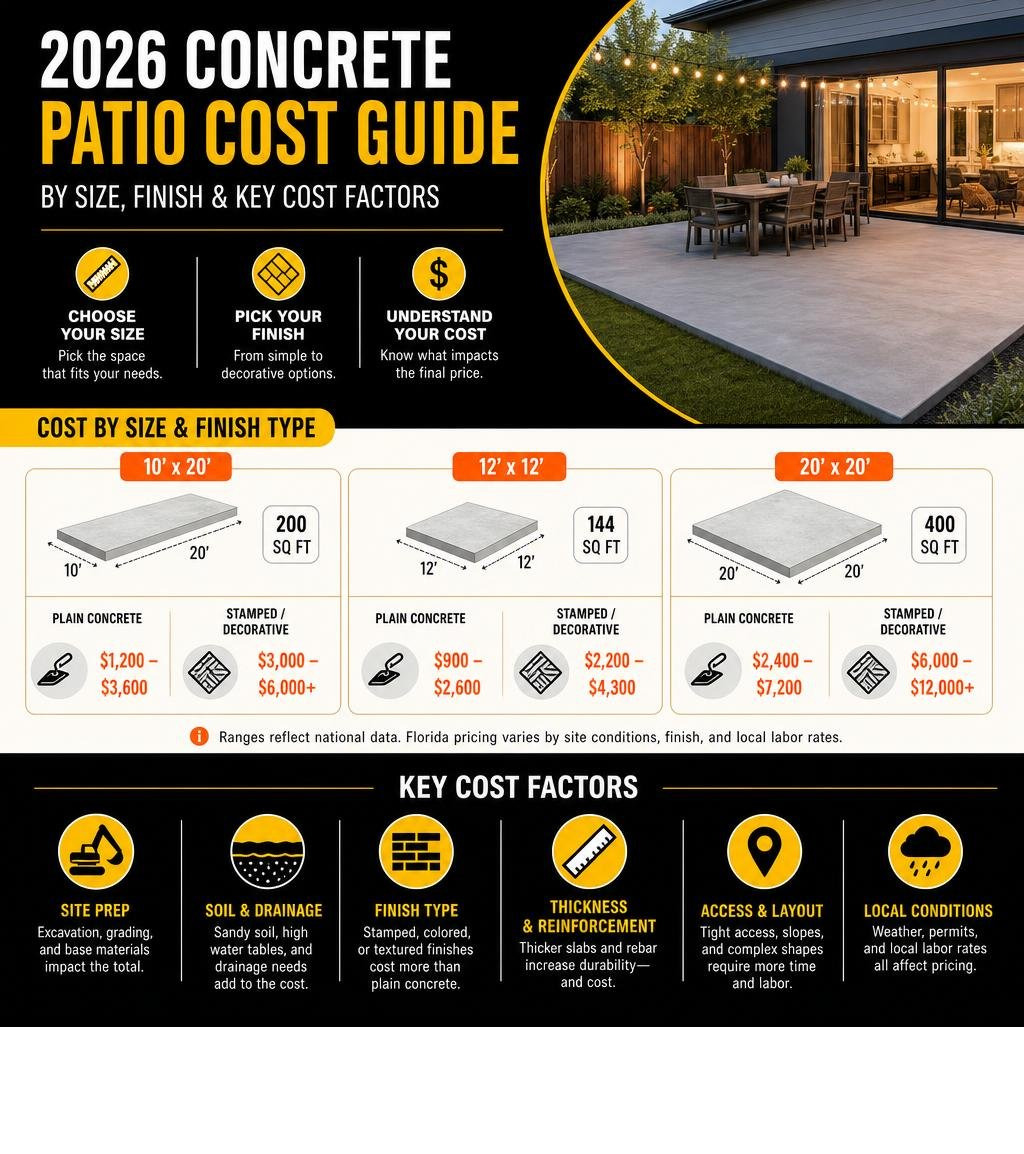
| Patio Size | Square Footage | Plain Concrete (Estimated Range) | Stamped or Decorative |
|---|---|---|---|
| 10×20 | 200 sq ft | $1,200 – $3,600 | $3,000 – $6,000+ |
| 12×12 | 144 sq ft | $900 – $2,600 | $2,200 – $4,300 |
| 20×20 | 400 sq ft | $2,400 – $7,200 | $6,000 – $12,000+ |
| 20×30 | 600 sq ft | $3,600 – $10,800 | $9,000 – $18,000+ |
Ranges reflect national data. Florida pricing varies by site conditions, finish, access, drainage, demolition, and local labor rates.
Quick Patio Budget Planner
| If your budget is… | Consider… |
|---|---|
| Under $2,500 | 12×12 broom-finish patio |
| $2,500-$5,000 | 10×20 patio with a basic finish |
| $5,000-$10,000 | Larger patio or decorative finish |
| $10,000+ | Outdoor living area with stamped concrete and upgrades |
The right patio size makes a real difference, not just in cost, but in how well the space actually works for your home. A 10×20 gives you a solid starting point for a table, a few chairs, and room to move. A 20×20 opens things up for larger gatherings or an outdoor kitchen setup. A larger patio creates more usable outdoor living space, but it also increases the importance of proper drainage, grading, reinforcement, and site preparation.
One thing homeowners often overlook is that two patios with identical dimensions can differ by thousands of dollars depending on drainage, access, demolition, and site preparation. We’ve installed patios where excavation and correction work took longer than the actual concrete pour because tree roots, poor drainage, or unstable soil had to be addressed first.
Before comparing contractors or requesting estimates, it helps to understand what actually drives patio costs.
I’m John DomBek, owner of JCD Concrete Inc., and with over 40 years of experience pouring residential concrete across the Space Coast, I’ve answered the question of how much does a 10×20 concrete patio cost more times than I can count. Every project is a little different, and I’ll walk you through exactly what drives the price so you know what to expect before anyone sets foot on your property.
What You’ll Learn
- Typical costs by patio size
- Plain vs. stamped concrete pricing
- What increases the price
- Which patio size fits your backyard plans
- How much a 20×30 concrete patio may cost
- Florida-specific cost factors
- What patio upgrades can add the most value
How Much Does a 10×20 Concrete Patio Cost?
A 10×20 concrete patio provides a highly functional 200-square-foot footprint. This size is one of the most popular choices for homeowners in Melbourne, Palm Bay, and Titusville because it fits comfortably into most suburban backyards while offering plenty of room for outdoor dining sets, grills, and lounge chairs.
When looking at the overall investment, the total cost of a concrete patio in Brevard County, FL is determined by two primary components: materials and labor. Materials include the concrete mix itself, formwork, base gravel, and the reinforcement required for a durable, long-lasting slab. Labor covers the excavation, grading, setting forms, pouring, finishing, and curing.
Limited backyard access, narrow side yards, landscaping, fences, or long distances between the street and the patio location can increase labor costs because additional equipment may be needed.
We’ve completed projects where the concrete pour took only a few hours, but preparing the site properly took an entire day. In our experience, the quality of the preparation often has a bigger impact on the finished patio than the actual pour.
Estimating the Base Price: How Much Does a 10×20 Concrete Patio Cost for Plain Concrete?
If you are looking for a clean, durable, and highly functional outdoor surface that does not break the bank, plain concrete is one of the most commonly used patio options. For a typical residential installation, we typically apply a traditional broom finish. This involves pulling a specialized broom across the wet concrete surface just before it sets, creating fine, non-slip ridges that provide excellent traction during our heavy summer afternoon downpours.
When calculating the base cost to install a concrete patio in Brevard County, FL, it is crucial to look at the quality of the materials going into your ground. At JCD Concrete Inc., while many contractors still use 4,000 PSI concrete—or even less—we build every residential patio using 5,000 PSI concrete because we believe homeowners deserve the strongest, longest-lasting surface possible.
Using 5,000 PSI concrete ensures that your patio can better withstand hot tubs, outdoor kitchens, masonry fireplaces, and other concentrated loads, along with the constant shifting of our sandy Florida soils. It helps improve long-term durability and provides greater resistance to cracking than lower-strength mixes. Choosing a high-strength mix from the start is the best way to secure long-term value, saving you money on repairs and premature replacement down the road.
Upgrading the Finish: How Much Does a 10×20 Concrete Patio Cost for Stamped or Decorative Finishes?
For homeowners who want to elevate their backyard design, upgrading from a plain slab to a decorative finish is a fantastic option. Decorative concrete allows you to achieve the high-end look of natural stone, brick, or wood planks while retaining the seamless durability and low maintenance of a solid concrete slab.
There are three main decorative upgrades to consider:
- Stamped Concrete: This process involves pressing large, textured rubber stamps into the freshly poured concrete to replicate patterns like slate, cobblestone, or flagstone. It adds depth and character to your outdoor living space.
- Stained Concrete: We apply acid-based or water-based stains to penetrate the concrete surface, creating rich, translucent, and variegated color tones that mimic natural stone.
- Exposed Aggregate: By washing away the top layer of concrete paste before it fully cures, we reveal the beautiful natural stones and pebbles embedded within the mix. This finish offers a highly textured, rustic look with built-in slip resistance.
One thing we regularly see is homeowners choosing decorative finishes after the patio has already been designed. Planning for stamped concrete from the beginning often produces a better finished result and avoids unnecessary changes later.
While decorative finishes increase the initial cost due to the artistic skill, specialized tools, and additional sealing steps required, they offer incredible cost-efficiency. Stamped concrete typically costs about one-third less than installing natural stone or individual pavers, giving you a premium look at a fraction of the price. Plus, the textured surfaces provide crucial slip resistance around pool areas and high-traffic coastal zones.
Comparing Patio Sizes: 10×20 vs. 12×12 vs. 20×20
Choosing the right dimensions for your patio depends heavily on how you plan to use the space and the layout of your backyard. Let’s compare three common residential sizes:
- 12×12 Patio (144 sq ft): This square layout is perfect for compact yards in areas like Satellite Beach or Indialantic. It comfortably fits a small bistro table and a couple of chairs, making it an excellent cozy retreat.
- 10×20 Patio (200 sq ft): The rectangular shape of a 10×20 slab is highly versatile. It allows you to create distinct zones, such as a dining area on one side and a lounging space with a couple of chairs on the other.
- 20×20 Patio (400 sq ft): This expansive layout is designed for serious outdoor entertaining. It provides ample space for full outdoor kitchens, large dining tables, fire pits, and multiple seating arrangements.
To help you visualize the cost differences, let’s look at a high-level comparison of these sizes:
_compressed.webp?alt=media&token=9ceeb6ac-d735-458d-beae-1942fa15cdb1 "Finished backyard concrete patio slab connected to a covered rear porch of a Florida home")
When planning, keep in mind that larger slabs often benefit from slightly better per-square-foot pricing because mobilization, site setup, and clean-up costs are spread across a larger area. If you want to explore all your options, our team can help you design custom concrete patios in Brevard County, FL tailored exactly to your home’s layout.
Which Patio Size Is Right for Your Backyard?
The best patio size depends on how many people you entertain, what furniture you want outside, and whether you plan to add features like a grill, pergola, fire pit, or outdoor kitchen. After more than 40 years installing residential concrete throughout Brevard County, one mistake we regularly see is choosing a patio that looks large enough on paper but feels cramped once furniture, walkways, and cooking areas are added.
We generally encourage homeowners to think about how they’ll actually use the patio five years from now, not just how they’ll use it today.
| Patio Size | Best For | Considerations |
|---|---|---|
| 12×12 | Small seating area, bistro table, compact backyard | Lower cost, but limited room for larger furniture |
| 10×20 | Dining set, grill, lounge chairs, everyday backyard use | Strong balance of cost and usable space |
| 20×20 | Entertaining, outdoor kitchen, fire pit, multiple seating zones | Higher cost, but much more flexible layout |
| 20×30 | Large outdoor living area, poolside patio, covered patio, full entertainment space | Requires more attention to grading, drainage, access, and reinforcement |
Choose a 12×12 patio if you want a simple sitting area, a small table, or a low-cost upgrade for a compact yard.
Choose a 10×20 patio if you want enough room for a dining set, a grill, and comfortable movement without taking over the entire backyard.
Choose a 20×20 patio if you entertain regularly or want space for multiple uses, such as dining on one side and a fire pit or lounge area on the other.
Choose a 20×30 patio if you are building a true outdoor living area with a covered structure, pool connection, outdoor kitchen, large seating arrangement, or future add-ons. This size gives you the most flexibility, but it also makes site prep more important because even small drainage or grading issues become more noticeable across a larger slab.
How Much Does a 20×30 Concrete Patio Cost?
A 20×30 concrete patio is 600 square feet, making it three times larger than a 10×20 patio. For plain concrete, a 20×30 patio commonly falls around $3,600 to $10,800, depending on site preparation, slab thickness, reinforcement, access, and finish. For stamped or decorative concrete, the same size can often range from $9,000 to $18,000 or more.
The reason the range is so wide is that large patios magnify every cost factor. A small amount of extra excavation on a 10×20 slab may be manageable, but on a 600-square-foot patio, poor drainage, tree roots, uneven grade, or limited equipment access can add significant labor.
One issue we frequently encounter in Brevard County is that homeowners plan the patio size around furniture but forget about water movement. A 20×30 slab needs a proper slope away from the home, a stable compacted base, and enough drainage planning to prevent water from collecting at the edges or flowing back toward the foundation.
A 20×30 patio makes the most sense when you want a long-term outdoor living space, not just a small concrete pad. It can support covered seating, poolside use, outdoor dining, and entertainment features, but the installation should be planned carefully from the start.
Key Cost Factors for Florida Concrete Patios
Installing a concrete patio in Florida requires specialized knowledge of our unique coastal environment. Standard national cost estimators often overlook the specific regional challenges we face every day along the Space Coast.
Our sandy soil, high water tables, intense heat, and heavy seasonal rainfall all play a major role in how a patio must be constructed. If a contractor fails to account for these local elements, your beautiful new patio can settle, crack, or wash out during the first major storm.
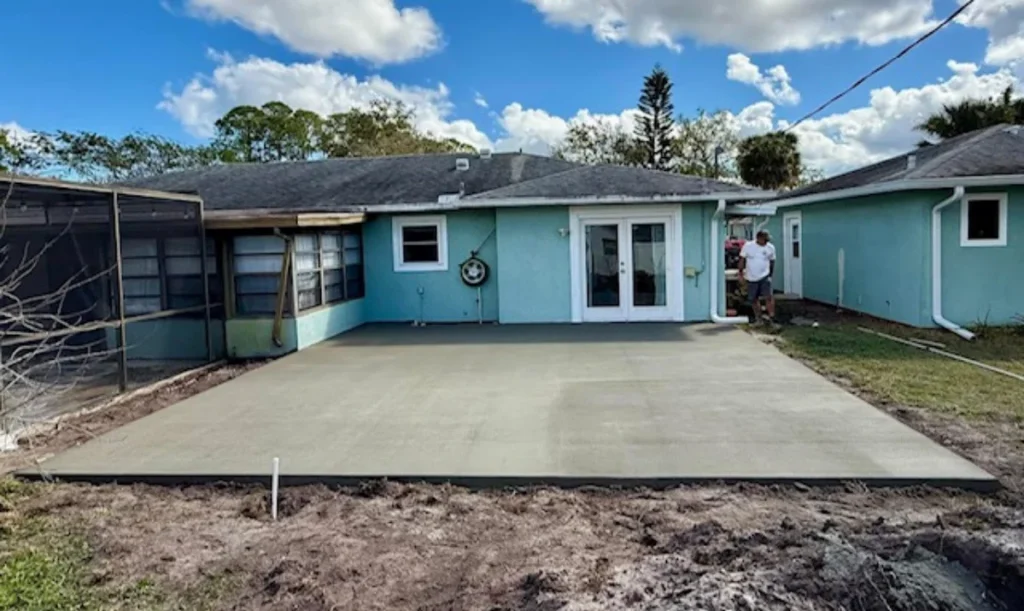
_compressed.webp?alt=media&token=3371f2c2-f218-4594-b73e-ea4f3875e82e "New backyard concrete patio poured behind a Florida home")
Concrete Patio Cost Factors at a Glance
| Cost Factor | Lower Cost | Higher Cost |
|---|---|---|
| Finish | Broom finish | Stamped, stained, or decorative finish |
| Backyard Access | Open access for equipment | Narrow side yard, fence, landscaping, or hand work |
| Excavation | Minimal grading needed | Extensive digging, tree roots, poor soil, or uneven grade |
| Drainage | No added drainage needed | French drain, grading correction, swales, or runoff control |
| Demolition | New patio area | Existing slab, pavers, deck, or old concrete removal |
| Slab Thickness | Standard 4-inch patio slab | Thicker sections for hot tubs, fireplaces, or heavy loads |
| Reinforcement | Standard reinforcement | Additional reinforcement requirements for heavy-load applications |
| Patio Size | Smaller footprint | Larger slab requiring more material and finish time |
One thing homeowners often overlook is that the concrete itself is only one part of the price. Access, drainage, excavation, and demolition can change the final estimate just as much as the patio size or finish. This is why an on-site estimate is so important for Florida patios.
Site Prep, Grading, and Drainage
_compressed.webp?alt=media&token=34e7641b-1b8c-408e-bd14-0f57a84a58ce "user-inserted")
Proper site preparation is the most critical phase of any concrete project. In towns like Palm Bay, West Melbourne, and Port St. John, backyards are often flat and prone to standing water during our wet summer months.
Before we pour a single drop of concrete, we must carefully assess the grading. The ground must be excavated, cleared of organic matter, and sloped away from the home’s foundation so water drains properly instead of collecting against the house.
Florida’s intense summer storms can expose drainage problems that weren’t obvious during dry weather, making proper grading one of the most important parts of a successful patio installation.
Because Brevard County has a high water table and highly permeable sandy soil, we must thoroughly compact the subbase. In some cases, we install a compacted crushed stone or gravel base to provide a stable foundation that resists erosion and washouts. If your yard has severe drainage issues, we may also recommend integrating drainage solutions, such as French drains or surface culverts, to safely direct water away from the slab. Proper drainage and base preparation are just as vital to the longevity of your project as using 5,000 PSI concrete.
We’ve installed patios where excavation took longer than the actual concrete pour because tree roots, old buried material, and poor drainage had to be corrected first. Those details are not always obvious during a quick square-foot price conversation, but they often determine whether the finished patio performs well for decades or starts showing problems after a few rainy seasons.
Slab Thickness, Reinforcement, and Control Joints
For most residential patios with foot traffic, seating, and outdoor dining furniture, a 4-inch concrete slab is commonly used. However, if you plan to place a heavy hot tub, a massive brick fireplace, or park an RV near the patio edge, we recommend thickening the slab to 5 or 6 inches in those specific load-bearing zones to handle the concentrated weight.
Proper reinforcement is an important part of building a durable, long-lasting concrete patio. We make sure every patio is built with the reinforcement appropriate for its intended use and loading requirements.
Properly placed control joints help manage natural concrete movement and reduce the likelihood of random cracking as the slab cures and experiences seasonal temperature changes.
Proper reinforcement, combined with quality site preparation, control joints, and our standard 5,000 PSI concrete, helps produce a stronger, longer-lasting patio.
Concrete Patio Cost Comparison: Concrete vs. Stamped Concrete, Pavers, Stone, and Decks
When homeowners compare patio materials, the biggest question is usually not which option looks best in a showroom. It is which material gives you the right balance of upfront cost, maintenance, durability, and long-term value in Florida’s climate.
Here is a practical cost comparison for common backyard patio options:
| Patio Material | Upfront Cost | Maintenance | Lifespan | Best For |
|---|---|---|---|---|
| Plain concrete | Lowest to moderate | Low; periodic cleaning and sealing as needed | Long-lasting when properly installed and maintained | Simple patios, dining areas, grill pads, and poolside extensions |
| Stamped concrete | Moderate to high | Moderate; decorative surfaces typically need regular sealing | Long-lasting with proper sealing and care | Homeowners who want a decorative stone or paver look without installing individual units |
| Pavers | Moderate to high | Moderate; may require weed control, joint sand, and occasional resetting | Long-lasting when the base is prepared correctly | Decorative patios with individual patterns and replaceable sections |
| Natural stone | Highest | Moderate to high depending on stone type and joint material | Very long-lasting with proper base preparation | Premium outdoor living spaces where appearance is the top priority |
| Composite deck | High | Low to moderate; periodic washing and inspection | Long-lasting, though framing and fasteners still matter | Raised spaces, covered areas, or homes where a deck layout works better than a slab |
| Wood deck | Moderate upfront, higher long-term maintenance | High; staining, sealing, board replacement, and pest protection may be needed | Shorter than concrete or composite in Florida’s humidity unless carefully maintained | Raised patios, coastal homes with elevation needs, or traditional deck designs |
For many Brevard County homeowners, plain concrete is the most budget-friendly starting point, especially for a 10×20 or 12×12 patio. Stamped concrete makes sense when you want a more finished outdoor living space without jumping to the cost of natural stone. Pavers and stone can look excellent, but the base preparation has to be done correctly because sandy soil and heavy rain can create settling, uneven edges, and trip hazards over time.
After more than 40 years installing residential concrete throughout Brevard County, one pattern we see often is that homeowners compare materials by the square-foot price alone. That can be misleading. A patio that costs less upfront but needs frequent sealing, resetting, staining, board replacement, or pest-related repairs may not be cheaper over the life of the space.
What Patio Upgrades Add the Most Value?
The concrete patio itself creates the foundation for outdoor living, but the features you build around it often determine how much value and daily use you get from the space. The best upgrade is not always the most expensive one. It is the one that matches how you actually plan to use the backyard.
| Upgrade | Why It Adds Value | Planning Note |
|---|---|---|
| Outdoor kitchen | Creates a true entertainment and cooking area | Plan slab size, utilities, and traffic flow early |
| Fire pit | Extends patio use into cooler evenings | Leave safe clearance from seating and structures |
| Covered patio | Adds shade and weather protection | May require footings, permits, and drainage planning |
| Pergola | Adds shade, structure, and visual appeal | Consider post locations before the slab is poured |
| Pool connection | Creates a cleaner, more usable poolside layout | Slope and slip resistance become especially important |
| Decorative finish | Improves appearance without switching to pavers or stone | Stamped or stained finishes need proper sealing |
From a contractor’s perspective, the highest-value patio upgrades are the ones planned before the concrete is poured. If you might add a pergola, covered patio, outdoor kitchen, or heavy fire feature later, it is smarter to discuss those plans during the initial estimate. That way, the slab thickness, reinforcement, drainage, and layout can be built around the future use instead of being modified after the fact.
One mistake we regularly see is homeowners pouring a basic patio first and then realizing later that they need thicker sections, better drainage, or different dimensions for the upgrades they actually want. A little planning upfront can prevent expensive changes later.
Frequently Asked Questions About Concrete Patio Costs
Do I need a permit for a 10×20 concrete patio in Brevard County?
In many Brevard County municipalities, a permit is required for a new concrete patio. Requirements vary depending on the city and the scope of work, so your contractor should verify the applicable permit requirements before construction begins.
Permitting fees vary by city, but obtaining the right permit is important. It helps ensure your project complies with local zoning laws and stormwater management regulations, protecting your home’s resale value and preventing costly fines.
How long does a concrete patio take to pour and cure?
A standard 10×20 patio installation typically takes 2 to 4 days from start to finish. This includes site excavation, setting up the wooden forms, laying down reinforcement, pouring the concrete, and applying the final finish.
Once poured, you can typically walk on the new concrete after 24 to 48 hours. However, you should avoid placing heavy patio furniture or grills on the surface for at least 7 days. Concrete undergoes a chemical curing process that takes 28 days to reach its full structural strength.
How do I maintain my concrete patio in Florida’s climate?
Maintaining a concrete patio in Florida is remarkably simple. To protect the surface from salt air, UV damage, and organic staining from fallen leaves or mold, we recommend applying a high-quality concrete sealer every 2 to 3 years.
For routine cleaning, a simple sweep and an occasional wash with a garden hose or a light pressure washer using a mild biodegradable detergent will keep your patio looking its best for years.
Conclusion
Choosing the right patio size is about more than square footage—it’s about building an outdoor space that fits your lifestyle, budget, and long-term plans. By understanding the key factors that influence costs—from site preparation and drainage to slab thickness and decorative finishes—you can make an informed decision that fits your budget and lifestyle.
At JCD Concrete Inc., we pride ourselves on delivering exceptional craftsmanship and long-term value. With our over 40 years of experience as a concrete contractor, we know exactly what it takes to pour concrete that stands up to the demanding coastal climate of Melbourne, FL. From our standard 5,000 PSI high-strength concrete to our meticulous site preparation, we ensure your investment is built to last.
Ready to start planning your backyard transformation? Contact us today to learn more about our custom concrete patio services and get a free, detailed quote tailored to your property.