Is a Concrete Overlay Right for Your Brevard County Home?

If you are searching for concrete overlay contractors, here is the decision that matters most: an overlay can be a smart, cost-effective option when the existing slab is still solid, but replacement is the better long-term investment when the concrete is moving, sinking, or failing underneath.
- Best for cosmetic wear, fading, light pitting, and surface staining
- Best for structurally sound slabs that are still level and fully supported
- Replacement is better for movement, settling, washouts, drainage problems, and major cracks
- Resurfacing usually costs less than replacement because it avoids demolition, haul-off, and a new concrete pour
- Ask for a written proposal, proof of licensing and insurance, local references, and an honest slab evaluation before signing anything
Your concrete driveway, patio, or pool deck takes a beating in Brevard County. The combination of intense UV exposure, high humidity, salt air along the coast, and heavy summer rains can leave older surfaces cracked, pitted, and faded well before their time. For many homeowners, a concrete overlay can restore the look and function of a worn surface without the cost and disruption of tearing everything out. But the most important part of the decision is knowing when not to resurface.
I’m John DomBek, owner of JCD Concrete Inc., and with more than 40 years of experience installing and repairing residential concrete throughout Brevard County, I’ve seen plenty of projects where an overlay made sense and plenty where replacement was the only honest recommendation. In this guide, I’ll explain how to tell the difference so you can make a confident decision for your home.
What Is a Concrete Overlay and How Does It Work?
A concrete overlay is a new surface layer applied over an existing concrete slab to improve appearance while extending the useful life of a structurally sound slab. It can be used on driveways, patios, walkways, and pool decks when the original concrete is still stable enough to support the new finish.
Many homeowners assume discoloration or surface wear means the slab has reached the end of its life, but that’s often not the case. One issue we frequently encounter when inspecting older properties in Florida is surface wear that looks worse than it really is. Fading, light pitting, worn texture, and cosmetic staining do not always mean the slab needs to be removed. In those cases, concrete flatwork repairs and resurfacing options may give the homeowner a clean, refreshed surface without starting from scratch.
The key is the condition of the slab underneath. An overlay depends on proper surface preparation and a solid base. If the concrete is still level, supported, and free from major structural movement, resurfacing may be appropriate. If the slab is shifting, hollow underneath, or cracked because the base is failing, an overlay will not fix the real problem.
For homeowners, the simplest way to think about it is this: overlays improve a sound slab, while replacement corrects a failing one.
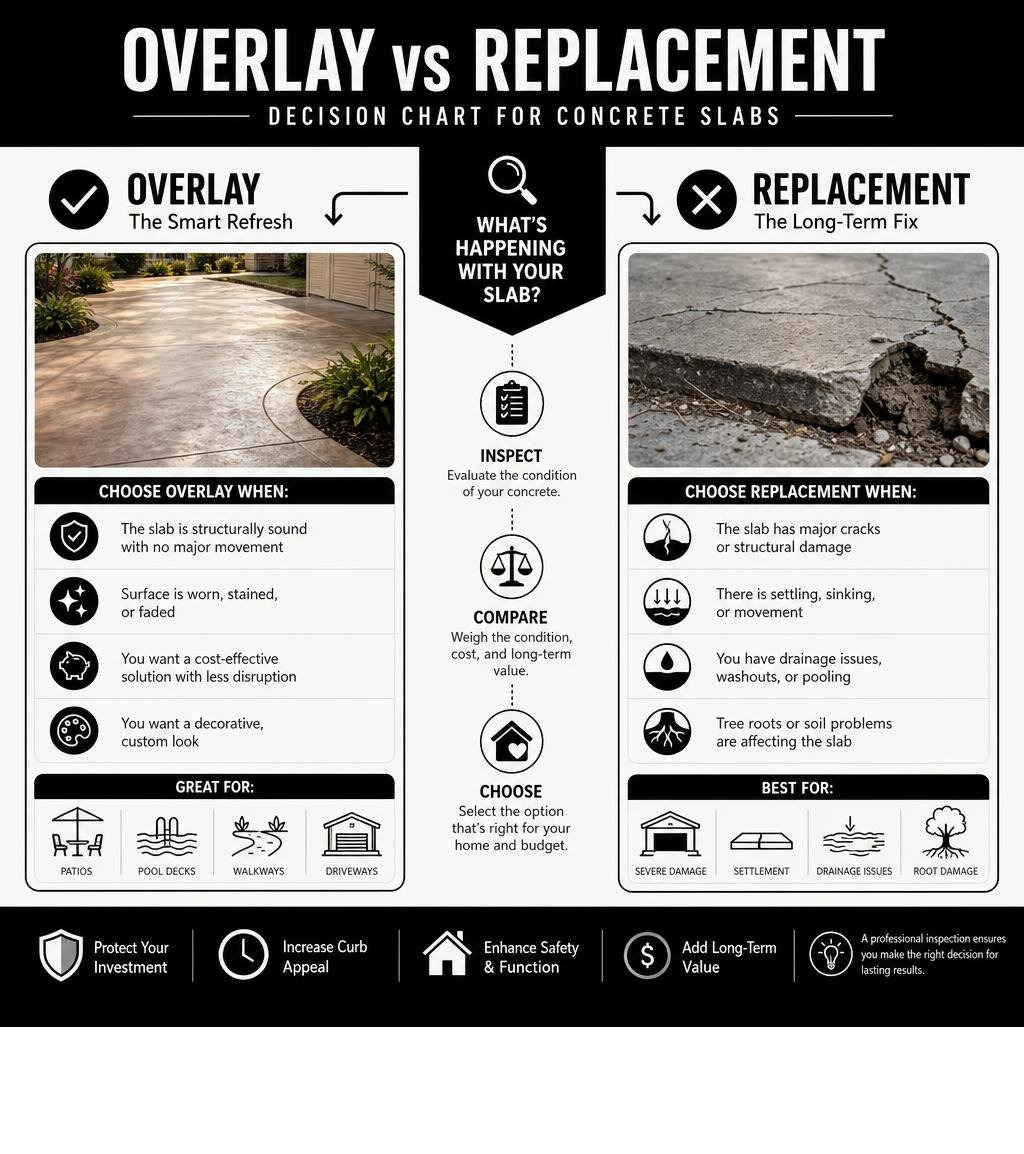
Choosing Between Concrete Resurfacing and Full Replacement
As a homeowner, one of the most important decisions you will make is whether to resurface your existing slab or tear it out and replace it entirely. With more than 40 years of experience in the local construction industry, we always advise starting with an honest assessment of the subgrade and structural integrity of your concrete.
One mistake we regularly see is contractors attempting to apply a decorative overlay over a slab that is fundamentally failing. If your concrete is sinking, shifting, or has deep cracks that run all the way through the slab, an overlay is only a temporary band-aid. The underlying movement will eventually show through the new surface.
In Brevard County, our sandy soil, high water tables, and heavy summer rains can create problems below the concrete long before the surface tells the full story. Stormwater can wash away the sand beneath a driveway or patio, causing the slab to settle or lose support. In these cases, resurfacing will not solve the problem. You need a complete tear-out and a professional replacement with proper subgrade compaction and drainage planning.
To help you compare your options, here is a breakdown of when to resurface and when to replace:
| Scenario / Condition | Concrete Resurfacing (Overlay) | Full Concrete Replacement |
|---|---|---|
| Surface Appearance | Best for cosmetic wear, discoloration, minor pitting, and light stains. | Better for severe surface breakdown or concrete that is too deteriorated to resurface. |
| Cracking | Works for hairline cracks and minor surface cracking. | Necessary for wide, deep, or active cracks that suggest movement. |
| Subgrade & Sinking | Not suitable. The slab must be level and fully supported. | Required if the slab is sinking, tilting, hollow, or affected by washouts. |
| Cost Value | Lower upfront cost because demolition and a new pour are avoided. | Higher upfront cost, but often the better long-term investment for failing concrete. |
| Project Timeline | Usually faster and less disruptive. | Longer process because it requires removal, base work, forming, pouring, and curing. |
Cost Comparison: Concrete Overlay vs Full Replacement
| Factor | Concrete Overlay | Full Replacement |
|---|---|---|
| Upfront Cost | Lower | Higher |
| Project Time | Faster | Longer |
| Cosmetic Damage | ✓ | ✓ |
| Structural Damage | ✗ | ✓ |
| Drainage Problems | ✗ | ✓ |
| Long-Term Fix | Sometimes | Yes, when the existing slab or base is failing |
This table is a helpful starting point, but the real answer depends on what is happening below the surface. If the concrete is only worn, stained, or faded, an overlay may be the better value. If the slab is settling, moving, or losing support underneath, replacement is usually the more dependable long-term fix.
If your slab is structurally sound but simply looks dated, choosing an overlay for your concrete driveway, patio, or walkway can improve curb appeal without the cost of full replacement. However, when replacement is the right call, we recommend doing it correctly the first time. While many local builders use standard 4000 PSI concrete as their baseline, we install 5000 PSI concrete on our residential projects to improve durability under heavy use and Florida weather. Proper drainage and base preparation are just as important as the concrete mix itself.
Why Concrete Overlays Fail
A concrete overlay usually fails for one of two reasons: the existing slab was not prepared correctly, or the slab was never a good resurfacing candidate in the first place. That is why we focus on inspection before talking about colors, textures, or decorative finishes.
In our experience, drainage issues and slab movement are far more common causes of overlay failure than the resurfacing material itself. If water is pooling, washing out the base, or the slab is shifting underneath, even a good resurfacing product will struggle because the problem is below the surface.
Common reasons concrete overlays fail include:
- Poor preparation: Dirt, old coatings, weak surface material, or improper cleaning can keep the overlay from bonding properly.
- Moisture problems: Trapped moisture, poor drainage, or water pushing through the slab can lead to peeling, bubbling, or surface breakdown.
- Slab movement: If the concrete is shifting, settling, rocking, or cracking from below, the new surface will usually crack with it.
- Drainage issues: Water pooling on the slab or running toward the house can shorten the life of any resurfacing system.
- Cheap materials: Low-quality resurfacing products may look fine at first but often do not hold up well under Florida sun, rain, vehicle traffic, and salt air.
- The wrong slab: Some concrete is simply too damaged, unstable, or poorly supported for an overlay to make sense.
This is where a contractor’s judgment matters. A resurfacing product can improve a solid slab, but it cannot fix a failing base. If we see major cracks, washouts, unstable soil, drainage problems, or tree-root damage, we are more likely to recommend replacement because it gives the homeowner a better long-term result.
How to Choose the Best Concrete Overlay Contractors Near Me
Because concrete overlays require good judgment as much as good materials, finding the right concrete overlay contractors near me is critical. A bad overlay job can quickly turn into a peeling or cracking surface that is frustrating and expensive to correct. When looking for concrete overlay contractors near me, you want someone who understands both resurfacing and replacement, not someone who recommends the same solution for every slab.
Start by verifying that any contractor you consider is fully licensed and insured to operate in your specific city or county. Whether you live in Palm Bay, Melbourne, West Melbourne, Cocoa Beach, Satellite Beach, or the surrounding areas, local building codes and permitting requirements must be followed. Working with an unlicensed contractor puts you at major financial and legal risk if something goes wrong on your property.
To help narrow down your search, we have put together comprehensive local hiring guides. You can read our advice on finding concrete contractors in Brevard County and discover practical ways to find concrete driveway contractors for step-by-step advice on vetting local businesses. At JCD Concrete Inc., we meet and exceed all of these standards by maintaining full licensing, comprehensive insurance, and a long history of local projects.
Questions to Ask Concrete Overlay Contractors Before Hiring
When you begin receiving estimates, don’t just look at the bottom-line price. Ask questions that reveal whether the contractor is evaluating the concrete honestly:
- Is my slab actually a good candidate for an overlay, or would replacement be better?
- If you recommend an overlay, why don’t you recommend replacement?
- What problems would make you recommend replacement instead of resurfacing?
- How will you prepare the existing concrete before resurfacing it?
- How do you handle existing cracks, low spots, or drainage concerns?
- Can I see local projects in Brevard County that have held up over time?
- What kind of warranty do you offer on workmanship and surface performance?
That second question is important because it forces the contractor to explain what they actually saw during the slab evaluation. If they cannot clearly explain why replacement is unnecessary, they may not have looked closely enough at the base, drainage, cracking, or movement.
Red Flags When Evaluating Concrete Overlay Contractors
As you compare bids, keep an eye out for these common warning signs that suggest a contractor might be cutting corners:
- Extremely low bids: Quality materials, preparation, and experienced labor cost money. A bid that is far lower than others may mean important prep work is being skipped.
- No slab inspection: If a contractor recommends an overlay without checking for movement, hollow areas, drainage problems, or major cracking, that is a concern.
- Ignoring washouts or settling: Building up low spots with overlay material will not fix a slab that is losing support underneath.
- No replacement conversation: A trustworthy contractor should be willing to say when resurfacing is not the best long-term answer.
- High-pressure sales tactics: If a contractor insists resurfacing is the only option without discussing replacement, get another opinion.
- Lack of local references: If they cannot provide references from past clients in Brevard County, they may not understand how our high humidity, salt air, sandy soil, and seasonal rain affect concrete projects. For more tips on avoiding these pitfalls, check out our guide on choosing a concrete driveway company in Brevard County.
When We Recommend Replacement Instead of an Overlay
The strongest recommendation a contractor can make is not always the cheapest one. After more than 40 years installing residential concrete throughout Brevard County, we have learned that overlays are a good solution only when the slab underneath is still dependable. If the base is failing, replacement is usually the better long-term investment.
At JCD Concrete Inc., we are more likely to recommend replacement when we see:
- Slab movement: Concrete that is shifting, rocking, or no longer sitting level should not be covered with a new surface.
- Settling or sunken areas: Low spots often point to poor base support or erosion underneath the slab.
- Washouts: Florida’s heavy rains can remove sand from beneath driveways, patios, and walkways, leaving concrete unsupported.
- Drainage problems: If water is running toward the house, pooling on the slab, or eroding the edges, resurfacing alone will not fix the issue.
- Major cracks: Wide or active cracks usually indicate movement that will return through a new overlay.
- Tree-root damage: Roots can lift, crack, and distort concrete in ways that require removal and correction.
- Unstable base: If the ground below the slab was never compacted properly, the surface problem will keep coming back.
One issue we frequently encounter is a driveway or patio that looks like a resurfacing candidate from above, but the edges reveal erosion, voids, or poor drainage underneath. In those cases, replacing the concrete allows us to correct the base, improve drainage, and build a stronger surface instead of hiding the problem temporarily.
How We Evaluate Whether an Overlay Makes Sense
A successful concrete overlay starts with the decision-making process, not the coating itself. Homeowners do not need an installation lesson, but they should understand what a responsible contractor is looking for before recommending resurfacing.
Here is the simplified process we follow:
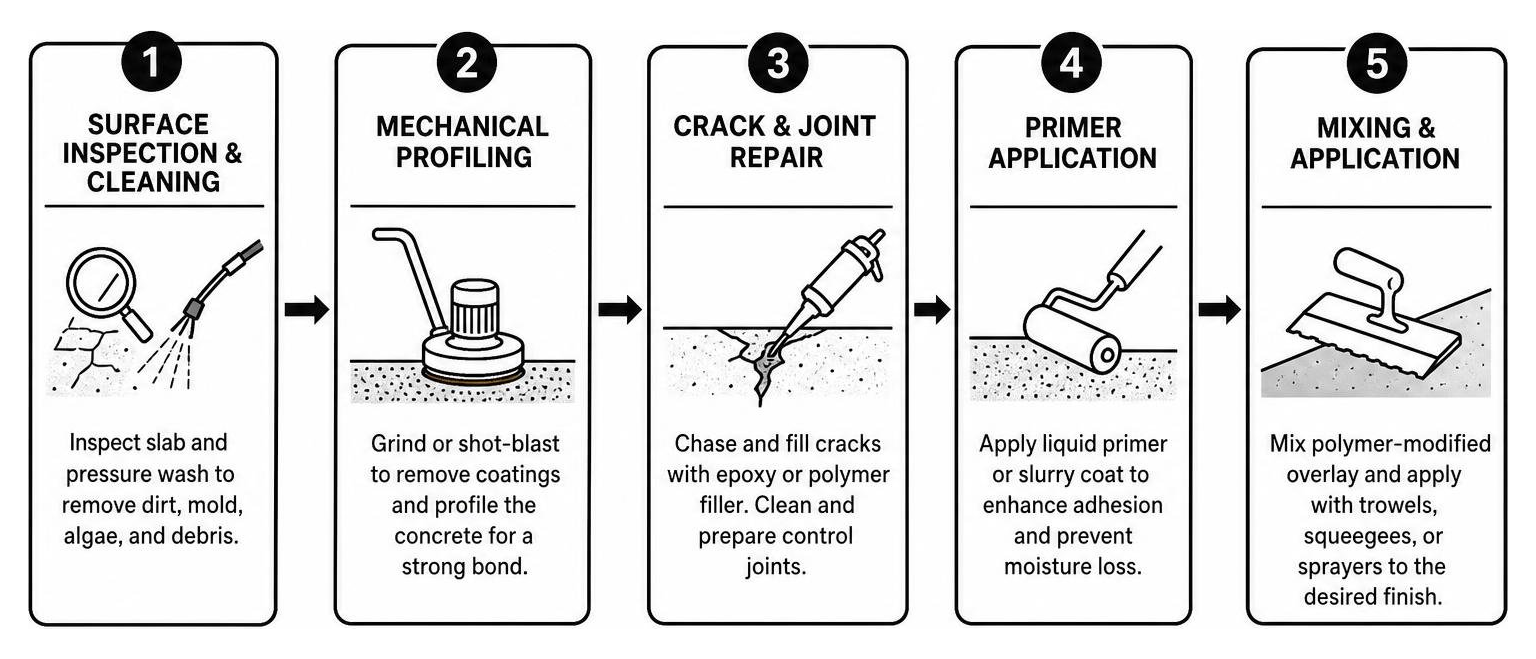
- Evaluation: We inspect the slab for movement, settling, drainage problems, major cracking, and signs of washout.
- Preparation: We clean and prepare the existing concrete so the new surface has a solid foundation.
- Repair: We address minor cracks, worn areas, and surface defects when the slab is still a good overlay candidate.
- Resurfacing: We apply the selected finish based on the area, appearance goals, and how the surface will be used.
- Sealing: We protect the finished surface to help it stand up to Florida sun, rain, foot traffic, vehicles, and salt air.
If you are restoring a high-traffic area, partnering with a concrete paving contractor in Brevard County helps ensure the project is evaluated properly from the start.
Frequently Asked Questions About Concrete Resurfacing
How do I know if my slab can be resurfaced?
The only reliable way to know is to have the slab inspected by a contractor who is willing to look beyond the surface. A slab may be a good resurfacing candidate if it is still level, fully supported, and structurally sound, with only cosmetic wear, light pitting, minor surface cracks, staining, or faded texture.
One of the most common conversations we have with homeowners is that they call asking about resurfacing, but after inspecting the slab we discover the real problem is underneath the concrete, not on top of it. If the slab is settling, moving, hollow underneath, cracked through the full depth, affected by tree roots, or losing support from washouts, resurfacing will not correct the underlying issue.
In those cases, replacement is usually the more honest recommendation. An overlay can refresh a sound slab, but it cannot stabilize a failing base, correct poor drainage, or stop active movement below the concrete.
Is concrete resurfacing worth it?
Concrete resurfacing can be worth it when the existing slab is still structurally sound and the main problems are cosmetic, such as fading, light pitting, surface stains, or worn texture. In that situation, an overlay may improve curb appeal and extend the useful life of the concrete without the cost and disruption of a full tear-out.
Resurfacing is not worth it when the slab is moving, settling, cracked through the full depth, hollow underneath, or affected by drainage problems. If the base is failing, an overlay only covers the symptom temporarily. Replacement usually costs more upfront, but it is the better long-term investment when the concrete or the ground underneath it needs to be corrected.
What is the typical cost of concrete resurfacing versus replacement?
Concrete resurfacing usually costs less than full replacement because it avoids demolition, disposal, base reconstruction, forming, and a brand-new concrete pour. That is why overlays can be appealing when the existing slab is still structurally sound.
However, pricing depends heavily on the size of the area, the condition of the existing concrete, the finish selected, access to the work area, drainage needs, and the amount of preparation required. Very few contractors can publish accurate overlay pricing without first seeing the slab in person.
Replacement costs more upfront, but it can be the smarter long-term choice if the slab is moving, settling, cracked from the base, or affected by drainage problems. In those cases, resurfacing may only delay the repair and add cost later.
For smaller projects like shed bases or equipment pads, you can read about our concrete pads and slabs services to compare project types.
Can you apply an overlay to a cracked driveway?
Yes, but only if the cracks are minor and the slab is not actively moving. Hairline cracks, light surface wear, and minor pitting can often be handled during preparation.
However, if your driveway has deep structural cracks, settling, drainage problems, tree-root damage, or washouts in the sandy soil underneath, you should talk with a professional about whether concrete driveway replacement is the better long-term option. A new concrete driveway with proper base preparation, drainage planning, and durable 5000 PSI concrete will usually perform better than covering a failing slab.
Conclusion
A decorative concrete overlay can be a cost-effective way to refresh tired, worn-out concrete when the existing slab is still structurally sound. It can improve the appearance of a driveway, patio, walkway, or pool deck without the disruption of a full tear-out.
The key is choosing a contractor who will tell you the truth. At JCD Concrete Inc., we recommend overlays when appropriate, and we recommend replacement when it is the better long-term investment. After more than 40 years of experience serving homeowners across Brevard County, we know that the right answer depends on the condition of the slab, the base underneath, drainage, cracking, and how the space will be used.
Ready to find out whether your concrete should be resurfaced or replaced? Contact us today to schedule your free on-site consultation.
Continue Your Research
- Learn more about our concrete repair services
- Compare options for concrete driveways
- Explore our concrete flatwork services
- See how spray decking works for pool decks and patios
- Read more about JCD Concrete Inc.