Selecting the Best Drainage Pipe Under Driveway Materials

The best drainage pipe under a driveway for most residential applications is usually dual-wall corrugated HDPE or SDR-35 PVC, depending on the site conditions, vehicle loads, soil, drainage path, and whether the pipe is acting as a yard drain or a roadside culvert. Here is a quick homeowner-focused comparison:
| Pipe Type | Best For | Should You Use It? |
|---|---|---|
| Dual-wall corrugated HDPE | Most residential driveway drainage runs | Yes, when properly selected and supported |
| SDR-35 PVC | Rigid drainage runs with sealed connections | Yes, especially where clean connections matter |
| Schedule 40 PVC | Heavier traffic or tighter cover conditions | Sometimes, when extra strength is needed |
| Single-wall corrugated | Light-duty yard drainage away from traffic | Usually not under driveways |
| Thin-wall white PVC | Non-traffic, light-duty drainage only | No, not under driveways |
| Culvert pipe | Driveway entrances, roadside swales, and larger drainage flows | Yes, when the driveway crosses a swale or county drainage path |
Here in Brevard County, getting this right matters more than most homeowners expect. Florida’s sandy soil, high water table, and heavy seasonal rainfall put real pressure on drainage systems. A pipe that works fine in a dry climate can shift, crush, or clog here if it is not sized and installed correctly. One issue we frequently encounter is drainage pipe that was installed too shallow or without adequate backfill support, which leads to pipe failure right where vehicle loads are highest.
In many cases, the failed pipe isn’t the real problem. Improper grading or poor drainage planning often allows water to wash away the base beneath the driveway long before the pipe itself begins to fail.
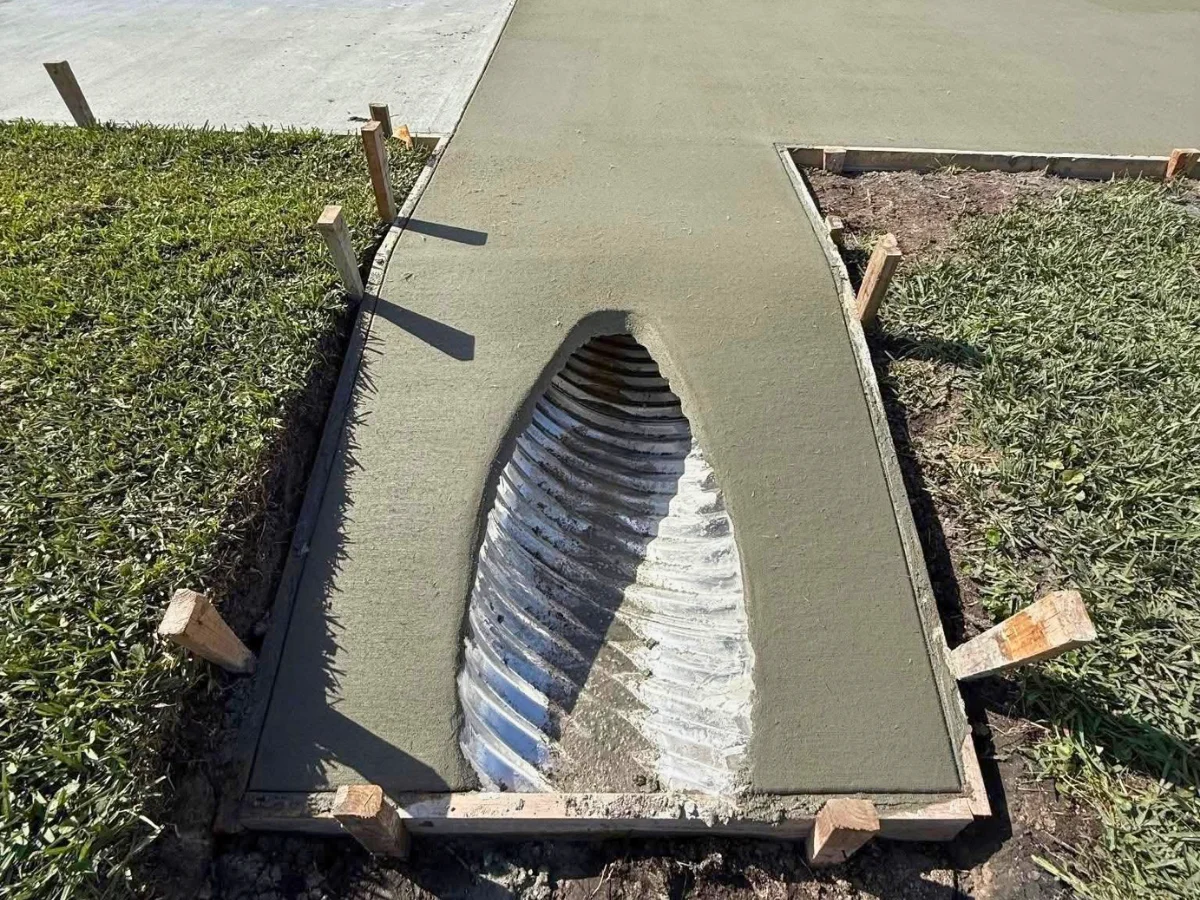
If your driveway crosses a roadside swale or larger drainage path, the right solution may be a culvert rather than a small yard drain pipe. Our concrete culverts service explains how properly built culverts help maintain stormwater flow through driveway entrances while protecting the driveway base.
I’m John DomBek, owner of JCD Concrete Inc., and over more than 40 years of experience installing residential concrete throughout Brevard County, I’ve seen what happens when the wrong drainage pipe under a driveway is chosen or poorly installed. This guide focuses on what homeowners actually need to know before concrete gets poured: what pipe to use, when a culvert is the better choice, why depth and support matter, how drainage problems should be evaluated, what mistakes to avoid, and when to bring in a qualified contractor.
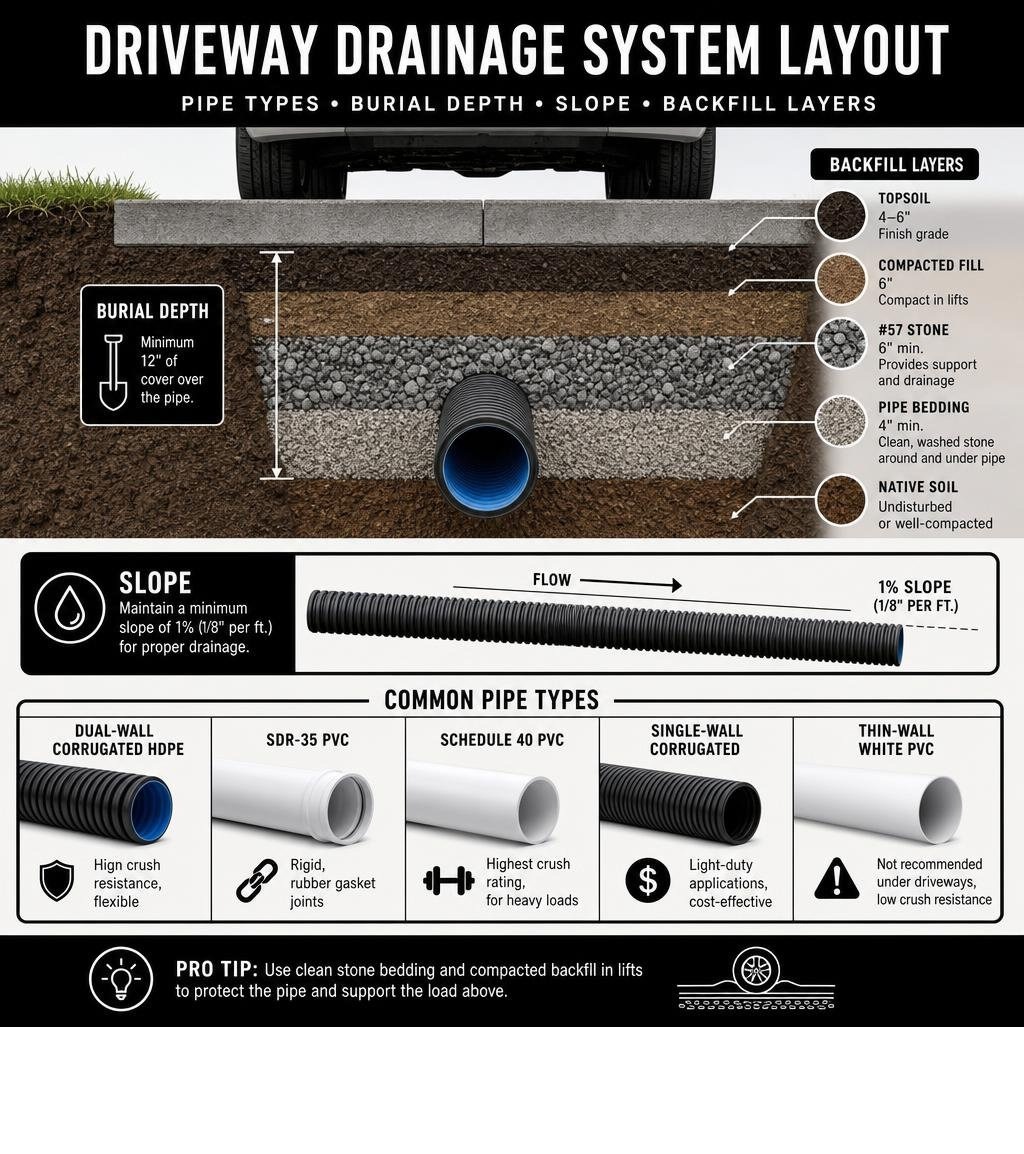
Choosing the right material for your drainage pipe under driveway installation is the foundation of a long-lasting driveway. Vehicle weight transfers through the concrete and base material to the soil around the pipe. If the pipe is too weak, poorly supported, or wrong for the application, the result can be sunken concrete, washouts, standing water, and expensive repairs.
For most homeowners, the decision comes down to three practical questions: Will vehicles drive over it? Will it carry yard drainage or roadside swale flow? And can it be installed with enough cover, slope, and support for the property? A qualified contractor should evaluate those conditions before recommending a pipe.
Corrugated HDPE vs. Smooth-Wall PVC
HDPE and PVC are both common choices, but they are not interchangeable. Single-wall corrugated pipe is flexible and inexpensive, which makes it useful for some yard drainage situations. Under a driveway, however, flexibility can become a weakness if the pipe is not designed for traffic areas or properly supported by the surrounding soil.
Dual-wall corrugated HDPE is a better driveway option because it combines a stronger exterior wall with a smoother interior. That makes it more suitable for residential drainage runs where strength, flow, and installation flexibility all matter.
In many residential projects, contractors choose either dual-wall HDPE or SDR-35 because they provide a good balance of durability, drainage performance, and long-term reliability. The best choice depends on the property’s drainage conditions rather than simply selecting the strongest pipe available.
Why Stronger Pipe Matters Under Driveways
We occasionally inspect driveways where inexpensive pipe was installed to save money, only to find it crushed, unsupported, or partially blocked a few years later. Replacing a failed pipe after the driveway has been poured is significantly more expensive than installing the right drainage system from the beginning.
Under a driveway, the pipe must work as part of the whole system: concrete, base, bedding, soil, drainage flow, and backfill. SDR-35, Schedule 40, or dual-wall corrugated HDPE are usually more appropriate than thin-wall or single-wall options because they are better suited to the pressure and drainage demands of a driveway environment.
For most residential driveways, SDR-35 or dual-wall corrugated HDPE provides the best balance of strength, durability, and cost-effectiveness when the site conditions support their use.
Load-Bearing Requirements and Proper Burial Depth
A common question homeowners ask is: How deep does a drainage pipe need to be buried?
The honest answer is that proper burial depth depends on pipe type, vehicle loads, soil conditions, drainage requirements, driveway design, and local regulations. A qualified contractor should determine the appropriate installation depth during a site evaluation rather than relying on a one-size-fits-all number.
What matters most is adequate compacted cover and proper support around the pipe. Without enough material above and around the pipe to distribute vehicle weight, the load can concentrate directly over the pipe and increase the risk of crushing, settling, or cracking in the driveway above.
For standard residential driveways, we look at the expected traffic, the pipe material, the surrounding soil, the water flow path, and the concrete driveway design before deciding how the pipe should be protected. If heavy trucks, RVs, trailers, or construction equipment may use the driveway, that evaluation becomes even more important.
Our installation process follows accepted drainage and building practices while adapting them to Brevard County’s sandy soils, high water table, and heavy rainfall.
What Proper Drainage Pipe Installation Looks Like
Even the strongest pipe can fail if it is not supported correctly. Flexible pipes like dual-wall HDPE depend on the surrounding soil and backfill for long-term performance. Rigid pipes like PVC still need a stable trench, proper bedding, and careful backfill to prevent movement and settling.
After more than 40 years of experience installing residential concrete and managing drainage in the sandy soils of Brevard County, we focus less on giving homeowners a DIY checklist and more on helping them understand what a professional installation should include.
_compressed.webp?alt=media&token=536d26bf-1f34-4557-8dff-57bf3011fd9f "drainage pipe under driveway with concrete culvert end and sandy soil around a finished driveway")
A proper drainage pipe under driveway installation should include:
- Site evaluation: The contractor should look at where the water is coming from, where it needs to go, how much flow is expected, and whether the pipe is part of a yard drain, driveway drain, or roadside culvert.
- Proper excavation: The trench should be planned around the pipe type, driveway design, soil conditions, and required drainage path rather than dug as a shallow shortcut.
- Stable bedding: The pipe needs a firm, supportive base so it does not rest on loose pockets, sharp debris, or uneven soil.
- Correct pipe selection: The pipe should match the load, drainage purpose, connection points, and local requirements.
- Proper slope: Water should move consistently through the pipe without low spots that collect sediment and debris.
- Secure backfill: The material around the pipe should support the sides and help distribute pressure from the driveway above.
- Compaction: Backfill should be compacted carefully so the driveway does not settle, crack, or wash out over time.
For a deeper look at how proper subgrade preparation and compaction protect your entire driveway installation, read our comprehensive guide on concrete driveway installation in Brevard County, FL.
Making Secure Connections and Maintaining Proper Slope
A drainage pipe is only as good as its connections and its slope. If connections leak, water can wash away the surrounding sandy soil and create underground voids that eventually cause the concrete above to crack and sink. If the pipe does not maintain consistent fall, water can pool inside the pipe and increase the chance of sediment buildup and clogs.
Adapters and Fittings for a Drainage Pipe Under Driveway
Connecting different types of pipes—such as transitioning from a flexible corrugated yard pipe to a rigid PVC pipe under the driveway—requires the right fittings.
A professional installation should not depend on forced connections, makeshift tape, or mismatched parts. Proper adapters, couplings, and gasketed connections help keep the system aligned, sealed, and serviceable. The goal is simple: move water away from the driveway without allowing leaks that undermine the surrounding base.
Maintaining Slope for a Drainage Pipe Under Driveway with Minimal Elevation
In coastal Florida towns like Cocoa Beach, Cape Canaveral, and Indialantic, elevation changes are incredibly minimal. Maintaining a consistent downward slope when the ground is almost completely flat is one of our biggest challenges.
To keep water moving, the pipe must be set at a consistent grade that works with the property. When elevation is extremely tight, we highly recommend using smooth-wall PVC or dual-wall HDPE. The smoother interior surface reduces friction, allowing water to flow efficiently even with very little slope. During installation, we use commercial laser levels to ensure a perfectly consistent grade across the entire run, preventing any dips or humps that could trap water.
Local Regulations, Permits, and Alternative Drainage Solutions
Before you dig up your driveway or install a new culvert, you must check local building codes and permitting requirements. In Brevard County, water runoff is heavily regulated to protect our local waterways and prevent neighborhood flooding.
For example, if you are installing or replacing a culvert pipe under a driveway in Palm Bay, you must comply with the Driveways & Lot Drainage Permitting – City of Palm Bay guidelines. These regulations specify the allowed pipe materials, minimum diameters, and end treatment requirements, such as mitered concrete ends to help control erosion.
When a Culvert Is Better Than a Drainage Pipe
Not every drainage problem under a driveway should be handled with a small yard drain pipe. If the driveway crosses a roadside swale, neighborhood drainage path, or county-controlled drainage area, a culvert is usually the more appropriate solution. Culverts are designed to move larger volumes of water through a driveway entrance while preserving the flow of the roadside drainage system.
This is especially important in Brevard County, where heavy rainfall can quickly overwhelm shallow drainage runs. A standard driveway drain may be enough for roof runoff, yard water, or a small low spot. But when water is moving through a swale in front of the property, the driveway opening has to allow that water to pass without backing up, washing out the base, or redirecting runoff toward neighboring properties.
A culvert may be the better choice when the project involves:
- Roadside swales: The driveway crosses an existing swale that carries stormwater along the street.
- County or city drainage: The pipe must preserve an established public drainage path or meet local permitting requirements.
- Driveway entrances: The drainage structure sits at the apron or entry point where vehicles turn in from the road.
- Heavy runoff: Water collects quickly during Florida storms and needs a larger, more durable passage.
- Larger water volumes: The pipe must move more than minor yard drainage or downspout runoff.
- Concrete end treatments: Mitered concrete ends or other end treatments may be needed to stabilize the culvert opening and reduce erosion.
One mistake we regularly see is homeowners replacing a failed pipe without addressing the drainage problem that caused it to fail in the first place. Washouts beneath driveways are one of the most common drainage problems we encounter throughout Brevard County. Installing a stronger pipe will not solve poor grading, inadequate drainage planning, or a swale that no longer moves water correctly.
That is where contractor experience matters. A good culvert installation is not just about putting a bigger pipe under the driveway. The contractor should evaluate how water approaches the driveway, how it exits, whether the swale has enough capacity, how the driveway base will be protected, and whether concrete end treatments are needed to keep the system stable over time.
If a traditional underground pipe is not feasible due to a high water table or shallow utility lines, there are several highly effective alternatives:
- Trench Drains: Also known as channel drains, these feature a narrow grate level with the driveway surface that intercepts sheet flow before it reaches your garage or home. They are ideal for sloped driveways and can be integrated beautifully into a new concrete pour.
- Gravel-Filled Trenches (French Drains): A gravel-filled trench lined with geotextile fabric can redirect water without a central pipe, though its capacity is lower than a piped system.
- Dual-Wall Culverts: For larger swales, installing a heavy-duty concrete or dual-wall plastic culvert is the standard way to maintain neighborhood street drainage.
If you need to replace an existing roadside culvert, we have put together a simple, homeowner-friendly guide on How to Replace Driveway Culvert in 5 Simple Steps to walk you through the process.
Frequently Asked Questions about Driveway Drainage
Can I use thin-wall PVC under a driveway?
No, we strongly advise against using thin-wall PVC under any area that will experience vehicle traffic. Thin-wall PVC is generally not designed for vehicle traffic and can fail when installed beneath a driveway. If the pipe collapses, you will have to cut through your driveway concrete to replace it. Always opt for SDR-35 or Schedule 40 PVC for traffic zones.
How deep does a driveway drain pipe need to be?
The proper burial depth depends on the pipe material, anticipated vehicle loads, soil conditions, driveway design, and local drainage requirements. A qualified contractor should determine the appropriate depth during a site evaluation to ensure the pipe is properly protected and supported.
What is the best alternative to a traditional pipe?
The best alternative depends on your specific water problem. For intercepting surface water running down a sloped driveway, a professionally installed trench drain system is highly effective. For managing subsurface water in areas with limited burial depth, a gravel-filled trench lined with filter fabric can help disperse water naturally into the surrounding sandy soil.
Conclusion
Installing a drainage pipe under driveway surfaces is not a project where you want to cut corners. Choosing the wrong material, burying it too shallow, or skipping proper compaction will frequently lead to a collapsed pipe, costly washouts, and damaged concrete.
At JCD Concrete Inc., we bring over 40 years of experience to every project we undertake in Brevard County. Whether you are in Palm Bay, Melbourne, Cocoa, Rockledge, or Merritt Island, we understand how to design drainage systems that handle Florida’s unique climate and sandy soils.
After more than 40 years installing residential concrete throughout Brevard County, we’ve learned that long-lasting driveways begin long before concrete is poured. Proper drainage planning, stable base preparation, and using 5000 PSI concrete all work together to produce a driveway built for Florida’s challenging conditions.
If you are planning a new driveway project or need to replace a failing culvert, let our experienced, owner-operated team handle the job correctly from the start. Visit our concrete culverts service page or contact us today to discuss your project.
Continue Your Research
Planning a driveway project involves many moving parts, from drainage and culvert selection to budgeting and choosing the right concrete design. We have created these detailed guides and service pages to help you make the best decisions for your property:
- Concrete Culverts: Learn how properly installed culverts help move stormwater through driveway entrances, roadside swales, and drainage paths while protecting the driveway base.
- Driveway Replacement Cost Guide: Learn about the key factors that influence the overall cost of replacing a concrete driveway, including site prep, thickness, and drainage integration.
- Concrete Driveway Replacement: Discover our step-by-step process for removing old, cracked driveways and replacing them with durable, beautiful new concrete designed to last for decades.