What Does a Concrete Patio Cost in 2026?

Concrete patio installation cost typically falls between $4 and $28 per square foot depending on finish type, slab thickness, site conditions, and your location. Here is a quick look at what most homeowners can expect:
| Finish Type | Typical Cost per Sq Ft | Common Total Range |
|---|---|---|
| Plain broom finish | $6 – $16 | $1,500 – $5,000 |
| Stained concrete | $8 – $15 | $2,500 – $6,500 |
| Exposed aggregate | $10 – $18 | $3,000 – $7,500 |
| Stamped decorative | $12 – $28 | $4,000 – $12,000+ |
Nationally, most homeowners spend between $1,900 and $5,400, with the average landing around $3,500 for a standard backyard patio. However, local conditions, soil type, drainage needs, and concrete strength can push that number higher or lower.
If you are planning a new patio in Brevard County, Florida, there are a few local factors that play a bigger role than most national guides will tell you, including sandy soil, high water tables, salt air exposure, site access, and stormwater management.
I’m John DomBek, owner of JCD Concrete Inc., and after more than 40 years installing residential concrete throughout Brevard County, I have seen how much concrete patio installation cost can vary based on what is actually under the ground before a single form is set. This guide breaks down the pricing factors that matter most so you can understand your estimate and budget with confidence.
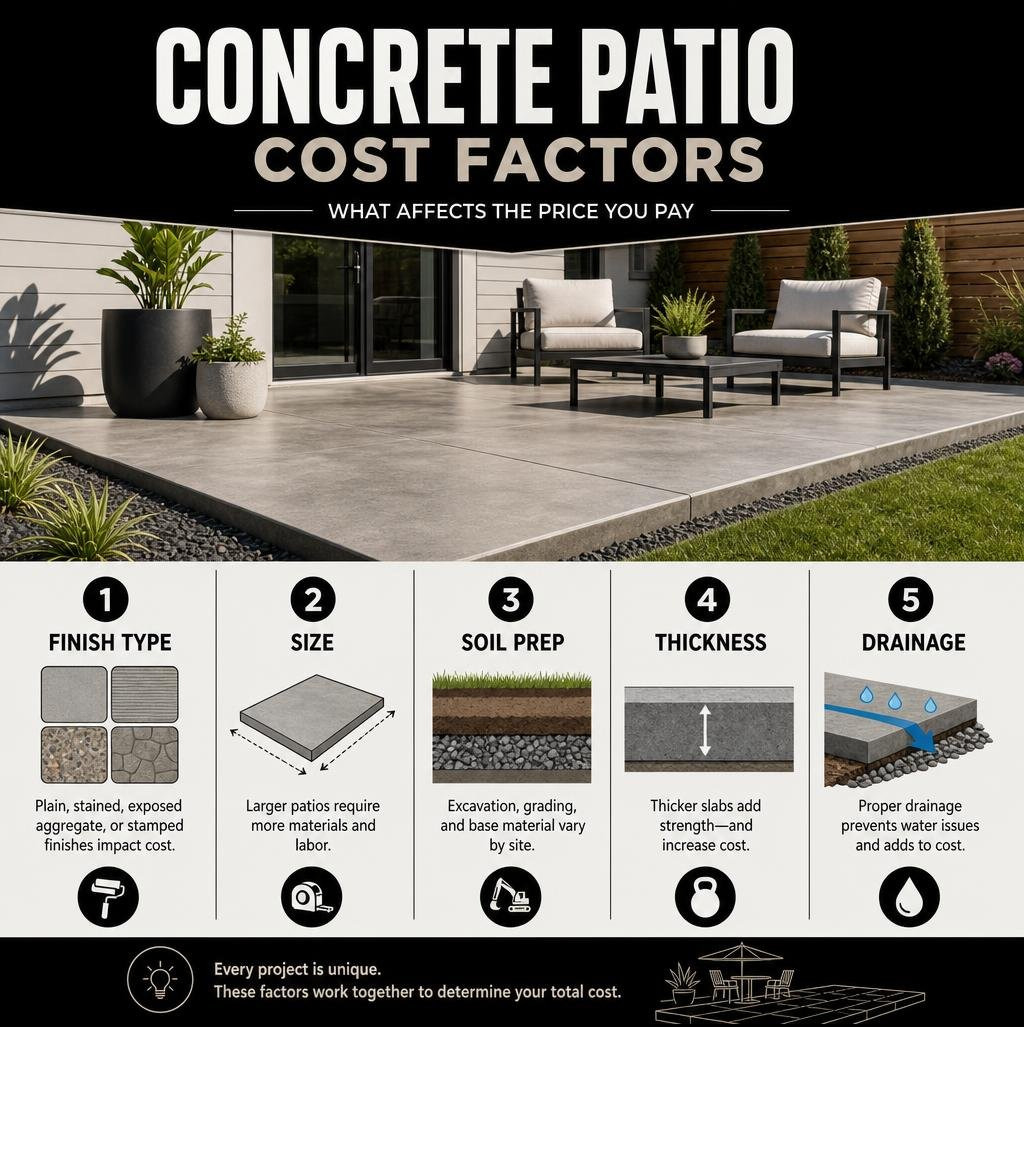
What Affects Concrete Patio Installation Cost?
When evaluating a concrete patio estimate, it is easy to get caught up in the raw price per square foot. However, the total cost of your project is shaped by several practical variables: patio size, slab thickness, concrete strength, site preparation, drainage, finish type, access to the pour area, and local labor rates.
In our coastal Florida climate, spanning from Titusville down to Palm Bay and across the barrier islands like Cocoa Beach and Indialantic, the environment often calls for stronger construction practices than a basic inland slab. At JCD Concrete, we install 5000 PSI concrete on every residential project because we believe the added strength and durability are worth the modest increase in material cost, especially in Brevard County’s coastal environment. For more detail on timing and early strength, see our guide to 5000 PSI concrete cure time.
That higher-strength mix is only one part of the final price. A patio that needs extra grading, pump-truck access, thicker concrete, or additional reinforcement will cost more than a simple, easily accessible broom-finish slab. The goal is not just to find the lowest number, but to understand what is included in the estimate.
Average Concrete Patio Installation Cost per Square Foot
On a per-square-foot basis, the unit cost of concrete installation covers everything from excavation and subgrade preparation to formwork, reinforcement, pouring, and finishing. A basic broom-finish slab represents the most cost-effective starting point, whereas premium decorative finishes require more labor, specialized materials, and additional detail work.
Material delivery logistics also affect the final price. If your backyard in Satellite Beach or Melbourne has tight side-yard access, a concrete mixing truck may not be able to drive close to the pour site. In these common scenarios, a concrete pump truck or specialized transport equipment may be needed to move the material safely without damaging existing landscaping, fencing, or septic drain fields.
Patio Size and Shape
It is a common misconception that concrete pricing scales in a perfectly linear fashion. Smaller patios often carry a higher cost per square foot because mobilization, crew setup, equipment, and concrete delivery still have to be covered. Whether we are pouring a 100-square-foot grill pad or a 600-square-foot entertainment area, there are fixed project costs that do not disappear just because the patio is small.
Shape also matters. Straight edges and simple rectangular formwork can be laid out quickly and result in minimal material waste. Custom curves, sweeping radiuses, steps, and irregular layouts require more skilled formwork and often more material waste, which can increase the overall estimate.
_compressed.webp?alt=media&token=8a1352f7-5ad6-48c5-956e-c4c40413e568 "Freshly poured concrete patio with steps beside a Florida home")
Drainage, Sandy Soil, and Site Prep Costs
Site preparation is one of the biggest reasons concrete patio estimates vary in Brevard County. A patio poured over poorly prepared soil may look fine on day one, but if the ground underneath shifts, washes out, or holds water, cracking and settlement often follow.
Throughout Brevard County, from the sandy ridges of Merritt Island to the low-lying areas of West Melbourne, sandy soils can shift over time if they are not properly prepared. Seasonal heavy rainfall, especially from June through October, can also wash out the soil beneath a poorly installed slab if water is allowed to pool next to or move under the patio.
That is why drainage and base preparation directly affect concrete patio installation cost. Depending on the property, the estimate may need to account for clearing organic material, removing unstable soil, bringing in suitable fill, grading the patio area, compacting the subgrade, and setting the proper slope to move stormwater away from the home.
For many patios, we grade the area to establish a precise slope, often around a quarter-inch per foot, to direct runoff safely away from the foundation. We then compact the subgrade and install steel rebar reinforcement to help the slab remain stable over time.
These prep steps can add cost upfront, but they are often what separate a patio that lasts for decades from one that begins cracking or settling after only a few seasons. To learn more about our site preparation and flatwork process, you can explore JCD Concrete’s full range of concrete services in Brevard County.
Finish Choices and Optional Upgrades That Affect Price
Choosing the right finish is one of the clearest ways homeowners can control concrete patio installation cost. A plain broom finish is usually the most budget-friendly option, while decorative finishes add cost because they require more labor, materials, and time.
_compressed.webp?alt=media&token=09cec949-46a5-4a78-b47a-af64924bbf30 "Stamped concrete patio with a gray rectangular paver pattern")
A classic broom finish provides an excellent slip-resistant surface for patios, walkways, and pool-adjacent areas. Exposed aggregate adds texture by revealing the stone within the concrete. Stained concrete adds color, while stamped concrete can mimic stone, slate, brick, or wood plank patterns at a lower cost than many individually placed materials.
If you want to see how these finishes look in real-world Florida backyards, take a look at our guide to concrete patios in Brevard County, FL. If you are specifically considering decorative pattern work, our concrete patio service page explains more about stamped concrete options for Brevard County homes.
Plain vs. Decorative Concrete Patio Installation Cost
The difference in cost between a plain broom-finish slab and a decorative stamped patio comes down to labor intensity and specialized materials. A standard pour involves placing the concrete, screeding it flat, and applying the finish as it cures.
A stamped concrete patio requires additional steps, including color work, release agents, pattern stamping, detailing, cleaning, and sealing. Those steps create a more customized look, but they also add labor hours and material cost.
| Feature | Plain Broom Finish | Decorative Stamped Concrete |
|---|---|---|
| Labor Intensity | Moderate | High |
| Specialized Materials | Standard high-strength mix | Color hardeners, release agents, sealers |
| Maintenance | Low | Moderate; resealing is typically needed over time |
| Aesthetic Appeal | Clean, simple, functional | Decorative; can mimic slate, stone, brick, or wood |
Optional Upgrades to Price Before the Pour
If you plan to add backyard features later, it is usually more cost-effective to account for them before the patio is poured. Retrofitting these additions later can require cutting, drilling, or removing part of the slab.
Common upgrades that can affect the estimate include:
- Fire pit footings: Added structural support for a heavy stone or brick fire pit.
- Seating walls: Extra layout planning and support for built-in masonry or concrete seating.
- Outdoor kitchen prep: Conduits, drain lines, water lines, or thickened slab areas for grill islands.
- Lighting conduit: PVC conduit under the slab for future low-voltage landscape lighting.
- Pergola anchors: Embedded anchor points for a future shade structure.
- Hot tub provisions: A thicker slab and additional reinforcement in the hot tub area.
The key pricing takeaway is simple: pattern, color, borders, structural features, and utility prep should be discussed during the estimate so the patio is built for its intended use from the start.
Why Concrete Patio Estimates Vary So Much
Two concrete patio estimates can look very different even when the square footage is similar. That does not always mean one contractor is overcharging or another is offering a bargain. It often means the estimates include different levels of preparation, materials, reinforcement, finish work, access planning, and long-term durability.
For example, a low bid may assume minimal grading, lighter-duty materials, limited reinforcement, or a basic finish. A more complete estimate may include stronger concrete, rebar reinforcement, proper compaction, drainage planning, pump-truck logistics, cleanup, and permitting support where required.
In Brevard County’s coastal environment, those details matter. Sandy soil, salt air, high water tables, and heavy seasonal rainfall can all affect the way a patio should be prepared and poured. A patio that costs less upfront but does not account for those conditions may cost more later if it cracks, settles, or drains poorly.
What Is Included in a Professional Estimate?
A professional concrete patio estimate should explain more than the final price. It should help you understand the work required to prepare the site, pour the slab correctly, finish the surface, and leave the area clean when the project is complete.
For most patio projects, a complete estimate should clearly address:
- Excavation: Removing grass, loose soil, roots, old concrete, or unsuitable material from the patio area.
- Compaction: Preparing and compacting the subgrade so the slab has a stable base.
- Rebar: Including steel reinforcement where appropriate to help improve long-term slab performance.
- Forms: Setting the forms that define the patio shape, elevation, edges, and slope.
- Concrete: Specifying the concrete mix, thickness, and placement approach for the intended use.
- Finishing: Applying the selected surface finish, such as broom finish, exposed aggregate, stained concrete, or stamped concrete.
- Cleanup: Removing debris, excess material, forms, and jobsite mess after the work is complete.
- Joints: Planning control joints to help manage where normal concrete shrinkage cracks may occur.
- Drainage: Establishing slope and runoff management so water moves away from the home and does not collect on or under the patio.
After more than 40 years installing concrete throughout Brevard County, we have seen that the best estimates are clear about these details upfront. That transparency helps homeowners compare proposals fairly and avoid surprises once the work begins.
When comparing estimates, ask what is included rather than only asking for the lowest per-square-foot number. Important questions include:
- What concrete strength will be used?
- Is steel reinforcement included?
- How will the subgrade be compacted?
- How will drainage and slope be handled?
- Is the finish plain, stained, exposed aggregate, or stamped?
- Are pump-truck costs or access challenges included?
- Are permits, cleanup, and sealing discussed clearly?
A clear estimate should help you understand not only what the patio will cost, but why it costs that amount.
Hiring a Professional vs. DIY Concrete Patio Installation
It can be tempting to search for a DIY concrete tutorial online and think, “I can save a lot of money doing this myself.” However, concrete patio installation is an unforgiving project, especially in Florida’s hot, humid climate.
Once the mixing truck arrives at your home in Cape Canaveral, Cocoa Beach, Melbourne, or Palm Bay, timing becomes very important. There is a limited window to place, screed, float, and finish the concrete before it begins setting. If the patio is not graded correctly, finished in time, or placed over a stable base, the repair can be far more expensive than hiring a professional from the start.
Professional installation also helps homeowners avoid hidden cost issues. Experienced concrete contractors understand access planning, drainage, municipal permit requirements, HOA concerns, reinforcement, concrete ordering, and finish timing. Those details may not be obvious in a DIY material-price calculation, but they affect whether the patio performs well over time.
When you partner with an experienced, owner-operated contractor, you get the peace of mind that comes with proper site preparation, heavy-duty compaction machinery, steel reinforcement, and premium 5000 PSI concrete mixes. To get a better understanding of what to budget for your specific project, review our detailed guide to concrete patio installation costs in Brevard County, FL.
_compressed.webp?alt=media&token=f624912c-99de-4700-8cbb-81b8538ea213 "Finished backyard concrete patio slab beside a screened Florida home")
Frequently Asked Questions About Concrete Patio Costs
How long does a concrete patio typically last?
When properly installed with a compacted base, steel reinforcement, and a high-strength 5000 PSI mix, a concrete patio can last 30 to 50 years or more. In Brevard County’s coastal environment, washing the patio periodically and applying a quality concrete sealer when appropriate can help reduce moisture and salt intrusion when properly maintained.
Do I need a permit to install a concrete patio in Brevard County?
In many municipalities across Brevard County, including Melbourne, Palm Bay, and the beachside cities, a building permit may be required for concrete flatwork. Local requirements can involve property line setbacks, stormwater runoff, and impervious surface limits. Working with a licensed contractor helps ensure your project is planned correctly and built according to local requirements.
Is poured concrete more cost-effective than alternative patio materials?
In many cases, yes. Compared with wood or composite decks, concrete usually requires less routine maintenance. Compared with individual pavers, poured concrete often costs less to install than individual pavers while requiring less ongoing maintenance. The best value depends on the finish, site conditions, drainage needs, and how the patio will be used. For a more detailed comparison, see our guide to concrete patios in Brevard County.
Why is one concrete patio estimate higher than another?
The difference often comes down to what is included. A higher estimate may include stronger concrete, better site preparation, reinforcement, drainage planning, pump access, decorative finish work, sealing, or permitting support. Always compare the scope of work, not just the square-foot price.
What is the most budget-friendly concrete patio finish?
A plain broom finish is typically the most cost-effective option. It provides a clean, durable, slip-resistant surface without the added labor and material costs of staining, exposed aggregate, or stamped decorative patterns.
When can I walk on, furnish, and seal a new concrete patio?
Most homeowners can usually walk on a new concrete patio after the first 24 to 48 hours, but heavier use should wait longer. Patio furniture is typically best added after several days, once the surface has had more time to harden, and sealing should be timed based on the finish, weather, and contractor recommendation. For a deeper breakdown, see our guide to concrete patio installation costs and curing considerations.
Conclusion
Concrete patio installation cost depends on more than square footage. Patio size, finish type, slab thickness, site access, drainage, soil preparation, reinforcement, and optional upgrades all influence the final estimate.
At JCD Concrete Inc., we bring over 40 years of Brevard County concrete experience to every backyard we transform. We understand Brevard County’s unique coastal challenges, from sandy soils and high water tables to drainage planning and salt air exposure. By combining our local drainage expertise with proper subgrade compaction, steel reinforcement, and our use of 5000 PSI concrete, we build patios that are built to last.
Ready to price your project accurately? Explore our dedicated concrete patio services page, or contact us today to schedule your on-site consultation and get a professional estimate for your home.