Why Your Concrete Driveway Is Sinking and What to Do About It
Sinking driveway repair is something many Brevard County homeowners face, often starting with a small crack or a low spot near the garage that gets worse every rainy season. Homeowners searching for concrete driveway sinking repair are often dealing with an underlying drainage or soil problem rather than a failure of the concrete itself.
Here is a quick overview of how to address it:
- Identify the cause – Look for pooling water, gaps at the garage slab, cracks wider than a credit card, or sections sitting lower than others.
- Look for signs of more serious settlement – Garage separation, sticking doors, wall cracks, or driveway sections dropping near the house should be evaluated before the problem gets worse.
- Choose the right repair method – Minor drops may be fixed with polyurethane foam injection; shattered or heavily settled slabs may need full replacement.
- Fix drainage first – Correcting downspouts, grading, and culvert issues before any repair prevents the problem from coming back.
- Call a professional when in doubt – Structural sinking is not a DIY fix; the underlying soil problem must be addressed, not just the surface.
In Florida, sinking driveways are rarely just a cosmetic issue. Sandy soil, high water tables, and the heavy seasonal rainfall we get here on the Space Coast create conditions where the ground beneath a concrete slab can shift, wash out, or settle in ways that put real stress on the concrete above. A driveway that looks tired and uneven today can become a tripping hazard, a drainage problem, and a sign of something more serious happening underground if it goes unaddressed.
I’m John DomBek, owner of JCD Concrete Inc., and after more than 40 years installing and replacing residential concrete throughout Brevard County, sinking driveway repair is one of the most common calls we get from homeowners in Melbourne, Palm Bay, Viera, and Merritt Island. In this guide, I’ll walk you through exactly why driveways sink here in Florida, how to choose the right fix, and how to make sure it holds up long-term.
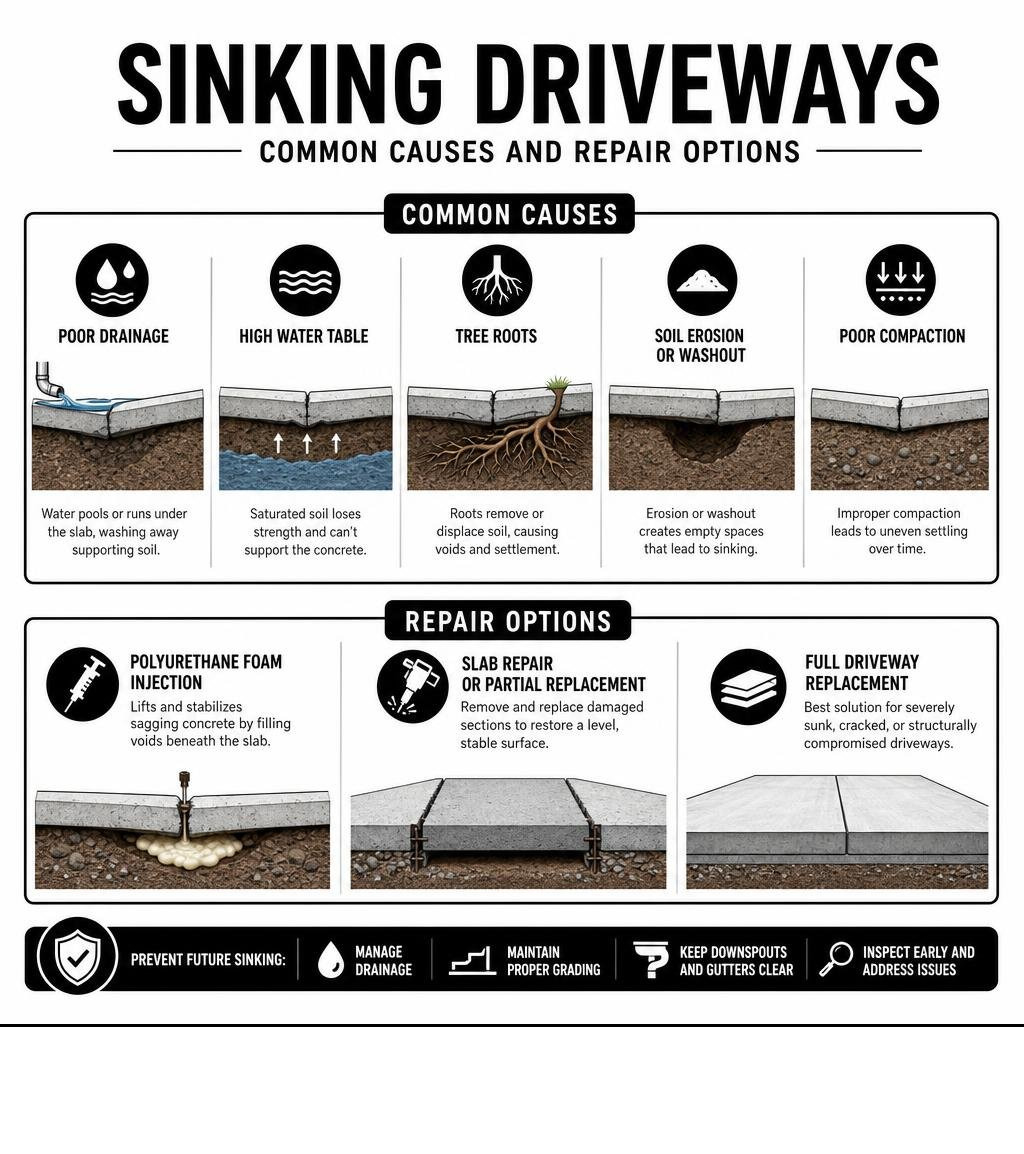
Soil, Drainage, and Foundation Risks: Why Concrete Driveways Sink
To understand how to fix a sinking driveway, you first have to understand why it started sinking in the first place. When the soil beneath a concrete slab moves, settles, or washes away, support beneath the slab disappears and sections of the driveway begin settling into the voids below.
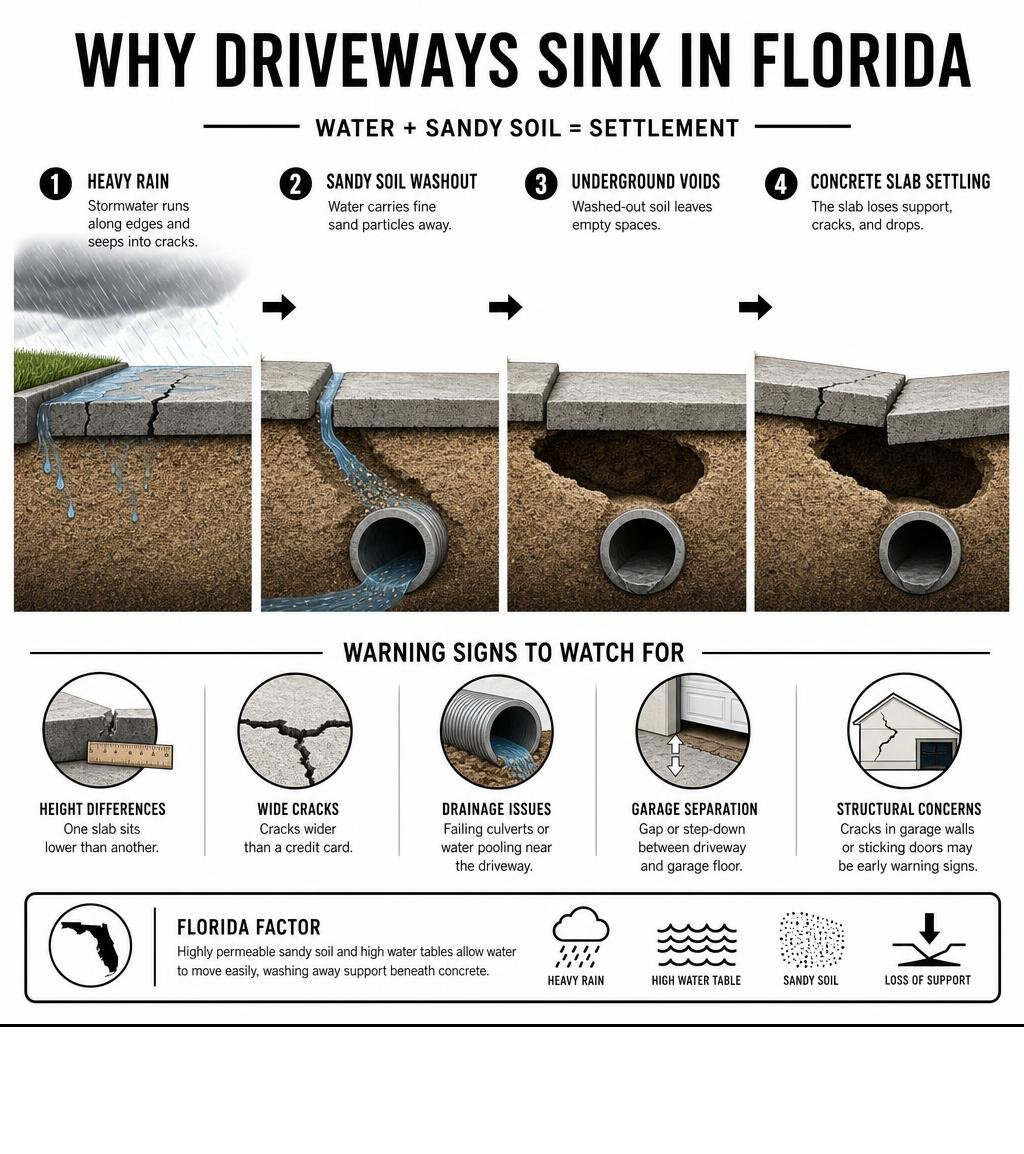
In our experience working across coastal Florida, the primary culprit behind concrete settlement is water. When stormwater is not managed properly, it seeps into minor cracks, flows along the edges of your driveway, and gradually washes away the supporting soil.
One issue we frequently encounter is a failing driveway culvert. Culverts are the drainage pipes installed beneath your driveway where it meets the street, designed to keep neighborhood stormwater flowing freely. If the joints in a metal or concrete culvert pipe begin to separate or rust out, water will leak through those gaps. Over time, every heavy downpour sucks sandy soil into the pipe and flushes it away, creating underground voids. Before you know it, the driveway apron above the pipe cracks and drops several inches. If you are dealing with this specific issue, you can learn more about our step-by-step process in our guide on how to replace a driveway culvert.
Why Florida’s Sandy Soil Causes Driveway Settlement
Here in Brevard County, from the barrier islands of Cocoa Beach and Satellite Beach to the mainland in Palm Bay, driveways are often built over highly permeable sandy soil. Sand drains quickly, but it also moves easily when water is not controlled. During heavy seasonal rainfall, stormwater can run along driveway edges, seep beneath slabs, and carry fine soil particles away from the base.
High water tables make the problem worse in low-lying coastal areas. When the water table rises, it saturates the subgrade beneath the driveway. As conditions dry out and the water level recedes, fine sand can shift or wash away, leaving weak spots and underground voids. If the driveway was poured over poorly compacted sand or without a properly prepared base, those voids can eventually cause sections of concrete to settle, tilt, or crack.
Drainage is usually the deciding factor. Many homeowners assume the concrete itself has failed, when in reality the problem is often the soil beneath it. Downspouts that empty near the slab, low spots that hold standing water, clogged culverts, and soil that slopes toward the driveway all increase the risk of washouts. The University of Florida IFAS Extension notes that compacted urban soils can increase stormwater runoff and erosion, which is why managing water around sandy fill is so important for Florida homes. When you add heavy vehicle loads like boats, RVs, or large trucks on top of a weakened sandy base, the concrete has very little support left and may begin to drop.
Cosmetic Cracks vs. Deeper Foundation Problems
As a homeowner, it is crucial to distinguish between a minor cosmetic issue and a structural warning sign.
- Cosmetic Cracks: Hairline cracks (typically under a quarter-inch wide) are common as concrete cures and ages. If the slabs on either side of the crack remain perfectly level with each other, the issue is likely cosmetic and can be sealed to prevent water intrusion.
- Structural Settlement: If you notice height differences between slab sections, cracks wider than a credit card, or one corner of a slab sitting lower than the rest, you are dealing with structural settlement.
One major red flag we look for is garage slab separation. If your driveway is pulling away from your garage floor, leaving a visible gap or a steep “step-down” transition, water will pool in that depression. This pooling water may contribute to drainage problems and should be evaluated before it affects nearby structures. Because the soil beneath your driveway connects directly to the soil supporting your garage and home, a sinking driveway section right next to your house can be an early warning sign worth taking seriously. If you notice diagonal cracks in your garage walls or doors that suddenly stick, it is time to look at the bigger picture. You can explore our dedicated page on concrete driveways to see how we design slabs that protect these critical transition points.
Choosing the Right Sinking Driveway Repair Method
Once you have identified that your driveway is sinking, you need to evaluate your repair options. The three most common methods are traditional mudjacking, modern polyurethane foam injection, and full concrete replacement. The best concrete driveway sinking repair depends on whether the slab can be leveled or whether the damage is extensive enough to require replacement.
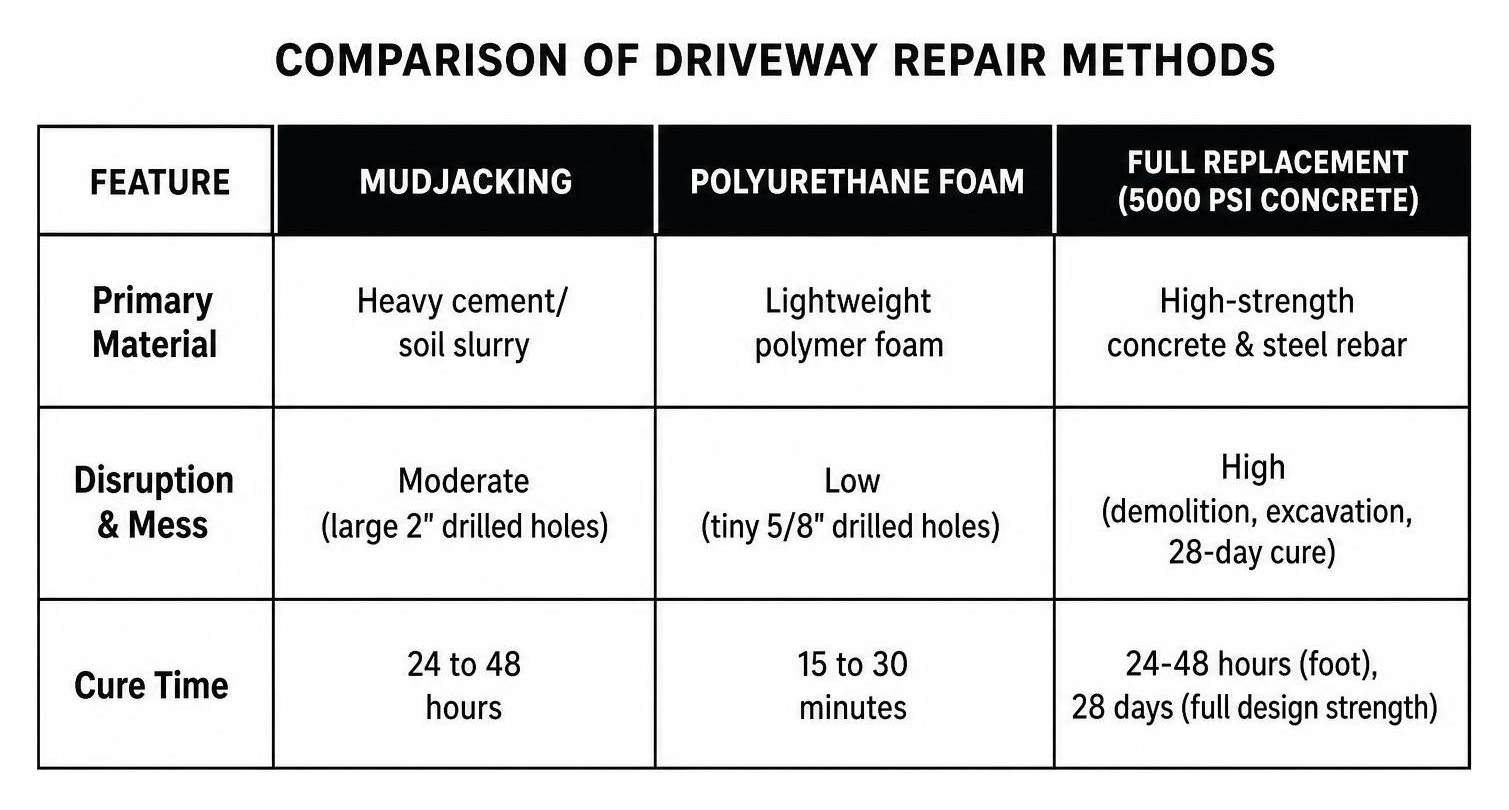
| Feature | Mudjacking | Polyurethane Foam | Full Replacement (JCD 5000 PSI) |
|---|---|---|---|
| Primary Material | Heavy cement/soil slurry | Lightweight polymer foam | High-strength concrete & steel rebar |
| Disruption & Mess | Moderate (large 2″ drilled holes) | Low (tiny 5/8″ drilled holes) | High (demolition, excavation, 28-day cure) |
| Cure Time | 24 to 48 hours | 15 to 30 minutes | 24-48 hours (foot), 28 days (full design strength) |
| Durability in Sand | Poor (heavy slurry can sink further) | Moderate (resists water absorption and adds little weight) | Excellent when the base and drainage are corrected |
| Long-Term Value | Low (often a temporary patch) | Moderate to High (stabilizes light slabs) | Offers the greatest long-term value when the underlying soil issues are corrected |
The right choice depends on the condition of the slab, the depth of the voids, the drainage problem causing the settlement, and whether the existing concrete is still strong enough to save. JCD Concrete Inc. already covers related issues in our internal guides on culvert replacement, concrete leveling, driveway drainage, and driveway replacement, so homeowners can stay focused on local Brevard County solutions instead of generic national advice.
Professional Sinking Driveway Repair: Polyurethane Foam vs. Mudjacking
If your concrete slab is still in one piece but has simply tilted or dropped, professional concrete leveling is often considered. A professional inspection helps determine whether leveling will actually solve the problem or simply delay replacement.
Historically, mudjacking was the go-to method. This process involves drilling larger holes into the concrete and pumping a heavy slurry beneath the slab to raise the low area. It can work in some situations, but it may not be the best long-term solution for every Florida driveway. If the soil underneath is already weak, wet, or washing out, adding more heavy material below the slab can create another temporary fix instead of solving the real problem.
Polyurethane foam injection (often called polyjacking) is the modern alternative. Technicians drill small holes and inject a lightweight foam beneath the settled slab. The foam expands to fill voids, helps support the concrete, and can lift the slab back toward its proper position with less mess and downtime than many older methods. Closed-cell polyurethane foam resists water absorption, and because it adds very little weight, it is often a better option for settled slabs over sandy Florida soil. If you are looking for local specialists who perform this type of leveling, you can search for concrete leveling contractors near you.
The American Concrete Institute describes slabjacking as a method for raising settled concrete or filling voids under a slab, while also noting that it does not correct underlying poor soil conditions. That is why a professional inspection needs to look beyond the low spot itself and determine whether drainage, erosion, or base preparation must be corrected before the repair can last.
When to Choose Full Replacement Over Sinking Driveway Repair
While foam leveling is a useful tool, it is not a complete solution. One mistake we regularly see homeowners make is spending money trying to lift a driveway slab that is already shattered into multiple pieces.
If a concrete slab is broken into sections smaller than three square feet, or if the concrete is spalling, crumbling, and structurally compromised, foam injection will not work. The foam will simply escape through the cracks without lifting the slab evenly.
In these cases, full replacement is the only viable, long-lasting solution. Tearing out the old, damaged concrete allows us to address the root cause of the failure: the subgrade. We can excavate the washed-out sand, install a properly prepared and compacted base, lay down heavy-duty steel rebar reinforcement, and pour a brand-new slab designed to handle heavy vehicle traffic for decades. To plan your budget for this project, take a look at our driveway replacement cost guide and read our comprehensive overview of concrete driveway replacement.
What Professional Sinking Driveway Repair Typically Includes
A sinking driveway should be evaluated as a soil, drainage, and structural support problem—not just a surface defect. A professional repair process looks at why the concrete dropped, whether the existing slab can be saved, and what needs to change so the problem does not return after the repair.
Inspection and Cause Identification
The first step is a detailed inspection of the affected area. A contractor will look for uneven slab sections, widening cracks, garage slab separation, standing water, washed-out edges, soft spots near the driveway apron, and signs that a culvert or drainage path is failing. The goal is to identify whether the driveway is sinking because of poor compaction, sandy soil washouts, high water table movement, heavy vehicle loads, drainage issues, or a combination of factors.
Repair vs. Replacement Decision
Once the cause is clear, the next step is deciding whether the slab is worth saving. If the concrete is mostly intact and the settlement is limited, professional leveling may be appropriate. If the slab is broken into many small pieces, severely cracked, spalling, or no longer structurally sound, replacement is usually the better long-term option. This decision matters because lifting a badly damaged slab often turns into a temporary patch instead of a reliable repair.
Drainage Corrections
Before any leveling or replacement work is completed, the drainage problem needs to be addressed. That may include redirecting downspouts, improving grading along the driveway edges, correcting low spots that hold water, repairing a failing culvert, or making sure stormwater flows away from the slab instead of underneath it. Without drainage corrections, the same sandy soil washouts can continue beneath the repaired concrete.
Professional Leveling When the Slab Can Be Saved
For slabs that are still structurally sound, polyurethane foam injection may be used to fill underground voids and lift the settled concrete back toward its original position. This method is often less disruptive than replacement and can be a good fit when the driveway has dropped but has not shattered. The key is making sure the underlying washout and water movement are also controlled so the leveled slab stays supported.
Full Replacement When the Damage Is Too Severe
When the driveway is too damaged to lift, full replacement allows the contractor to remove the failed concrete, rebuild the base, correct drainage concerns, compact the subgrade properly, add reinforcement, and pour a new driveway designed for local soil and weather conditions. For Brevard County homeowners dealing with widespread cracking, major settlement, or recurring washouts, replacement is often the most dependable way to restore both safety and curb appeal.
Why Driveways Sink Again After Repairs
Once your driveway has been leveled or replaced, your job is not quite finished. If the water and soil problems that caused the concrete to drop are not corrected, the driveway can sink again.
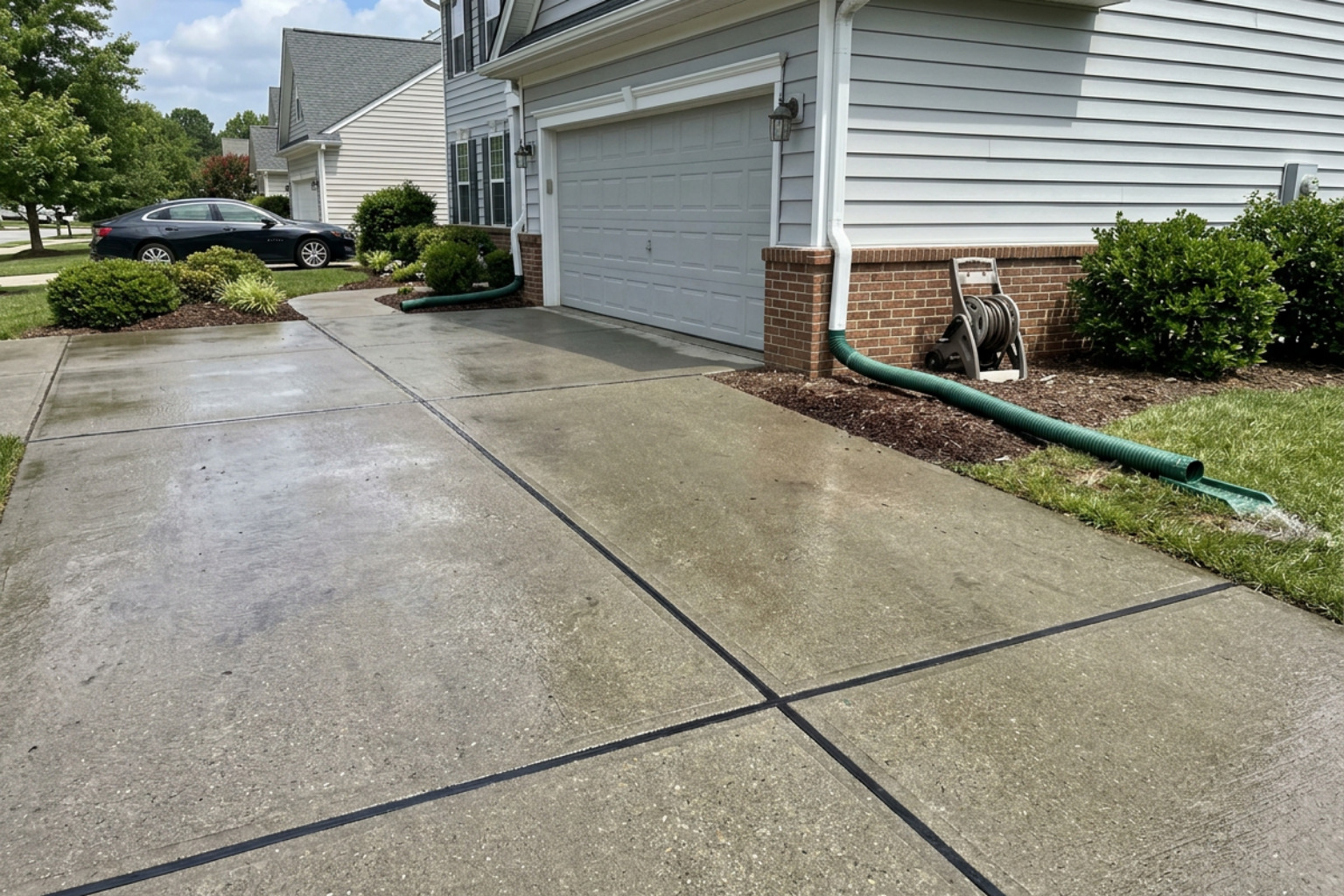
One mistake we regularly see is homeowners paying to level a driveway without addressing the drainage problem underneath it. In many cases, the driveway sinks again because the soil continues washing away after every heavy rain. The slab may look better for a while, but the same weak spots are still forming below the surface.
The most common reasons driveway repairs fail include:
- Drainage not corrected: Downspouts, poor grading, and low spots can keep sending stormwater toward the driveway edge or underneath the slab.
- Ongoing sandy soil washouts: In Brevard County, loose sandy soil can keep moving when water is allowed to flow under the concrete.
- Failing culverts: A separated, rusted, or clogged driveway culvert can pull soil away from the apron and create new voids beneath the concrete.
- Poor compaction: If the base was never compacted properly, the slab may continue settling even after a surface-level repair.
- Incomplete repairs: Lifting the concrete without filling voids, correcting drainage, or rebuilding the base only addresses the visible symptom.
After more than 40 years of installing residential concrete in Brevard County, we have learned that the key to a long-lasting driveway is keeping water away from the edges of the concrete and making sure the base is properly supported. Here are the most effective preventative steps you can take:
- Redirect Downspouts: Never allow a roof gutter downspout to discharge water directly onto the edge of your driveway. The concentrated blast of water will quickly carve out a channel beneath the slab. Use solid PVC downspout extensions to carry stormwater at least five feet away from the concrete.
- Maintain Proper Grading: Ensure the soil alongside your driveway slopes gently away from the concrete. If the soil is flat or sloped toward the slab, water will pool along the edges and seep underneath.
- Seal Cracks and Joints Regularly: Check your driveway every spring. Use a high-quality, flexible polyurethane concrete sealant to fill any new cracks or joint separations. This prevents rainwater from entering the subgrade from above.
- Limit Heavy Loads: Avoid parking exceptionally heavy equipment, such as commercial delivery trucks or large construction dumpsters, on the edges of your residential driveway.
By taking these steps, you protect your investment and help the repair last. For more professional tips on maintaining your driveway, read our article on concrete driveway installation and replacement tips.
Frequently Asked Questions about Sinking Driveways
How much does it cost to fix a sinking driveway?
The cost of sinking driveway repair depends on the cause of the settlement, the amount of slab movement, and whether leveling or full replacement is required. Professional polyurethane foam leveling typically ranges from $600 to $2,500 depending on the volume of voids that need to be filled.
If the concrete is severely damaged and requires a full replacement, a complete tear-out and repour of a standard two-car driveway represents a larger investment. However, a new, professionally installed driveway offers the highest long-term value, as it corrects the underlying soil issues and provides a durable surface that can last 30 to 40 years.
Is sunken driveway repair possible without replacing the entire driveway?
Many homeowners ask whether sunken driveway repair is possible without replacing the entire driveway. The answer depends on how much settlement has occurred and whether the slab remains structurally sound. If the concrete is mostly intact, professional leveling may be an option. If the slab is broken, crumbling, or sitting over ongoing washouts, replacement is usually the more reliable fix.
Can I drive on my driveway immediately after polyurethane leveling?
One advantage of polyurethane foam leveling is its fast cure time. Unlike traditional mudjacking slurry, which requires 24 to 48 hours to dry, polyurethane foam expands and reaches its full structural strength in just 15 to 30 minutes. In most cases, you can park your car back on the leveled driveway the exact same day the work is completed.
How does Florida’s high water table affect driveway sinking?
Brevard County’s high water table means the soil just a few feet below your yard is frequently saturated with water. During heavy summer rainstorms, the water table rises, soaking the sandy subgrade beneath your driveway. As the water table recedes during dry periods, it can pull fine sand particles down with it, creating empty pockets (voids) beneath your concrete.
This cycle of saturation and drying is why proper soil compaction and professional drainage planning are so critical for Florida driveways.
Conclusion
A sinking driveway is more than just an eyesore—it is a structural warning sign that the ground beneath your home is shifting. Whether your driveway is sinking due to a failing culvert pipe, sandy soil washouts, or years of heavy vehicle traffic, addressing the issue early can save you thousands of dollars in secondary repairs.
At JCD Concrete Inc., we believe in doing things right the first time. We focus on correcting the underlying cause of the failure rather than simply repairing the visible damage. When we handle a driveway replacement, we don’t just pour new concrete over old problems. We excavate the site, thoroughly compact the sandy subgrade, install proper drainage solutions, lay down steel reinforcement where appropriate, and exclusively pour 5000 PSI concrete—a high-strength mix designed to withstand the harsh Florida heat, heavy loads, and coastal salt air.
If you are tired of looking at cracked, uneven concrete and want a permanent solution backed by over 40 years of local, owner-operated experience, we are here to help. We proudly serve homeowners throughout Brevard County, including Melbourne, Palm Bay, Cocoa Beach, Viera, and Merritt Island. Whether you need sunken driveway repair, concrete leveling, or a complete driveway replacement, identifying the cause of the settlement is the first step toward a lasting solution.
Ready to restore your home’s curb appeal and eliminate safety hazards? Visit our JCD Concrete services page to learn more about what we do, or contact us today to schedule your free, no-hassle estimate.