How 4000 PSI vs 5000 PSI Concrete Compare: Quick Answer
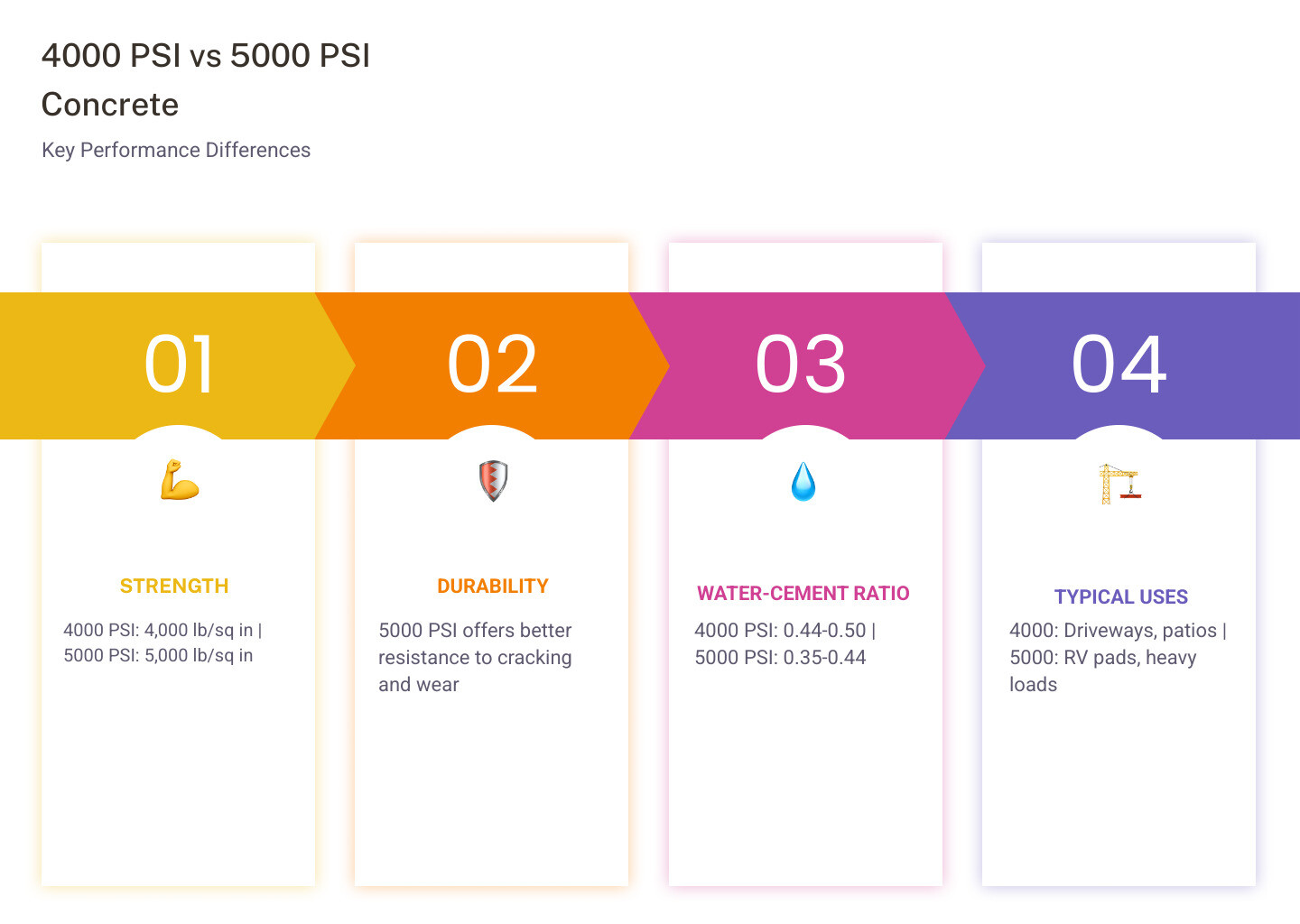
When comparing 4000 PSI vs 5000 PSI concrete, the core difference comes down to compressive strength, density, and what kind of work you’re putting that surface through.
| Feature | 4000 PSI | 5000 PSI |
|---|---|---|
| Compressive strength | 4,000 lb/sq in | 5,000 lb/sq in |
| Typical use | Driveways, patios, garage floors | RV pads, heavy trucks, high-demand slabs |
| Water-cement ratio | 0.44-0.50 | 0.35-0.44 |
| Durability | Good | Better, especially in aggressive conditions |
| Cost premium | Baseline | Moderately higher |
| Shear capacity difference | Baseline | ~12% stronger |
The short version:
- In Brevard County’s heavy rain, sandy soil, and coastal conditions, higher-strength concrete can better withstand surface wear, moisture exposure, and heavier vehicle loads over time.
Neither is the wrong choice when it’s matched to the right job. The mistake is when the wrong one gets used for the wrong application.
Here in Brevard County, the choice between these two concrete strengths comes up on nearly every project we consult on. Florida’s sandy soil, heavy rainfall, and coastal conditions create real demands on concrete that don’t apply the same way in other parts of the country. Understanding the practical difference between these two mixes can save you from surface failures, premature cracking, and a driveway that doesn’t hold up the way it should.
As a residential concrete contractor serving Brevard County, FL, we’ve worked with 5000 PSI concrete on driveways, slabs, and patios across the Space Coast. The right mix matters, but so do proper base preparation, reinforcement, placement, and curing. Together, those choices play a big role in whether a concrete surface holds up for years or starts developing avoidable problems much sooner.
Understanding the Difference Between 4000 PSI and 5000 PSI Concrete
To understand 4000 psi vs 5000 psi concrete, we first have to look at what that “PSI” number actually represents. PSI stands for pounds per square inch, which is a measure of compressive strength—the amount of downward pressure the concrete can handle before it fails.
While a 1,000 PSI difference might just seem like a number on a delivery ticket, it represents a significant change in the “recipe” of the concrete. To reach 5000 PSI, the mix typically requires more cement and less water. This results in a denser material with fewer microscopic voids.
In our experience across Palm Bay and Titusville, the difference isn’t just about how much weight the slab can hold; it’s about surface hardness and permeability. A 5000 PSI mix is harder to scratch, less likely to absorb oils or moisture, and stands up better to the abrasive wear of heavy tires turning in a driveway.
| Specification | 4000 PSI Concrete | 5000 PSI Concrete |
|---|---|---|
| Cement Content | Approx. 580 lbs per cubic yard | Approx. 650+ lbs per cubic yard |
| Water-Cement Ratio | 0.44 to 0.50 | 0.35 to 0.44 |
| Modulus of Elasticity | ~3.60 million PSI | ~4.03 million PSI |
| Primary Advantage | Versatile, cost-effective | Extreme durability, density |
| Common Failure Risk | Surface scaling if over-watered | Requires proper placement, reinforcement, and curing to perform as intended. |
Why Many Contractors Use 4000 PSI Concrete
Many residential concrete contractors in Florida still use 4000 PSI concrete for standard driveways, patios, and sidewalks because it meets minimum residential requirements and is less expensive than higher-strength mixes. While 4000 PSI can perform adequately in some situations, we believe Brevard County’s heavy rain, sandy soil, heat, and long-term vehicle stress demand a stronger approach.
At JCD Concrete, we use 5000 PSI concrete for our residential driveway installations because it provides a denser, more durable surface designed to better withstand Florida conditions over time. We often recommend this for standard concrete flatwork such as sidewalks, backyard patios, and driveways intended for standard passenger cars and SUVs. This is because we’ve seen firsthand how weaker mixes can wear down faster, especially in areas with drainage challenges, heavy vehicles, or frequent moisture exposure.
Why 5000 PSI Concrete is the Choice for High-Demand Applications
There are scenarios where 4000 PSI just isn’t enough for the long haul. This is where 5000 PSI concrete driveway installations come into play.
We suggest upgrading to 5000 PSI in the following situations:
- RV and Boat Storage: If you’re parking a 30,000-lb motorhome or a large boat on a trailer, the extra compressive strength prevents the concrete from “crushing” or fatiguing over time.
- Heavy Truck Traffic: For properties that see frequent deliveries or have heavy-duty work trucks.
- Coastal Exposure: In areas like Cocoa Beach or Merritt Island, the salt air is a constant threat. The higher density of 5000 PSI concrete makes it much harder for salt and moisture to penetrate the surface and reach the internal reinforcement.
- Industrial Sheds: If you are building a workshop where you’ll be dropping heavy tools or moving machinery, the increased surface hardness is vital.
We commonly recommend 5000 PSI for RV pads and oversized vehicle parking in Brevard County because heavier loads can accelerate surface wear and stress weaker concrete mixes over time.
Performance and Durability in the Florida Climate
Brevard County presents unique challenges for any concrete contractor. Between the intense UV rays, the humidity, and the sudden afternoon downpours that can drop inches of rain in an hour, your concrete has to do more than just sit there—it has to perform.
One of the biggest issues we see in places like Grant-Valkaria and Malabar is “washout” and pooling water. Drainage problems are one of the biggest causes of driveway failure we see along the Space Coast, especially when water undermines the soil beneath the slab. When comparing 4000 psi vs 5000 psi concrete, the 5000 PSI mix has a lower water-cement ratio, which makes it less permeable. In our experience, denser concrete mixes generally hold up better against moisture exposure and heavy Florida rain.
When homeowners compare concrete and pavers in Florida, they often find that a solid, higher-PSI concrete slab does a better job of controlling water runoff. Unlike pavers, which can shift or let weeds and water weaken the base, a continuous concrete pour creates a stable, predictable surface that can be sloped properly for drainage.
Comparing 4000 PSI vs 5000 PSI Concrete for Driveway Longevity
Longevity is a major concern for our clients in Satellite Beach and Indian Harbour Beach. While 4000 PSI concrete is very durable, 5000 PSI concrete offers an extra layer of protection against surface wear.
Over 20 to 30 years, a driveway goes through thousands of heating and cooling cycles in Brevard County. Hot sun, sudden rain, and daily use all put stress on the slab. In general, 5000 PSI concrete is stiffer than 4000 PSI concrete, which can help limit small deflections that contribute to surface wear and cracking over time. For a concrete driveway installation in Brevard County, FL, that added strength can mean better long-term appearance and durability.
Managing Space Coast Soil and Drainage Challenges
Our local soil is famously sandy, which can be both a blessing and a curse. It drains well, but it can also shift easily if water isn’t managed correctly. This is why we emphasize concrete driveways that incorporate proper culverts and drainage solutions.
When a driveway is poured over a culvert, that section has to handle more stress than the rest of the slab. It acts a bit like a short bridge over the drainage area. Moving from 4000 PSI to 5000 PSI concrete provides additional strength and stiffness in high-stress areas like driveway culverts and drainage crossings. That added performance can help the edges stay more stable under vehicle traffic and reduce the risk of cracking over time.
Structural Capacity and Mix Design Considerations
The “strength” of concrete isn’t just a label; it’s a result of careful chemistry. The water-to-cement ratio plays a major role in concrete strength and long-term durability.
To get 4000 PSI, we usually work with a ratio of 0.44 to 0.50. To reach 5000 PSI, that ratio has to drop below 0.44. This makes the wet concrete “stiffer” and more difficult to work with, which is why professional placement is so important. If a contractor adds too much water on-site to make it easier to spread, they can easily drop a 5000 PSI mix down to 3000 PSI or less, destroying the very durability you paid for.
How 4000 PSI vs 5000 PSI Concrete Affects Load Distribution
Concrete is incredibly strong when you push on it (compression) but weaker when you try to pull it apart or bend it (tension/flexure). For concrete pads slabs, the thickness of the slab and the PSI work together to distribute the weight of your vehicles.
While 5000 PSI concrete is only slightly better in “flexural” strength (about 2.5% increase in bending moment capacity), its real advantage is in shear capacity and stiffness. A stiffer 5000 PSI slab resists “curling” and edge cracking better than a 4000 PSI slab of the same thickness. This is why for heavy-duty applications, we don’t just look at how thick the slab is, but the quality of the material inside it.
The Role of Professional Placement and Curing
In the heat of a West Melbourne or Viera summer, concrete can dry out too fast. If the water evaporates before the chemical reaction (hydration) is complete, the concrete won’t reach its design strength.
When pouring 5000 PSI concrete, our process involves:
- Strict Water Control: We never add excess water to the truck on-site.
- Proper Vibration: Ensuring there are no air pockets, especially in 5000 PSI mixes which are naturally thicker.
- Curing Management: Using techniques to keep moisture in the slab during those first critical days.
You can see the results of this attention to detail in our latest job slab work, where proper finishing techniques ensure the surface remains tight and durable.
Cost-Benefit Analysis for Brevard County Homeowners
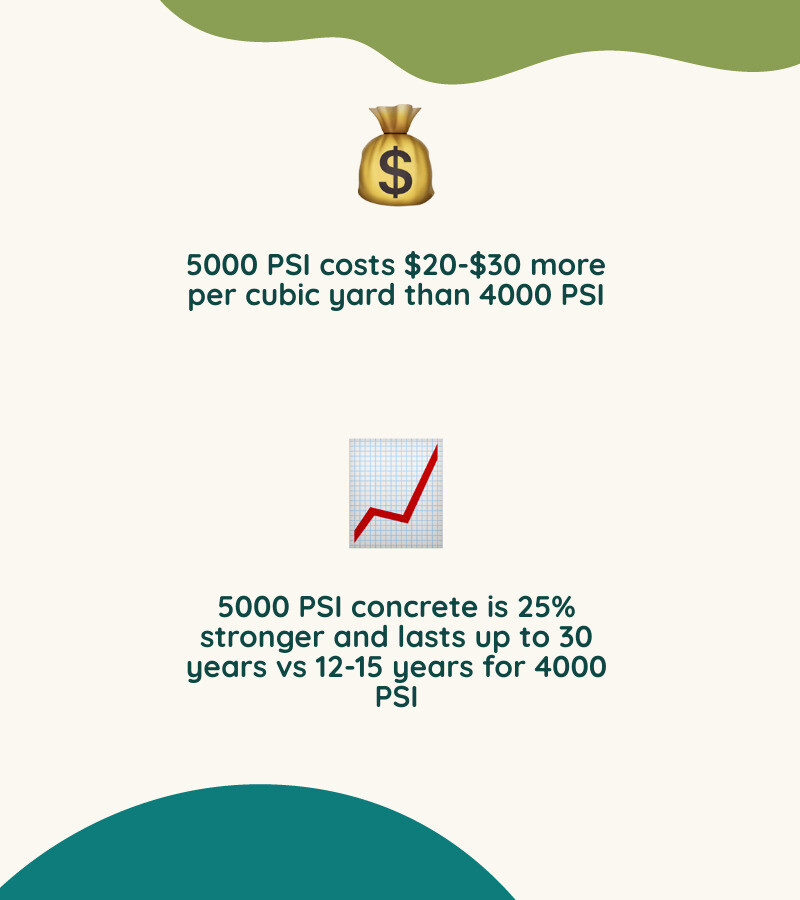
When homeowners in Cocoa or Indialantic look at the bottom line, they often wonder if the upgrade is worth it. In 2026, the cost difference between 4000 and 5000 PSI concrete usually amounts to a premium of about $20 to $30 per cubic yard.
For a standard two-car driveway, that might add a few hundred dollars to the total project cost. When you compare that to the total investment, it’s a relatively small price to pay for a slab that is 25% stronger and significantly more resistant to the elements.
We look at this as long-term value. If a 5000 PSI driveway lasts 30 years without needing a concrete driveway replacement, while a lower-strength mix might start spalling or cracking in 12 to 15 years, the higher-strength option is actually the cheaper choice over time. It’s about doing the job once and doing it right.
Frequently Asked Questions about Concrete PSI
Is 5000 PSI overkill for a standard residential driveway?
For a standard driveway that only sees a sedan or a light SUV, 5000 PSI can be considered “extra.” However, it is never a bad thing. It provides better resistance to oil stains and surface wear. If your budget allows for the small premium, it offers peace of mind. While many contractors still use 4000 PSI concrete to reduce costs, we choose to use 5000 PSI concrete because we believe the added durability and long-term performance are worth the investment for Florida homeowners.
How long does it take for 4000 PSI concrete to reach full strength?
Concrete is a living material that hardens over time. It typically reaches about 70% of its strength (around 2800 PSI for a 4000 PSI mix) within 7 days. This is usually when we clear a driveway for standard vehicle traffic. It reaches its full “design strength” at 28 days, though it will actually continue to gain tiny amounts of strength for years.
Does higher PSI concrete prevent all types of cracking?
No. All concrete can crack. Cracking is often caused by the ground shifting, the concrete shrinking as it dries, or thermal expansion. While 4000 psi vs 5000 psi concrete comparisons show that the 5000 PSI mix is stronger, it is also slightly more brittle. Preventing cracks requires a combination of high-quality concrete, proper steel reinforcement, well-placed control joints, and a perfectly compacted subbase.
Conclusion
Choosing between 4000 psi vs 5000 psi concrete doesn’t have to be a guessing game. At JCD Concrete, we believe 5000 PSI concrete is the better long-term choice for residential driveways and heavy-use concrete surfaces in Brevard County. The added strength, density, and durability help concrete hold up better against Florida’s heavy rain, sandy soil conditions, and long-term vehicle wear.
At JCD Concrete Inc., we’ve spent over 40 years as an owner-operated business, helping Brevard County residents make these exact decisions. We focus on durable concrete work designed to hold up to Florida conditions for the long term. Whether you’re in Mims or Micco, we bring the same level of expertise and top-quality materials to every job.
Ready to start your next project? More info about concrete services is just a click away, or give us a call to discuss which mix is right for your specific needs.