What to Know Before Replacing Your Concrete Driveway
Concrete driveway removal and replacement involves demolishing and removing the existing slab, evaluating and preparing the underlying soil, correcting drainage concerns where needed, and installing a new concrete surface.
When replacement is done correctly, long-term performance depends on much more than the concrete itself. Site preparation, compaction, drainage, reinforcement where appropriate, concrete strength, finishing, curing, vehicle loads, and ongoing site conditions all affect how the driveway performs over time.
Our comprehensive replacement process is designed to address the specific challenges of our coastal environment:
- Assessment and Demolition: We evaluate the existing driveway, separate the old concrete from adjoining surfaces where needed, remove the slab, and haul the debris for appropriate recycling or disposal.
- Base Preparation and Drainage: We prepare, grade and compact the underlying soil to create a stable base, while planning drainage around the conditions of the property.
- Forming and Reinforcement: We establish the new driveway layout with forms and incorporate reinforcement where appropriate for the project.
- Pouring, Finishing, and Curing: We place the concrete, apply the selected surface finish, establish control joints, and provide guidance for the curing period.
Here in Brevard County, sandy soil, high water tables in some areas, coastal exposure, and heavy seasonal rainfall make proper drainage and base preparation especially important. If water is allowed to move beneath the slab or the underlying soil is poorly supported, sections of the driveway can settle, crack, or wash out over time.
I’m John DomBek, owner of JCD Concrete Inc., and after more than 40 years installing and replacing concrete throughout Brevard County, I’ve seen how much local soil and drainage conditions can affect driveway performance.
This guide explains what homeowners should expect during concrete driveway removal and replacement. If you’re still comparing budgets, the cost section below covers the major pricing factors separately.
When Does a Concrete Driveway Need Replacement?
Not every cracked or worn driveway needs to be torn out. The decision usually depends on the extent of the damage, whether the slab is still adequately supported, and whether drainage or soil movement is contributing to the problem.
Some isolated damage can be repaired, but repairs become less practical when settlement, widespread cracking, or drainage problems affect multiple sections of the driveway.
One issue we frequently encounter in Brevard County is loss of support beneath the slab. Sandy soil can move or wash away when drainage is poor, leaving sections of concrete with uneven support. In those situations, repairing only the visible crack may not address the reason the driveway is moving.
Signs that a professional should evaluate the driveway for replacement include:
- Multiple displaced cracks: Sections on opposite sides of a crack are no longer level with one another.
- Widespread spalling or deterioration: Large areas of the surface are breaking down rather than showing isolated cosmetic damage.
- Recurring settlement: Sections continue sinking or moving after previous repairs.
- Persistent drainage problems: Water repeatedly pools along the driveway or moves beneath the slab.
- Severely damaged sections: Multiple panels are broken, displaced, or no longer providing a stable driving surface.
A professional inspection can determine whether targeted repair is practical or whether removing the existing concrete provides a better opportunity to correct the underlying soil and drainage conditions. When a driveway needs replacement, the goal is to install a new driveway over a properly prepared and supported base.
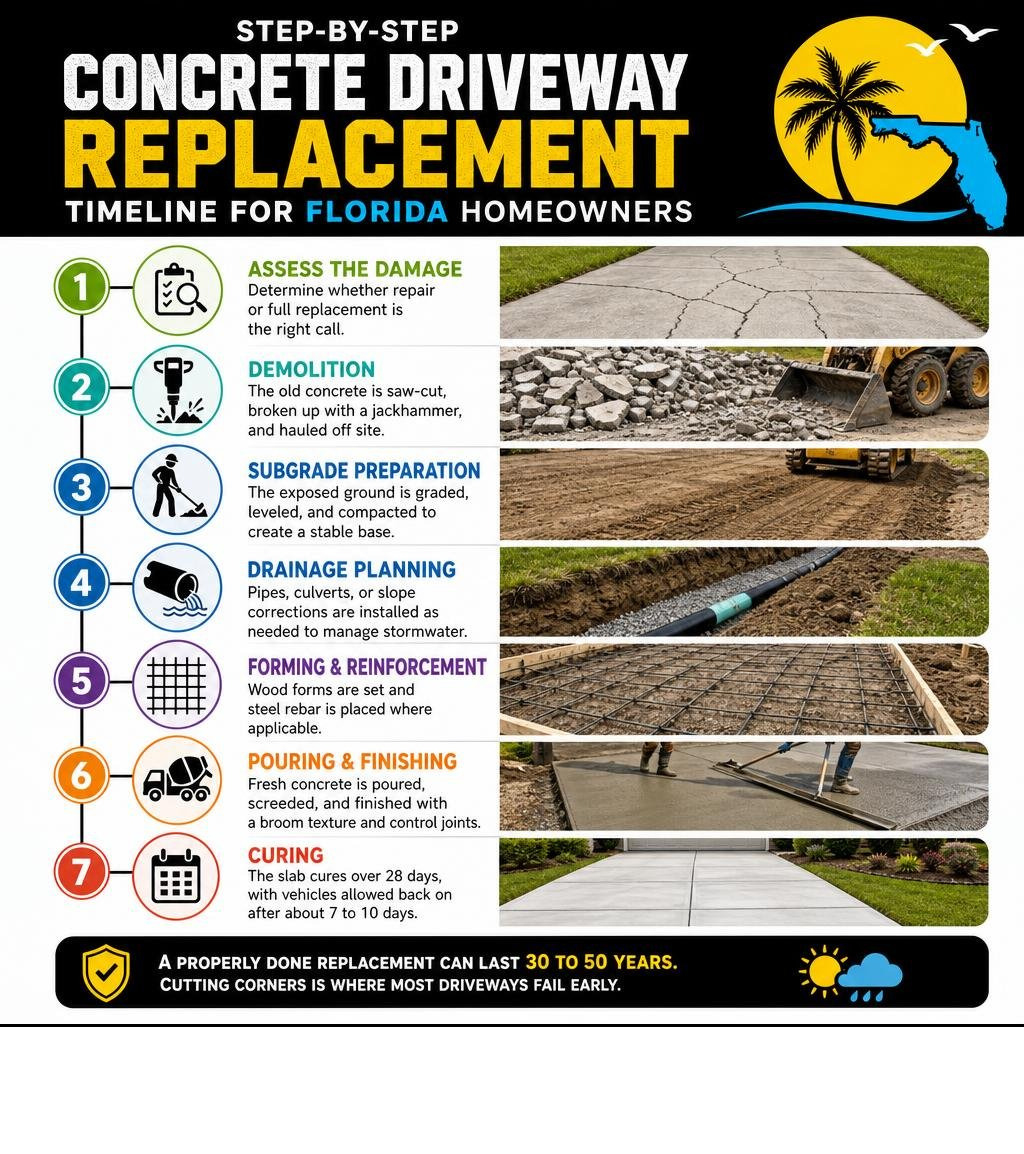
The Concrete Driveway Removal and Replacement Process
A quality driveway replacement involves much more than removing the old slab and pouring new concrete. The work completed before the pour—including demolition, inspection of the exposed subgrade, grading, compaction, drainage planning, formwork, and reinforcement where appropriate—has a major effect on how the finished driveway performs.
If site preparation, drainage or compaction is inadequate, even high-strength concrete can be more vulnerable to settlement, cracking and other performance problems. When we handle a concrete driveway installation in Brevard County, we follow a practical multi-phase process developed over more than 40 years of hands-on work. As an owner-operated contractor, JCD maintains hands-on oversight throughout the driveway replacement process.
Phase 1: Preparing for Driveway Demolition
Before excavation or demolition begins, underground utilities need to be located and the work area needs to be evaluated for adjacent sidewalks, curbs, garage slabs, drainage structures, landscaping, and other surfaces that should remain in place.
Before excavation begins, the contractor responsible for digging should follow Sunshine 811 utility-locate requirements so member utilities have an opportunity to mark underground facilities.
The existing concrete is then separated from adjoining surfaces where necessary, broken into manageable sections, removed from the property, and transported for appropriate recycling or disposal.
The amount of demolition work depends on the driveway’s size, thickness, reinforcement, accessibility, and whether nearby concrete or structures need to remain undisturbed. For more details on preparing your property for this phase, you can read our guide to preparing for concrete driveway installation and replacement.
Phase 2: Inspecting the Base After the Old Driveway Is Removed
One advantage of full driveway removal is that the underlying conditions become visible. Once the old slab is gone, the contractor can evaluate areas of soft or disturbed soil, previous washout, root damage, poorly supported edges, drainage concerns, and conditions around the driveway apron or culvert.
This is an important step because replacing concrete over the same unsupported or poorly drained base can allow the original problem to return beneath the new driveway.
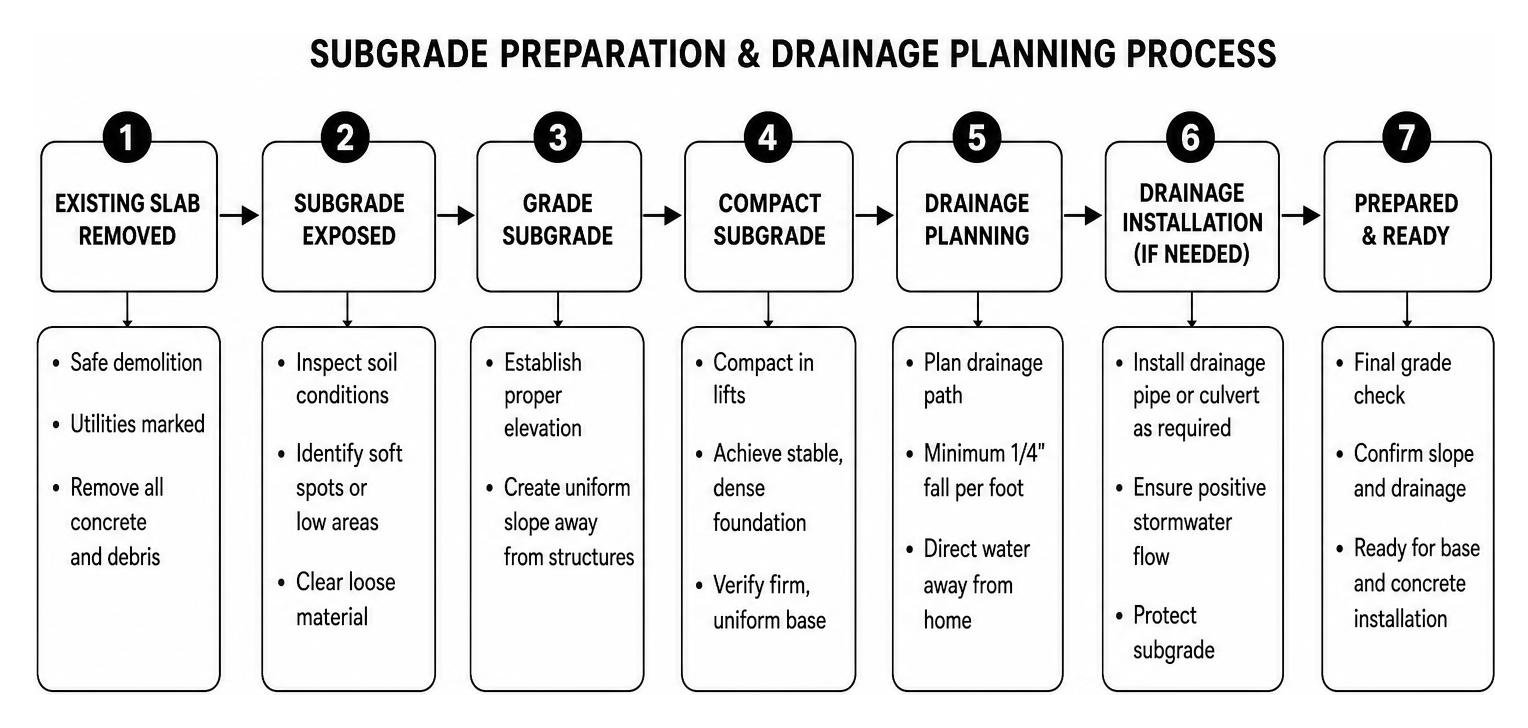
Phase 3: Subgrade Preparation and Drainage
After the existing driveway is removed and the underlying conditions are evaluated, the subgrade can be corrected and prepared for the new slab. In Brevard County, sandy soil and heavy seasonal rainfall make proper support and drainage particularly important.
Loose or disturbed areas should be properly prepared and compacted so the new driveway has consistent support. The site should also be graded according to the property’s drainage conditions so stormwater moves away from the home and does not repeatedly collect along or beneath the slab.
If the driveway crosses a roadside swale, the condition and placement of the culvert may also need to be evaluated before the new driveway is installed. Brevard County Public Works reviews work within County rights-of-way and residential driveway culvert installations as part of its permitting process to protect stormwater drainage systems; homeowners can review the County’s Brevard County right-of-way and driveway culvert requirements for more context.
If your property crosses a roadside swale, we also help with choosing the right drainage pipe and replacing a driveway culvert so stormwater can move through the drainage system properly and reduce the risk of washout or erosion around the new driveway.
Phase 4: Reinforcement, 5000 PSI Concrete, and Placement
JCD Concrete Inc. exclusively installs 4000 PSI vs 5000 PSI concrete on residential projects. We consider concrete strength one part of a durable driveway installation, alongside proper subgrade preparation, drainage, reinforcement where appropriate, placement, finishing, control joints, and curing.
A higher compressive-strength mix can provide additional capacity for demanding residential applications, but concrete strength alone does not prevent cracking, settlement, or drainage-related problems. The support beneath the slab and the quality of the overall installation remain critical.
Reinforcement may be incorporated where appropriate for the project. When steel reinforcement is used, proper placement within the slab is important so it can perform as intended and help hold sections of concrete together if cracking occurs.
Phase 5: Finishing and Curing
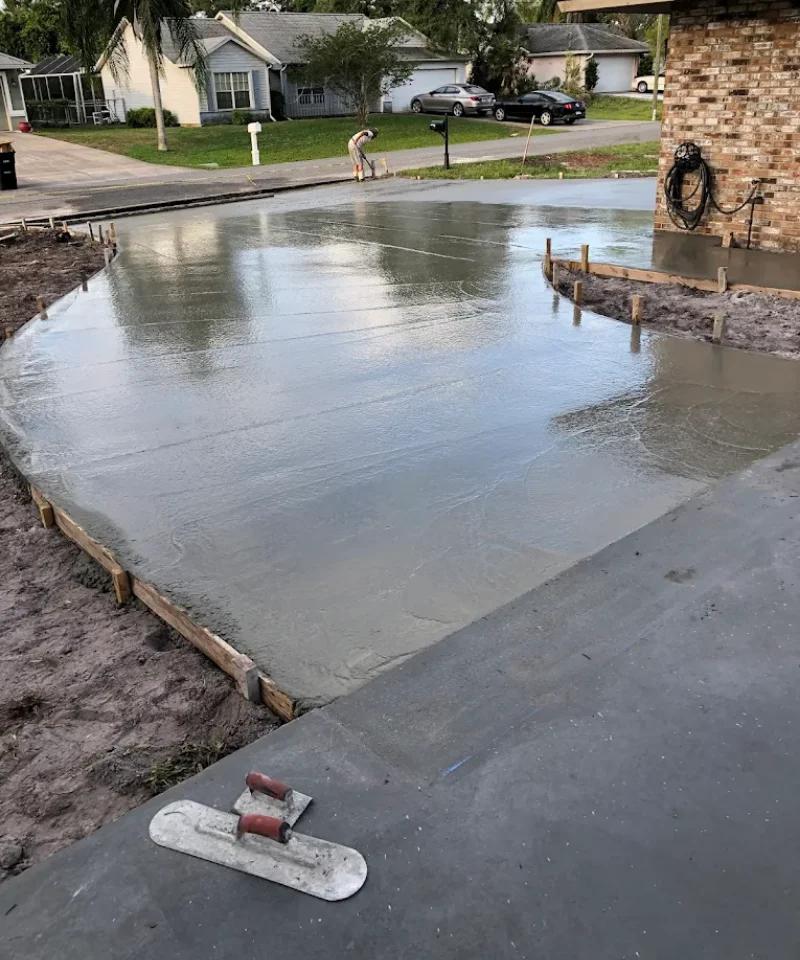
After placement, the driveway is finished and allowed to cure. Concrete continues gaining strength over time, so homeowners should follow the project-specific instructions provided by their contractor before allowing foot or vehicle traffic.
Control joints are intentionally placed to create planned locations where shrinkage movement can be accommodated. They help encourage cracking to occur along designated lines, but they do not guarantee that cracks will never develop elsewhere in the slab.
- First 24–48 hours: Protect the new surface and keep unnecessary traffic off the slab.
- First week: Concrete is continuing to gain strength; avoid vehicle traffic until the contractor confirms the driveway is ready.
- Around day 28: Concrete generally reaches its specified design strength under standard curing assumptions.
What Should Be Included in a Driveway Replacement Proposal?
Because much of the critical work will be hidden beneath the finished driveway, homeowners should compare replacement proposals based on scope as well as price.
- Demolition and removal: What existing concrete will be removed and how adjoining surfaces will be handled.
- Subgrade preparation: How exposed soil will be evaluated, prepared, and compacted.
- Drainage: How runoff, driveway slope, swales, and culverts will be addressed where applicable.
- Concrete specifications: The proposed slab design and specified concrete strength.
- Reinforcement: What reinforcement will be used, where, and why.
- Finishing and joints: The intended surface finish and joint plan.
- Curing and access: When homeowners should expect to walk or drive on the new surface.
What Affects the Cost of Concrete Driveway Removal and Replacement?
The cost of replacing a driveway depends on the amount of concrete being removed, access for demolition equipment, disposal requirements, site preparation, drainage corrections, driveway size, concrete specifications, reinforcement, finishing, and any culvert or right-of-way work involved.
Slab thickness should be selected based on the project, expected vehicle loads, site conditions, and installation requirements.
Removal can also reveal conditions that were not visible before demolition, such as washed-out soil, root damage, soft areas, or drainage problems. Correcting those conditions may change the project scope, but addressing them before the new slab is placed can help protect the replacement driveway.
For detailed budgeting information, review our driveway replacement cost guide.
Frequently Asked Questions About Driveway Replacement
Do I need a permit to replace my driveway in Brevard County?
Permit requirements depend on the property’s jurisdiction and the scope of work. Requirements may be different when the project affects a public right-of-way, driveway apron, roadside swale, curb connection, or culvert.
Brevard County Public Works reviews work within County rights-of-way and residential driveway culvert installations. Properties inside incorporated municipalities may be subject to additional or different requirements, so the applicable jurisdiction should be confirmed before work begins.
How long do I need to wait before driving on my new concrete?
For JCD projects, follow the wait time provided for your specific driveway rather than relying on a universal number. Vehicle weight, concrete conditions, weather, and curing all matter. Concrete continues gaining strength over time, and around day 28 it generally reaches its specified design strength under standard curing assumptions. For more details on what to expect during this phase, check out our guide on 5000 PSI concrete cure time.
What should I expect before driveway removal begins?
Before demolition, make sure vehicles, trailers, planters, and other movable items are clear of the work area. The contractor should also review utility locating, access for demolition and hauling equipment, adjoining concrete, drainage features, and any areas of the property that need protection during the work.
Ask in advance how long driveway access will be unavailable and where vehicles should be parked while the old concrete is removed and the new driveway cures.
Planning a Concrete Driveway Replacement in Brevard County
Concrete driveway removal and replacement gives homeowners an opportunity to do more than improve the surface. Once the old slab is removed, underlying soil support, drainage concerns, and damaged sections can be evaluated before the replacement driveway is installed.
After more than 40 years of local concrete experience, JCD Concrete Inc. understands the importance of proper preparation for Brevard County’s sandy soil, seasonal rainfall, drainage systems, and coastal conditions. We exclusively install 5000 PSI concrete on residential projects and focus on the complete installation rather than concrete strength alone.

If you’re considering replacing your driveway, explore our concrete driveway services or contact JCD Concrete Inc. to discuss your property and request an estimate.