Why Choosing the Right Concrete Driveway Installers Matters
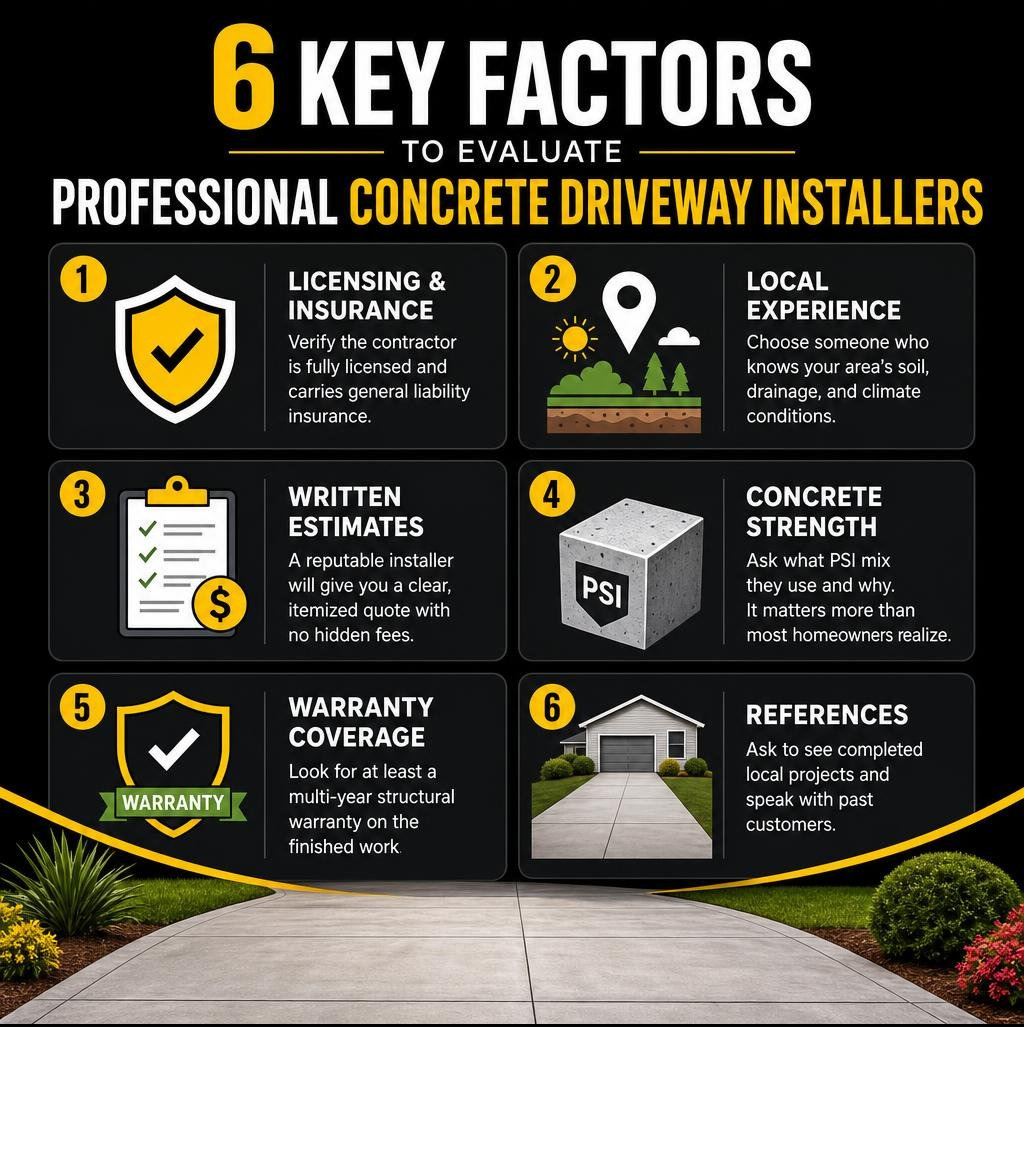
Concrete driveway installers vary widely in experience, workmanship, materials, and long-term results. Here is what to look for before you hire:
- Licensing and insurance – Verify the contractor is fully licensed and carries general liability insurance before signing anything.
- Local experience – Choose someone who knows your area’s soil, drainage, and climate conditions.
- Written estimates – A reputable installer will give you a clear, itemized quote with no hidden fees.
- Concrete strength – Ask what PSI mix they use and why. It matters more than most homeowners realize.
- Warranty coverage – Look for at least a multi-year structural warranty on the finished work.
- References – Ask to see completed local projects and speak with past customers.
A new concrete driveway is one of the most durable improvements you can make to a home. When installed correctly, it can last 30 to 50 years with minimal upkeep. But the key words there are “installed correctly.” In Brevard County, that means accounting for sandy soil, a high water table, and heavy seasonal rainfall from the start. Skip those steps, and even a good-looking driveway can start settling, cracking, or washing out within a few years.
Many homeowners searching for concrete driveway installation near me are primarily looking for a contractor with local experience, proper drainage knowledge, and a proven track record of quality workmanship. That is why finding the right installer matters as much as choosing the right material. Concrete driveways remain a practical choice for homeowners who want durability, low maintenance, and strong curb appeal. The work we do at JCD Concrete Inc. reflects that standard on every project.
I’m John DomBek, owner of JCD Concrete Inc. and a hands-on concrete driveway installer serving Brevard County with over 40 years of experience in concrete driveway installation and replacement, residential flatwork, site preparation, and drainage. Everything in this guide comes from real work done on real driveways across the Space Coast.
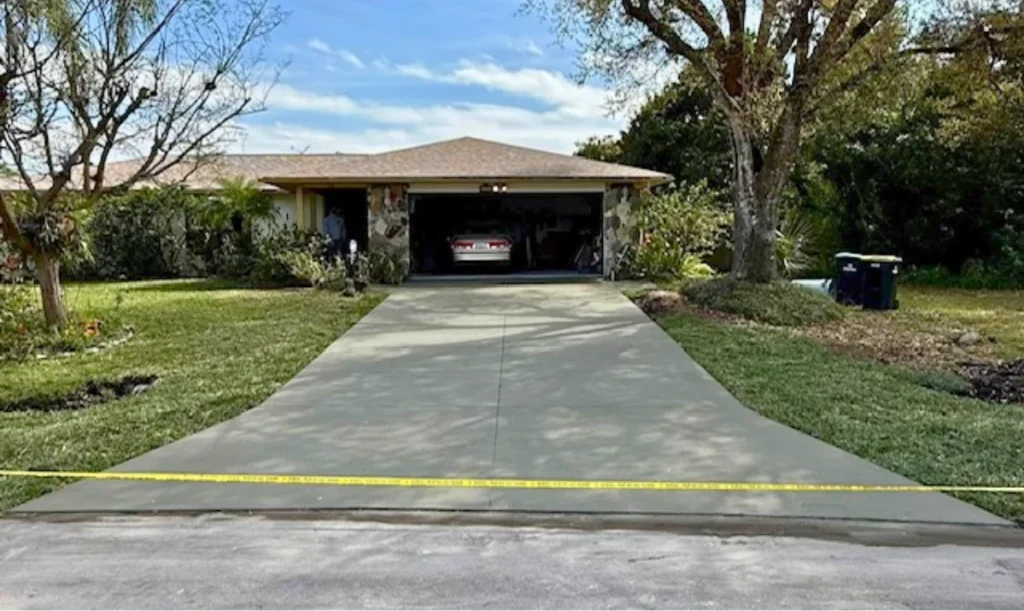
A professional concrete driveway starts with the right installer, a clear scope, and a realistic answer to what it costs to replace a driveway.
What to Look For in Professional Concrete Driveway Installers
When you start searching for professional concrete driveway installers, you quickly realize that not all flatwork contractors approach a job the same way. A concrete driveway is one of the most important structural improvements you can make to your property. It has to handle thousands of pounds of rolling vehicle weight day in and day out, all while dealing with the natural shifts of Florida’s sandy ground.
Homeowners planning to install a concrete driveway often benefit from consulting a contractor before finalizing site layouts, drainage plans, and driveway dimensions. Bringing us in before you finalize the layout, driveway shape, or property-line decisions can help prevent avoidable headaches later. Early planning gives us a chance to spot grading concerns, account for existing tree roots, review access points, and identify drainage issues before the work begins. It also helps us build a realistic project timeline, so you know what to expect from layout and demolition through pouring, finishing, and curing.
At JCD Concrete Inc., we believe in complete transparency from our very first conversation. We walk you through every phase of the project, explaining how we schedule the excavation, the pour, and the finishing details. This structured approach is why homeowners across the region trust us when they need specialized concrete driveway installers. Before you sign a contract with anyone, it is highly recommended to read through An Essential Guide to Concrete Driveway Installation Replacement to understand what a professional setup looks like.
How to Verify Credentials of Concrete Driveway Installers
You should never take a contractor’s word at face value when it comes to their qualifications. A professional crew will gladly provide proof of their credentials because they have taken the time and effort to earn them.
Start by asking about American Concrete Institute (ACI) certifications. These certifications are not just pieces of paper. They show that the crew has been formally trained and tested on proper procedures for placing, consolidating, finishing, jointing, and curing concrete flatwork. That matters because driveway performance depends on details you may not see during the pour. When a crew understands how concrete behaves, how it cures, and why timing matters, they are more likely to avoid mistakes that lead to cracking, scaling, uneven surfaces, or early repairs.
Next, ask to see their general liability insurance and workers’ compensation policies. Do not just look at a paper copy; call the insurance provider directly to verify that the policy is active and covers concrete flatwork. This protects you from being held liable if an accident occurs on your job site.
Finally, ask for local references. A reliable contractor who has worked in Brevard County for years will have a long list of local homeowners who can vouch for their work. When you call these references, ask specific questions about how the crew handled the cleanup, whether they stuck to the agreed timeline, and how well they communicated throughout the process. We encourage all our potential clients to review our 5 Tips for Concrete Driveway Installation Replacement to see how we hold ourselves to these exact high standards on every job.
Questions to Ask Concrete Driveway Installers Before Hiring
Before you make your final hiring decision, you need to ask a few direct questions to ensure you are getting a high-quality installation.
First, ask for detailed, written estimates. A proper bid should be fully itemized, showing the exact square footage, the depth of the excavation, the type of reinforcement being used, and the thickness of the slab. If a contractor gives you a single, vague number on a napkin, that is a warning sign that you might face unexpected fees later.
Second, ask about the planned concrete thickness. For a standard residential driveway, a minimum thickness of four inches is common, but five to six inches is highly recommended for areas that will host heavier vehicles like boats, RVs, or heavy-duty trucks. We have poured driveways in Palm Bay where homeowners wanted to save by going thinner, only to fix what that decision cost them five years later when heavy delivery trucks cracked the edges of their slab.
Third, discuss your warranty options. A reputable contractor will stand behind their work with a clear, written warranty that covers structural defects and significant cracking. At JCD Concrete Inc., we explain our warranties upfront so you know exactly what is covered. To get a better idea of how thickness, site prep, and materials influence your overall investment, take a look at our comprehensive Driveway Replacement Cost Guide.
The Professional Concrete Driveway Installation & Replacement Process
A professional installation is a carefully managed sequence of steps where each phase builds on the last. It is not just about showing up with a concrete mixer and pouring mud onto the ground.
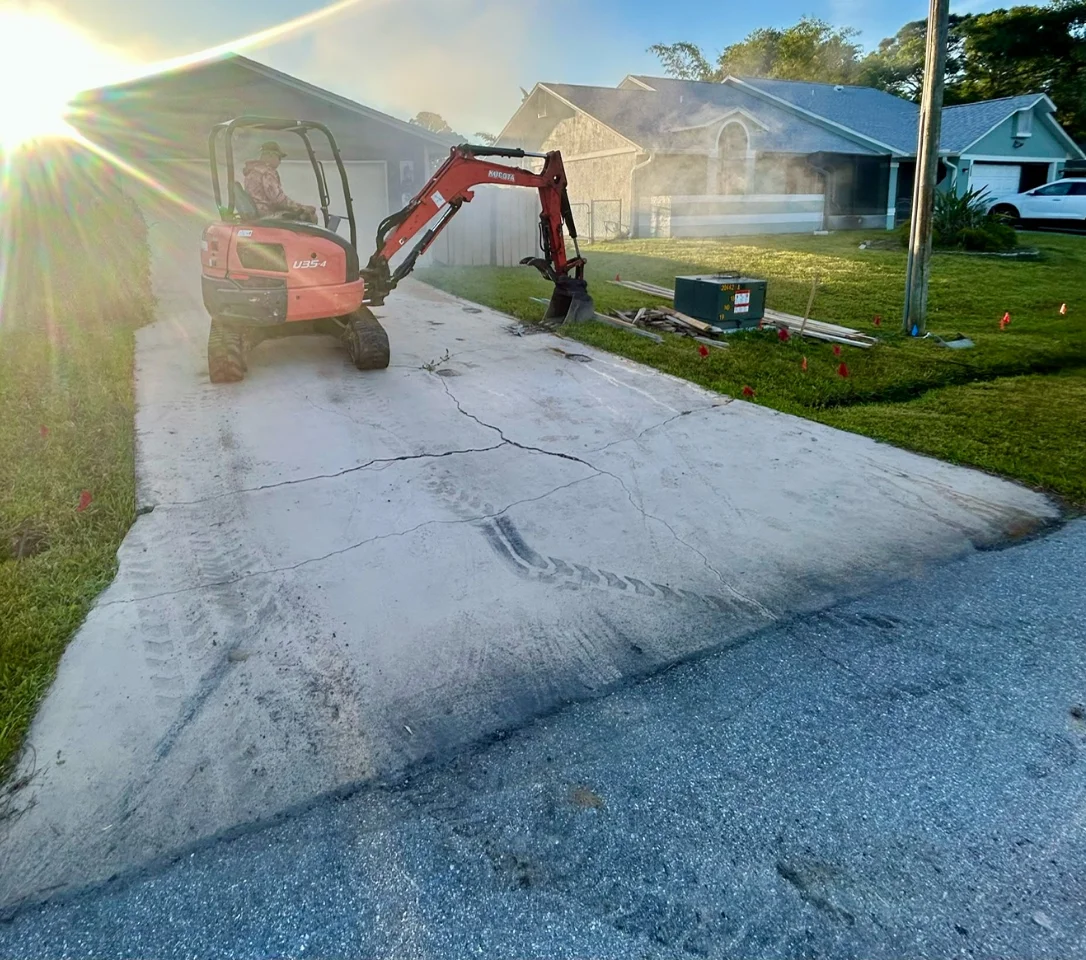
Our process always begins with a thorough site assessment. We look at the slope of your property, the location of nearby trees, the position of utility lines, and the existing drainage patterns. Once we have a clear plan, we move on to the demolition phase. We break up and remove your old, damaged driveway, loading it into our trucks for proper disposal. Complete haul-off of all old concrete and debris is included in our service because we believe in leaving your property cleaner than we found it. We outline our complete local approach in our guide to Concrete Driveway Installation Brevard County FL.
Base Preparation and Sandy Soil Compaction
In places like Cape Canaveral, Cocoa Beach, and Satellite Beach, we deal with highly sandy soil and a very high water table. These coastal conditions present unique challenges for concrete flatwork. Sand does not naturally hold its shape under heavy loads, especially when seasonal rains saturate the ground.
This is why thorough base preparation is just as critical to long-term performance as high-strength concrete. If you pour heavy concrete directly onto loose, uncompacted Florida sand, the weight of your vehicles will eventually cause the soil underneath to shift. This shifting leads to uneven settling, which is a primary cause of structural cracking and sinking slabs.
To prevent this, we excavate the area to the proper depth, clear out any organic material like grass and roots, and perform intensive ground compaction. We use commercial-grade vibratory plate compactors to pack the sandy subgrade into a solid, stable base. If the site has particularly soft soil or sits in a low-lying area, we may bring in a stable sub-base material to ensure the concrete has a uniform foundation to rest on. Taking these extra steps during a Concrete Driveway Replacement is what keeps the slab from shifting when the summer rains arrive.
Pouring, Finishing, and Cutting Control Joints
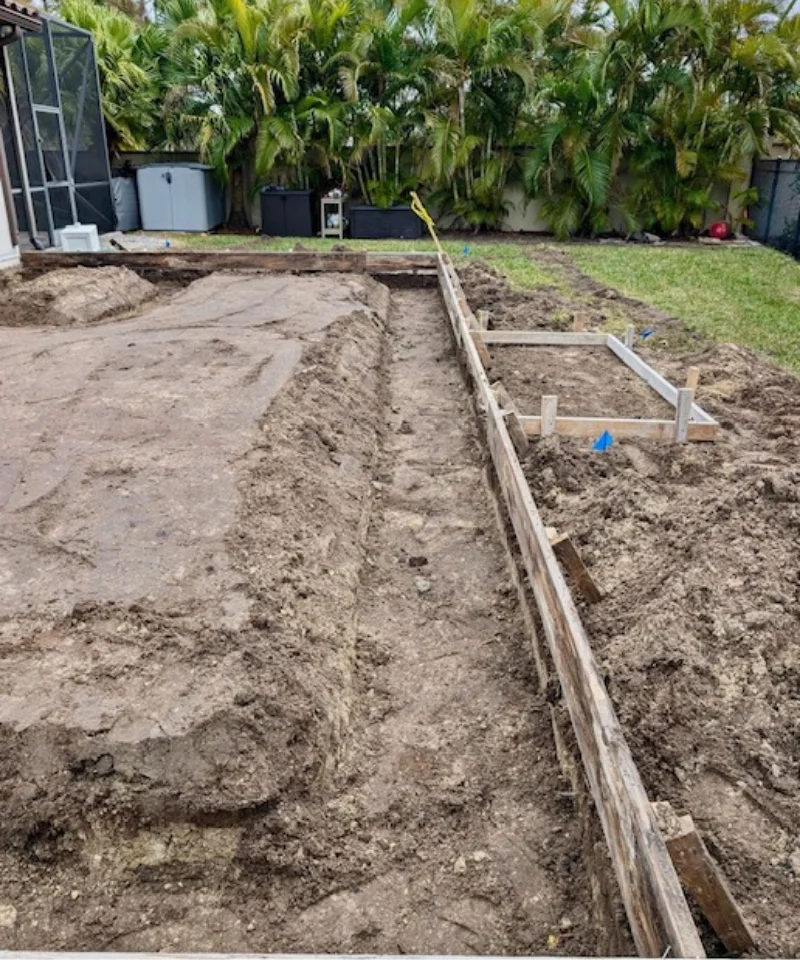
Once the base is compacted and the wooden forms are securely staked into place, we are ready for the pour. We distribute the concrete evenly across the formed area, using specialized tools to consolidate the mix and eliminate any air pockets that could weaken the slab.
The finishing process requires both speed and precision, especially in the hot Florida sun which can cause concrete to dry out too quickly on the surface. We apply a professional broom finish across the entire surface. A broom finish provides vital traction on a wet Florida driveway, ensuring that your vehicles do not slip during our frequent afternoon downpours.
After finishing the surface, we focus on joint placement. Concrete naturally expands and contracts with temperature changes, and it will develop minor hairline cracks as it cures and shrinks. To control where these cracks occur, we cut control joints into the slab. We cut control joints the day after the pour because timing matters for clean lines. If you wait too long, the concrete will start to crack on its own in random, unsightly patterns. By cutting these joints to a depth of at least one-quarter of the slab’s thickness, we create neat, straight lines where the concrete can safely expand and contract. You can see examples of this precise craftsmanship on our dedicated page for Concrete Driveway Melbourne FL.
Design, Finishes, and Climate Specifications for Florida Driveways
Our local climate on the Space Coast puts unique pressures on outdoor concrete. Between the intense summer heat, salt-laden ocean breezes, and torrential seasonal rainfall, your driveway has to be built to endure a lot of environmental stress.
When designing a driveway for this environment, we focus on both heat resistance and proper water runoff. Decorative finishes like stamped concrete or exposed aggregate can add visual interest to your property, but they need to be planned carefully so they do not reduce slip resistance or weaken long-term durability. For homeowners who want a reliable, classic look, a premium broom-finished slab remains the gold standard for traction and longevity. If you are located near the water, the concrete mix and finish should also account for salt air, moisture, and Florida’s intense seasonal weather.
5000 PSI Concrete vs 4000 PSI Industry Baseline
The strength of concrete is measured in pounds per square inch (PSI), which tells you how much pressure the material can handle before it fails. Understanding the difference between mix designs is essential when planning your driveway.
| Feature | 4000 PSI Concrete | JCD Standard 5000 PSI Concrete |
|---|---|---|
| Typical Use | Standard residential driveways, sidewalks | Heavy-duty residential, RV pads, coastal zones |
| Density & Permeability | Standard density, moderate permeability | Higher density, lower permeability (resists salt/moisture) |
| Wear Resistance | Good overall durability | Superior resistance to heavy vehicle loads and abrasion |
| Brevard County Suitability | Industry baseline | Premium protection against sandy soil movement |
While 4000 PSI is a legitimate industry baseline that performs well for standard residential use, we choose to use 5000 PSI concrete as our standard mix for driveways. This higher-strength mix provides superior structural integrity, making it far more resilient against heavy vehicles, turning tires, and the natural ground movement common in our sandy coastal soils. By upgrading to a 5000 PSI Concrete Driveway Brevard County, you are choosing a mix that has a tighter, denser internal structure. This density makes it harder for moisture and salt to penetrate the surface, helping your driveway perform the way it should for years.
Managing Drainage, Washouts, and Driveway Culverts
A driveway cannot last if water is allowed to pool around its edges or wash away the soil underneath. Proper grading and drainage management are just as important as the quality of the concrete itself. For example, a driveway that is improperly graded can direct water toward your garage, foundation, or entryway, which is why we carefully grade every site to direct water safely away from your home’s foundation.
In many parts of Brevard County, residential properties rely on roadside ditches to manage stormwater. This means your driveway must cross over a ditch, requiring a driveway culvert to keep the water flowing. If a culvert is cracked, rusted, or improperly installed, water will back up during heavy storms. When water stagnates and the system backs up, it begins to erode the sandy soil surrounding the pipe, eventually causing the driveway above it to collapse.
We specialize in full culvert replacement and washout prevention. We ensure that your new pipe is set at the correct elevation to maintain proper water flow, and we pack the surrounding soil thoroughly before pouring the concrete over it. To protect your property from erosion and water damage, we install robust Concrete Culverts designed to handle local runoff. If your current culvert is showing signs of sinking or rusting, you can learn about our replacement process by reading How to Replace Driveway Culvert in 5 Simple Steps.
Why We Focus Exclusively on Solid Concrete Slabs
Many homeowners ask us if we install interlocking pavers for driveways. While pavers can look nice initially, they frequently shift, sink, and separate in Florida’s loose, sandy soil because they lack a continuous, unified structure. To provide our clients with the most reliable, low-maintenance surface possible, we focus exclusively on solid concrete slabs. A solid concrete driveway provides a continuous, reinforced barrier that distributes weight evenly, preventing the individual shifting and weed growth common with pavers. You can read more about why we recommend this approach in our comparison of Concrete vs Pavers Florida.
Frequently Asked Questions About Driveway Replacement
Replacing a driveway is a significant home improvement project, and it is natural to have questions about the logistics. Here are the answers to the most common questions we hear from homeowners on the job site.
How long does a concrete driveway installation take?
The timeline required to install a concrete driveway depends on the size of the project, site conditions, drainage requirements, and weather. A typical residential driveway replacement takes about three to five days on-site, depending on the size of the project and the complexity of the grading.
- Day 1: Demolition and Excavation – We break up and haul away your old driveway, clear out any roots or organic material, and begin grading the area.
- Day 2: Subgrade Prep and Forming – We set up the wooden forms, compact the sandy soil to create a stable base, and lay down any required reinforcement.
- Day 3: The Pour and Finish – We pour the concrete, level and smooth the surface, apply the broom finish for traction, and begin the initial curing phase.
- Day 4: Joint Cutting and Cleanup – We return the day after the pour to cut the control joints, remove the wooden forms, and clean up the job site.
Do I need a permit for a driveway replacement in Brevard County?
Yes, most municipalities in Brevard County require a building permit for a driveway replacement or expansion. This is especially true if your driveway crosses a public right-of-way or connects to a city road over a drainage ditch.
Navigating local building codes, submitting permit applications, and scheduling the necessary inspections can be a confusing process for homeowners. When you work with us, we handle all the paperwork, permit submissions, and county inspections for you. We make sure the entire project complies with local regulations so you do not have to worry about code violations or delays.
How soon can I park my vehicle on the new concrete?
While concrete might look dry and solid within 24 hours, it goes through a chemical curing process that takes time to reach its full strength.
You can typically walk on your new driveway about 24 hours after the pour. However, you must keep all vehicles off the slab for at least seven days. Driving on the concrete too early can cause structural damage and cracking, as the material has not yet developed the strength to support heavy loads. Concrete reaches about 70% of its structural strength within the first seven days, and it continues to cure to its full design strength over a 28-day period.
Conclusion
Your driveway is more than just a place to park your car; it is a major structural component of your home that affects your property’s value, safety, and functionality. Building a driveway that can withstand Brevard County’s sandy soil, high water table, and intense weather requires experienced hands and a commitment to high-quality materials.
At JCD Concrete Inc., we do not take shortcuts. From thorough ground compaction to using premium 5000 PSI concrete as our standard, we build slabs that perform the way they should for years. Trust our 40 years of experience in concrete driveway installation and replacement to deliver a beautiful, durable driveway for your home. If you are ready to install a concrete driveway or replace your old, cracked pavement with a premium slab, contact us today to discuss our custom concrete driveways and get your project started.